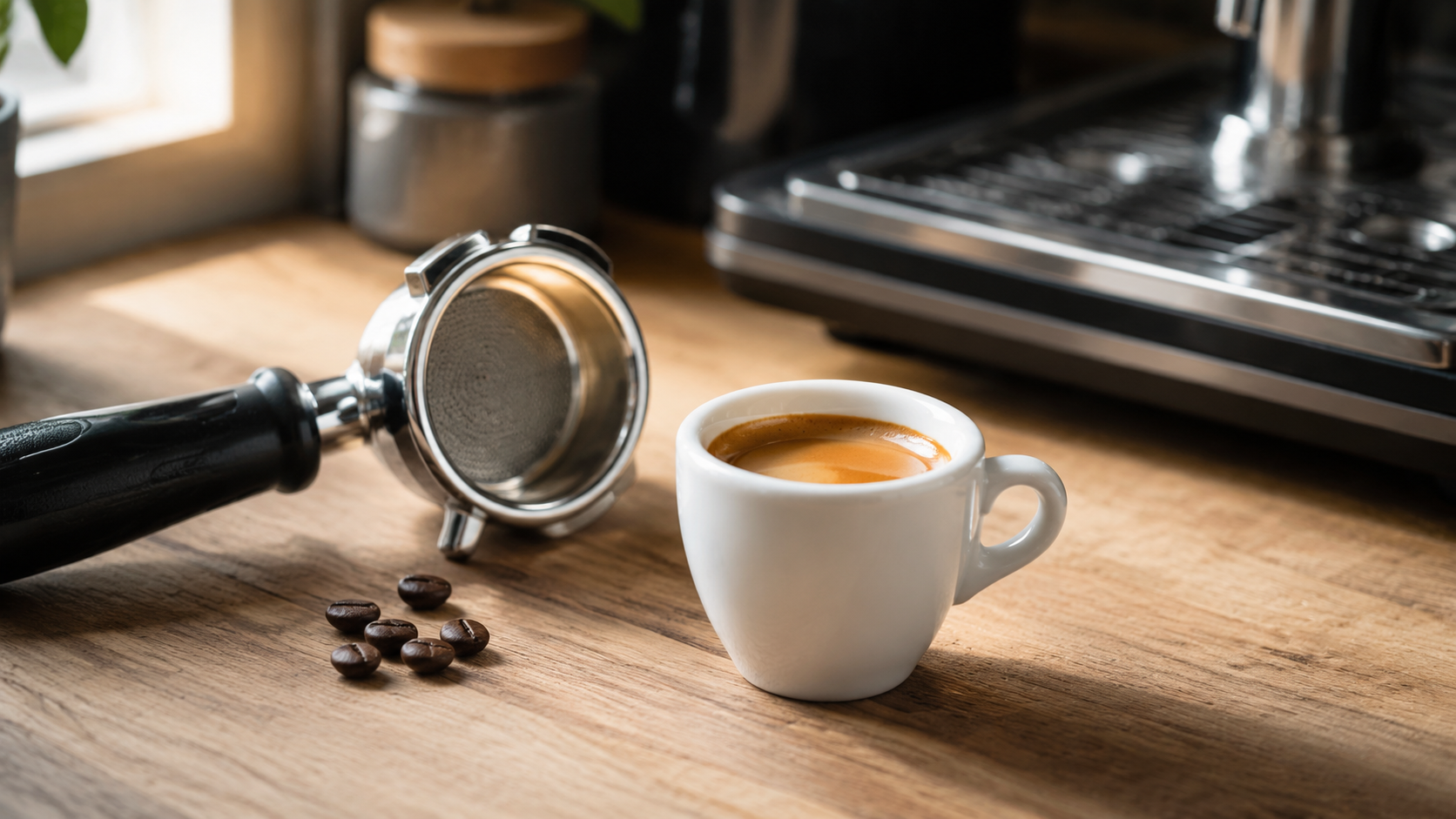
Espresso is a concentrated coffee beverage made by pushing hot water through finely ground coffee under pressure. A typical serving is small, but it can contain remarkable sweetness, acidity, bitterness, aroma, and texture.
Espresso is not a special coffee bean or a single roast level. It is a brewing method. Arabica, robusta, blends, single-origin coffees, and a wide range of roast levels can all be used to make espresso.
It also serves as the foundation for many familiar café drinks, including lattes, cappuccinos, Americanos, flat whites, macchiatos, and mochas. Understanding how espresso is brewed makes it easier to choose beans, adjust a grinder, diagnose an unpleasant shot, and prepare better coffee at home.
Espresso at a Glance
-
Brewing method: Hot water passes through finely ground coffee under pressure
-
Common dose: 18–20 grams for a modern double shot
-
Common yield: Approximately 36–40 grams of espresso
-
Starting brew ratio: About 1:2
-
Typical extraction time: Roughly 25–30 seconds
-
Common brewing pressure: Around 9 bars
-
Serving style: Straight or used as the base for milk and water-based drinks
These figures are practical starting points rather than rules that every coffee must follow. The final recipe should be adjusted according to the beans, grinder, basket, machine, and most importantly, taste.
What Makes Espresso Different from Regular Coffee?
Espresso and drip coffee begin with the same basic ingredients: roasted coffee beans and water. The difference lies in how the water passes through the grounds.
Drip coffee relies mainly on gravity. Espresso machines use pressure to push water through a compact bed of finely ground coffee. This produces a smaller drink with a higher concentration of dissolved coffee compounds.
A typical espresso has:
-
A concentrated flavor
-
A syrupy or full-bodied texture
-
A relatively small serving size
-
A layer of crema on the surface
-
Enough intensity to remain noticeable when combined with milk or water
Espresso is more concentrated per ounce than drip coffee, but that does not always mean it contains more caffeine per serving. According to the National Coffee Association, a one-ounce espresso typically contains about 63 mg of caffeine. A full mug of brewed coffee will often contain more total caffeine because the serving is much larger.
What Is Crema?
Crema is the golden-brown foam that forms on top of a freshly extracted espresso. It develops when pressurized water releases carbon dioxide and emulsifies oils contained in the ground coffee.
Fresh beans often create more visible crema because they retain more carbon dioxide after roasting. However, a thick layer of crema does not automatically guarantee excellent flavor.
Crema can provide clues about freshness and extraction, but taste remains the most important test. A beautiful shot can still taste harsh, hollow, or unbalanced.
How This Guide Was Prepared
This guide was developed using established coffee-industry references, including educational material from the National Coffee Association and espresso-preparation research published by the Specialty Coffee Association.
Brewing figures are presented as practical starting points rather than universal rules. Espresso recipes vary according to roast level, coffee density, grinder performance, basket size, water, equipment, and personal preference. Where no single standard applies, this guide explains the variation instead of presenting one recipe as the only correct method.
How Espresso Is Made
A barista begins by grinding coffee finely and placing a measured dose into the machine’s portafilter. The grounds are distributed evenly, tamped into a level coffee bed, and locked into the group head.
The machine then pushes hot water through the coffee. The resulting liquid flows through the basket and into the cup.
Modern espresso recipes vary, but the Specialty Coffee Association’s survey of professional preparation found that a common starting point is:
| Brewing variable | Practical starting point |
|---|---|
| Ground coffee dose | 18–20 grams |
| Espresso yield | About 36–40 grams |
| Brew ratio | Approximately 1:2 |
| Water temperature | Around 93°C or 200°F |
| Pump pressure | About 9 bars |
| Extraction time | Roughly 25–30 seconds |
These numbers describe a common modern espresso recipe, not a mandatory formula. The Specialty Coffee Association’s survey documented how participating professional baristas prepared espresso, with many using an 18–20 gram dose, a yield near 36.5 grams, a 1:2 brew ratio, and an extraction time between 25 and 30 seconds.
For example, 18 grams of ground coffee producing 36 grams of espresso is a 1:2 brew ratio. Measuring both the dry dose and the finished espresso by weight is generally more repeatable than judging the shot by volume alone.
Use the recipe as a starting point, then taste the espresso. If changing the grind size or yield makes the shot sweeter and more balanced, the new recipe is more useful than following a fixed number simply because it is considered standard.
What Should Good Espresso Taste Like?
Good espresso should taste balanced rather than simply strong or bitter. Depending on the beans and roast, it may offer flavors resembling chocolate, caramel, nuts, berries, citrus, or stone fruit.
The shot should normally have enough sweetness to balance its acidity and bitterness. Its texture may feel creamy, silky, or syrupy.
Personal preference still matters. Some people enjoy traditional dark-roast espresso with deep chocolate and roasted flavors. Others prefer lighter roasts that emphasize fruit, floral notes, and brighter acidity.
The goal is not to force every coffee into the same flavor profile. It is to adjust the recipe until the coffee tastes clear, pleasant, and balanced to you.
Espresso, Ristretto, and Lungo
These drinks use the same basic brewing method but differ in the relationship between the dry coffee dose and the amount of liquid produced.
Espresso
A standard modern espresso often begins near a 1:2 brew ratio. For example, 18 grams of coffee may produce about 36 grams of espresso.
Ristretto
A ristretto uses less liquid for the same amount of ground coffee. It is smaller and often has a heavier texture and more concentrated flavor.
Lungo
A lungo allows more water to pass through the coffee. It produces a larger drink but may taste thinner or more bitter if the extraction is not carefully controlled.
The exact definitions vary among cafés, so brew ratio is usually more informative than the drink name alone.
Do You Need Special Espresso Beans?
Any coffee bean can technically be used for espresso. Packages labeled “espresso roast” or “espresso blend” are not made from a separate type of coffee bean.
As the National Coffee Association explains, espresso roast is not one fixed roast level. It simply indicates that the roaster believes the coffee works well with the espresso brewing method.
Medium and medium-dark roasts are popular with beginners because they are often easier to extract and may produce familiar chocolate, caramel, and nutty flavors. Light roasts can also make excellent espresso, but they may require more careful adjustments to grind size, temperature, and brew ratio.
For more help choosing a suitable roast and flavor profile, see our guide to the best coffee beans for espresso.
Rather than choosing beans only by country, consider:
-
The roast date
-
Roast level
-
Flavor description
-
Recommended brewing method
-
Whether you plan to drink the espresso alone or with milk
Freshness matters, but beans can also be too fresh. Coffee that has rested for several days after roasting is often easier to brew consistently than coffee used immediately after roasting.
Common Espresso Problems and How to Fix Them
Espresso problems often come from the relationship between grind size, dose, yield, and extraction time. Changing one variable can influence the others, so adjust one thing at a time.
Espresso Tastes Sour or Thin
The coffee may be under-extracted, meaning the water did not dissolve enough flavor from the grounds.
Try:
-
Grinding slightly finer
-
Extending the extraction
-
Increasing the water temperature
-
Checking for uneven distribution or channeling
Some coffees naturally have bright acidity, so sourness should be judged alongside sweetness and overall balance.
Espresso Tastes Bitter or Dry
The shot may be over-extracted, or the coffee may simply be roasted darker than you prefer.
Try:
-
Grinding slightly coarser
-
Shortening the extraction
-
Lowering the water temperature
-
Using a smaller beverage yield
-
Trying a lighter roast
Espresso Runs Too Fast
A fast shot often indicates that the grind is too coarse, the dose is too low, or water has found an easy path through the coffee bed.
Grind finer and make sure the grounds are distributed evenly before tamping.
Espresso Barely Drips
The grind may be too fine, the basket may be overfilled, or the puck may be restricting water flow.
Use a slightly coarser grind and confirm that the dose is appropriate for the basket.
Results Change from Shot to Shot
Inconsistent dosing, retained grounds in the grinder, uneven distribution, and poor temperature stability can all cause variation.
Using a digital scale and following the same preparation routine each time can make troubleshooting much easier.
Why the Grinder Matters So Much
The grinder is one of the most important pieces of espresso equipment. Espresso requires small, precise grind adjustments because minor changes can significantly affect flow and taste.
A burr grinder designed for espresso generally provides better control than a blade grinder. It should be capable of producing fine, reasonably uniform particles and making small adjustments between settings.
If you are choosing your first grinder, compare the practical differences between blade and burr grinders before buying.
An expensive espresso machine cannot fully compensate for an inconsistent grinder. For many home setups, investing in a capable grinder produces a more noticeable improvement than spending the entire budget on the machine.
Making Espresso at Home
Home espresso can be rewarding, but it involves more practice than many other brewing methods.
Beginners who still need a machine can also explore our guide to the best espresso machines for beginners.
A basic setup includes:
-
An espresso machine
-
An espresso-capable burr grinder
-
Fresh coffee beans
-
A digital scale
-
A tamper that fits the basket
-
A clean, dry portafilter
-
Filtered water suitable for the machine
Start with a simple recipe:
-
Place 18 grams of finely ground coffee in the basket.
-
Distribute the grounds evenly.
-
Tamp the coffee level and consistently.
-
Place the cup and scale beneath the portafilter.
-
Start the shot and stop near 36 grams of espresso.
-
Note the extraction time.
-
Taste the espresso before making an adjustment.
If the shot tastes sour and runs quickly, grind finer. If it tastes dry or bitter and flows very slowly, grind coarser. Taste should guide the final decision—not the timer alone.
Popular Espresso-Based Drinks
Espresso works as the base for many drinks, but their flavor and texture change according to the amount of water, milk, and foam added.
| Drink | Basic composition |
|---|---|
| Americano | Espresso and hot water |
| Macchiato | Espresso with a small amount of milk or foam |
| Cappuccino | Espresso with steamed milk and a prominent foam layer |
| Latte | Espresso with a larger amount of steamed milk |
| Flat white | Espresso with steamed milk and a thin layer of microfoam |
| Mocha | Espresso, chocolate, and steamed milk |
Recipes and serving sizes differ between cafés and countries. These descriptions are practical guides rather than rigid international definitions.
How to Drink Espresso
Espresso is best tasted soon after brewing because its temperature, aroma, and texture change quickly.
Before drinking, you may stir the shot gently to combine its layers. Espresso is not perfectly uniform: the first liquid extracted and the final liquid entering the cup contain different concentrations and flavors.
Take a small sip and notice:
-
The aroma
-
Initial sweetness or acidity
-
Body and texture
-
Bitterness
-
Aftertaste
-
How the flavor changes as the shot cools
There is no requirement to drink espresso in one gulp. Slower tasting can make it easier to recognize its different characteristics.
Frequently Asked Questions
Is espresso stronger than regular coffee?
Espresso is more concentrated per ounce, so its flavor is usually more intense. However, a full cup of drip coffee may contain more total caffeine than one espresso shot because its serving size is much larger.
Is espresso a type of coffee bean?
No. Espresso is a brewing method. Arabica, robusta, blends, single-origin coffees, and different roast levels can all be used to make it.
Why does espresso sometimes taste sour?
Sourness can be caused by under-extraction, a grind that is too coarse, low brewing temperature, or uneven water flow. Some light-roast coffees also contain naturally brighter acidity.
Do I need to tamp with exactly 30 pounds of pressure?
No fixed number guarantees good espresso. A level, repeatable tamp is more useful than trying to reach one precise pressure measurement.
Can I make real espresso without an espresso machine?
Brewers such as moka pots and AeroPress devices can produce concentrated coffee, but they do not normally generate espresso-machine pressure. They can make enjoyable espresso-style drinks, although the result is technically different from traditional espresso.
Sources and Further Reading
-
National Coffee Association, “Espresso” — an overview of espresso brewing, caffeine, equipment, grinding, and preparation.
-
Specialty Coffee Association, “Defining the Ever-Changing Espresso” — findings from a professional barista survey covering dose, yield, brew ratio, temperature, pressure, and extraction time.
BeanAltitude uses industry references as a starting point and explains where recipes or definitions may vary. Product instructions and safety guidance from the equipment manufacturer should always take priority when operating or cleaning an espresso machine.
Final Thoughts
Espresso is not merely a smaller and stronger version of drip coffee. It is a flexible brewing method in which grind size, dose, water temperature, pressure, time, and beverage yield work together.
Beginners do not need to master every variable immediately. Start with a reliable recipe, measure the dose and yield, taste the result, and change one variable at a time.
With fresh coffee, a capable grinder, and a little patience, home espresso becomes less mysterious—and considerably more delicious.