

Blade grinder vs burr grinder is one of the most important comparisons to understand when improving your home coffee setup. Both appliances can reduce whole beans into smaller particles, but they do so in fundamentally different ways.
A blade grinder repeatedly chops beans with a fast-spinning metal blade. A burr grinder passes them between two abrasive surfaces positioned at a controlled distance from each other.
That mechanical difference affects grind consistency, extraction, flavor, adjustability, and whether the grinder can handle demanding brewing methods such as espresso.
For most people who brew coffee regularly, a burr grinder is the better long-term choice. A blade grinder remains useful when price, simplicity, and occasional use matter more than precision.
Blade Grinder vs Burr Grinder at a Glance
| Feature | Blade Grinder | Burr Grinder |
|---|---|---|
| Grinding method | Chops beans with spinning blades | Crushes beans between two burrs |
| Grind adjustment | Usually controlled by grinding time | Controlled by changing burr spacing |
| Particle consistency | Relatively uneven | More consistent |
| Brewing control | Limited | High |
| Espresso suitability | Generally unsuitable | Suitable if designed for espresso |
| Filter coffee suitability | Usable but inconsistent | Well suited |
| Price | Usually lower | Usually higher |
| Noise | Often high-pitched | Varies by design |
| Cleaning | Simple chamber | More parts and retained grounds |
| Best for | Occasional, low-cost use | Regular coffee brewing |
If you are planning a complete home setup, compare our best espresso machines for beginners before deciding how much of your budget to reserve for the grinder.
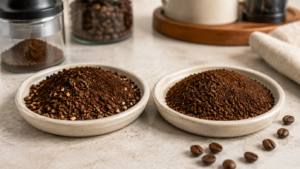
The most important distinction is not simply that one costs more. A burr grinder provides a repeatable way to change grind size, while a blade grinder relies heavily on timing and guesswork.
What Is a Blade Grinder?
A blade grinder uses one or more rotating metal blades inside a small chamber. When the motor starts, the blades strike and chop the coffee beans repeatedly.
The longer the machine runs, the smaller the average particle size becomes. However, this does not create one uniform grind size. Fine powder can accumulate while larger fragments remain in the same chamber.
Shaking or pulsing the grinder may help redistribute the beans, but it cannot provide the controlled particle size produced by a well-designed burr grinder.
Advantages of a Blade Grinder
- Low purchase price
- Compact and easy to store
- Simple one-button operation
- Fast for small quantities
- Useful for occasional coffee preparation
- Widely available
Disadvantages of a Blade Grinder
- Inconsistent particle sizes
- No precise grind adjustment
- Difficult to reproduce the same result
- Easy to create excessive fines
- Poor control for espresso
- Grounds must usually be poured from the chamber
- Coffee dust can collect around the lid and blades
A blade grinder may be adequate for someone who makes coffee infrequently and mainly wants freshly ground beans at the lowest possible cost.
What Is a Burr Grinder?
A burr grinder crushes coffee beans between two textured grinding surfaces. One burr remains fixed while the other rotates. Adjusting the distance between them changes the approximate size of the coffee particles.
The beans must pass through the burrs before leaving the grinding chamber. This controlled pathway generally produces a narrower particle-size range than random chopping.
Burr grinders are available as manual or electric models. They may use conical or flat burrs and can include stepped or stepless adjustment systems.
Advantages of a Burr Grinder
- More consistent particle size
- Repeatable grind adjustments
- Better control over extraction
- Settings for different brewing methods
- Improved espresso capability in suitable models
- Easier recipe adjustment
- Manual and electric options available
- Better long-term learning potential
Disadvantages of a Burr Grinder
- Higher initial cost
- More components to clean
- Some models retain grounds internally
- Electric models require additional counter space
- Not every burr grinder can grind finely enough for espresso
- Adjustment systems vary considerably in precision
A burr mechanism alone does not guarantee excellent results. Burr alignment, adjustment range, motor design, build quality, and intended brewing method also matter.
1. Blade Grinders Chop; Burr Grinders Crush
The clearest difference is the grinding mechanism.
A blade grinder moves beans around an enclosed chamber while cutting them repeatedly. Beans and fragments can contact the blades an unpredictable number of times.
A burr grinder feeds beans through a controlled space between two burrs. Changing that space provides a more reliable way to determine how fine or coarse the coffee becomes.
This is why pressing a blade grinder for exactly ten seconds does not guarantee that tomorrow’s grounds will match today’s. Bean density, quantity, movement, and the way the grinder is held can all change the result.
Breville’s grinder comparison provides a practical overview of how blade and burr mechanisms differ in consistency, adjustment, and everyday use.
2. Burr Grinders Produce More Consistent Grounds
No grinder produces perfectly identical particles. Every grinding process creates a distribution that includes larger pieces and very small particles known as fines.
The practical question is how broad that distribution becomes.
A blade grinder commonly produces noticeable powder alongside larger fragments. A capable burr grinder keeps more of the coffee within a useful target range.
Greater consistency makes brewing behavior easier to predict. Water encounters particles with more similar surface areas, allowing the brewer to adjust time, grind size, temperature, and coffee-to-water ratio with greater confidence.
3. Grind Consistency Affects Extraction
Our guide on how to brew better espresso at home explains how grind size works together with dose, yield, tamping, and extraction time.
Water extracts soluble compounds from coffee grounds. Smaller particles expose more surface area and generally extract faster, while larger particles extract more slowly.
When a grind contains both excessive fines and large fragments, the particles do not behave identically during brewing. The smallest particles may contribute bitterness, dryness, or astringency while the largest ones remain comparatively under-extracted.
Coffee flavor is more complicated than a simple “fine equals bitter, coarse equals sour” rule. Roast level, water, brew method, temperature, contact time, agitation, and ratio all affect extraction.
Still, a consistent grinder makes those variables easier to manage. When grind size changes predictably, you can diagnose a brew instead of negotiating with a jar of coffee confetti.
4. A Burr Grinder Provides Real Grind Adjustment
Most blade grinders do not have a true grind-size setting. The user controls the result by running the machine longer or shorter.
Short pulses may leave relatively coarse pieces, while extended grinding produces more fine material. However, longer grinding does not simply move every particle evenly from coarse to fine.
A burr grinder adjusts the space between its grinding surfaces. This makes it possible to move gradually from a coarse setting toward a finer one and return to a previous setting later.
That repeatability is valuable when you alternate between brewing methods or refine a recipe over several attempts.
Baratza’s guide to switching grind settings also explains why careful adjustments and purging retained grounds can improve consistency.
5. Burr Grinders Are Better for Most Brewing Methods
Different brewing methods require different grind characteristics.
| Brewing Method | Typical Starting Texture | Better Grinder Choice |
|---|---|---|
| French press | Coarse | Burr grinder |
| Cold brew | Coarse | Burr grinder |
| Drip coffee maker | Medium | Burr grinder |
| Pour-over | Medium to medium-fine | Burr grinder |
| AeroPress | Varies by recipe | Burr grinder |
| Moka pot | Fine to medium-fine | Burr grinder |
| Espresso | Fine with precise adjustment | Espresso-capable burr grinder |
These descriptions are starting points rather than universal settings. Grinder scales are not standardized, and the correct setting changes with the beans, equipment, dose, and recipe.
A blade grinder can produce coffee small enough for several methods, but it cannot make precise or repeatable adjustments. That becomes more noticeable when a recipe responds strongly to small grind changes.
6. Espresso Requires More Than the Word “Burr”
A blade grinder is generally a poor match for traditional non-pressurized espresso because espresso requires fine grinding and very small adjustments.
Water passes through a compact coffee bed under pressure. A small grind change can substantially alter shot time and flow. If the particles are highly inconsistent, the coffee bed may resist water unevenly and produce an unpredictable extraction.
However, not every burr grinder is suitable for espresso.
An espresso grinder should provide:
- A sufficiently fine grinding range
- Small adjustment increments
- Stable burr alignment
- Repeatable dosing
- Reasonably low retention
- Enough motor performance for fine grinding
- A practical way to dispense coffee into a portafilter
Once you have a suitable grinder, follow our step-by-step guide on how to dial in espresso to adjust grind size and shot time systematically.
An inexpensive burr grinder designed mainly for drip coffee may reach a fine-looking setting without offering the adjustment precision needed to dial in espresso.
Pressurized or dual-wall filter baskets are more forgiving and may work with pre-ground coffee or less precise grinders. Traditional single-wall baskets place greater demands on the grinder.
Grinder performance is only part of the equation, so use our guide to the best coffee beans for espresso when choosing a roast for your first setup.
7. Burr Grinders Cost More but Offer More Control
Blade grinders usually have simple motors, blades, and switches, which keeps their price low.
Burr grinders require shaped grinding surfaces, an adjustment mechanism, supports that maintain burr spacing, and a pathway that moves beans and grounds through the machine. Better models may also include timers, weight-based dosing, anti-static features, replaceable parts, or low-retention designs.
The higher cost does not mean every buyer needs a premium electric grinder.
A manual burr grinder can be a practical option when:
- You usually prepare one or two cups
- Counter space is limited
- Portability matters
- You do not mind hand grinding
- You want better consistency on a modest budget
Manual grinding becomes less convenient for large batches and can require substantial effort at fine espresso settings.
8. Conical and Flat Burrs Are Both Valid Choices
Burr grinders generally use either conical or flat burrs.
A conical set places a cone-shaped inner burr inside an outer ring. Beans move downward through the grinding surfaces, assisted by gravity.
A flat-burr grinder uses two parallel, ring-shaped burrs. Coffee enters near the center and moves outward as it is ground.
Both designs can produce excellent coffee. Burr geometry, diameter, alignment, rotational speed, manufacturing quality, and grinder construction matter more than the simple flat-versus-conical label.
Avoid assuming that every flat-burr grinder is automatically superior for espresso or that every conical grinder produces the same flavor. The individual grinder must be evaluated as a complete system.
9. Cleaning and Retention Differ
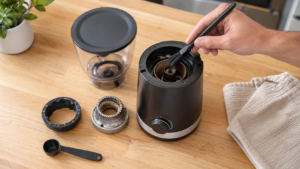
Blade grinders have relatively simple chambers, but fine coffee dust and oils can gather beneath the blades and around the lid.
Burr grinders contain more internal surfaces where grounds can remain. This retained coffee may become stale and mix with a later dose, particularly when the grinder is not used regularly.
Basic burr-grinder maintenance may include:
- Emptying the hopper when necessary
- Unplugging the machine before opening it
- Removing loose grounds with an appropriate brush
- Cleaning removable parts according to the manual
- Checking the grounds chute for buildup
- Avoiding water on parts that the manufacturer says must remain dry
- Reassembling and recalibrating the grinder correctly
Cleaning frequency depends on usage, grinder construction, and bean type. Dark, oily beans may leave residue more quickly than less oily coffee.
Follow the manufacturer’s instructions rather than relying on a universal schedule. Do not place rice, water, or unapproved cleaning materials in a burr grinder unless its manufacturer specifically permits it.
Does a Blade Grinder Overheat Coffee?
Blade grinders are often criticized for heating coffee during long grinding sessions. Friction and the motor can raise the temperature, especially when the grinder runs continuously.
However, uneven particle size and limited adjustment are usually more immediate practical concerns than heat alone.
Short pulses may reduce continuous heat buildup, but they do not transform a blade grinder into a precision grinder. The fundamental limitation remains its uncontrolled chopping action.
Can You Improve Coffee Ground With a Blade Grinder?
A few techniques can make a blade grinder somewhat easier to use:
- Weigh the same amount of beans each time.
- Use several short pulses instead of one long run.
- Gently shake the closed grinder between pulses.
- Stop and inspect the grounds before overprocessing them.
- Record the approximate total grinding time.
- Brew immediately after grinding.
- Use a brewing method that tolerates some inconsistency.
These steps may improve repeatability, but they cannot create the precise adjustment range of a burr grinder.
If a blade grinder is the only option available, use it. Freshly ground coffee prepared with care can still be enjoyable. Coffee equipment is a tool, not an entrance exam.
How to Choose the Right Burr Grinder
If you decide to buy a burr grinder, begin with your primary brewing method.
For Drip, Pour-Over, or French Press
Look for:
- Reliable medium-to-coarse settings
- Consistent adjustment steps
- Low static and manageable mess
- Easy access for cleaning
- Suitable capacity
- Available replacement parts
A filter-focused grinder does not necessarily need the tiny adjustment increments required for espresso.
For Espresso
Prioritize:
- Fine adjustment control
- Stable performance at espresso settings
- Repeatable dosing
- Low clumping
- Practical portafilter workflow
- Manufacturer support
- Burrs and replacement parts that remain available
An “all-purpose” grinder may be convenient, but switching repeatedly between espresso and coarse filter settings can waste coffee and make it difficult to return to the exact previous position.
For Multiple Brewing Methods
Consider whether you genuinely need one grinder for everything.
A versatile grinder can work well, but check:
- The full adjustment range
- How easily settings can be changed
- Whether it returns accurately to previous settings
- Retention when switching
- Dosing options for both a portafilter and filter brewer
Which Grinder Is Best for Beginners?
A burr grinder is the better choice for most beginners who expect to brew coffee regularly.
Choose a blade grinder if:
- Your budget is extremely limited
- You grind coffee only occasionally
- Compact storage is essential
- Precise recipe adjustment is not a priority
- You accept variable results
Choose a burr grinder if:
- You want repeatable coffee
- You use pour-over, French press, or drip brewing regularly
- You plan to make espresso
- You like adjusting recipes
- You switch between brewing methods
- You want a grinder that supports developing skills
For someone purchasing an espresso machine, it is usually better to budget for an espresso-capable burr grinder from the beginning. The grinder influences flow and extraction too directly to be treated as a minor accessory.
Common Grinder-Buying Mistakes
Assuming Every Burr Grinder Can Make Espresso
Some entry-level burr grinders are designed for filter brewing. Check the manufacturer’s intended use and adjustment range before purchasing.
Buying More Settings Instead of Better Adjustment
A large number printed on the box does not guarantee that the useful settings are evenly spaced or precise. Adjustment quality matters more than the advertised count alone.
Ignoring Workflow
A grinder can produce good grounds while still being awkward to use. Consider noise, static, dosing accuracy, retention, hopper size, and cleaning access.
Using One Setting for Every Coffee
Different beans may require different grind settings even when the brewing method stays the same. Roast level, age, density, and recipe can change how water moves through the coffee.
Neglecting Maintenance
Old grounds and coffee oils can affect flavor and grinder performance. Learn the cleaning procedure before buildup becomes an archaeological project.
Frequently Asked Questions
Is a burr grinder worth the extra cost?
A burr grinder is usually worth the additional cost for anyone who brews coffee regularly. It provides more consistent grounds, usable adjustment, and better recipe repeatability.
Can you make espresso with a blade grinder?
A blade grinder can reduce beans to fine particles, but it usually cannot provide the uniformity and precise adjustment required for predictable non-pressurized espresso. Pre-ground coffee used with a pressurized basket may produce more consistent results.
Is a manual burr grinder better than an electric blade grinder?
For grind consistency and adjustment, a well-designed manual burr grinder is generally better. The electric blade grinder is faster and requires less physical effort.
Are ceramic burrs better than steel burrs?
Neither material is universally better. Burr geometry, alignment, manufacturing quality, durability, and intended use are more meaningful than material alone.
Should I buy a conical or flat-burr grinder?
Both designs can perform well. Choose according to the complete grinder’s consistency, adjustment system, workflow, support, and suitability for your brewing method.
How often should a coffee grinder be cleaned?
There is no universal schedule. Usage frequency, bean oiliness, retention, and grinder design all affect cleaning needs. Follow the manufacturer’s manual and clean sooner when you notice residue, stale odors, restricted flow, or inconsistent dosing.
Can a blade grinder be used for spices too?
Some blade grinders are marketed for both coffee and spices, but aromas and oils can transfer between ingredients. Separate appliances are preferable if flavor contamination matters.
Final Thoughts
The blade grinder vs burr grinder decision comes down to cost and convenience versus consistency and control.
A blade grinder is inexpensive, compact, and capable of grinding beans for casual coffee. Its limitation is that grinding time cannot precisely control particle size.
A burr grinder offers adjustable and repeatable grinding, making it the better option for almost every brewing method. It is particularly important for espresso, although buyers must choose a model specifically capable of fine, precise adjustment.
If coffee is an occasional convenience, a blade grinder may be enough. If you want to improve flavor, repeat recipes, or understand how grind size changes extraction, a burr grinder is the more useful investment.