
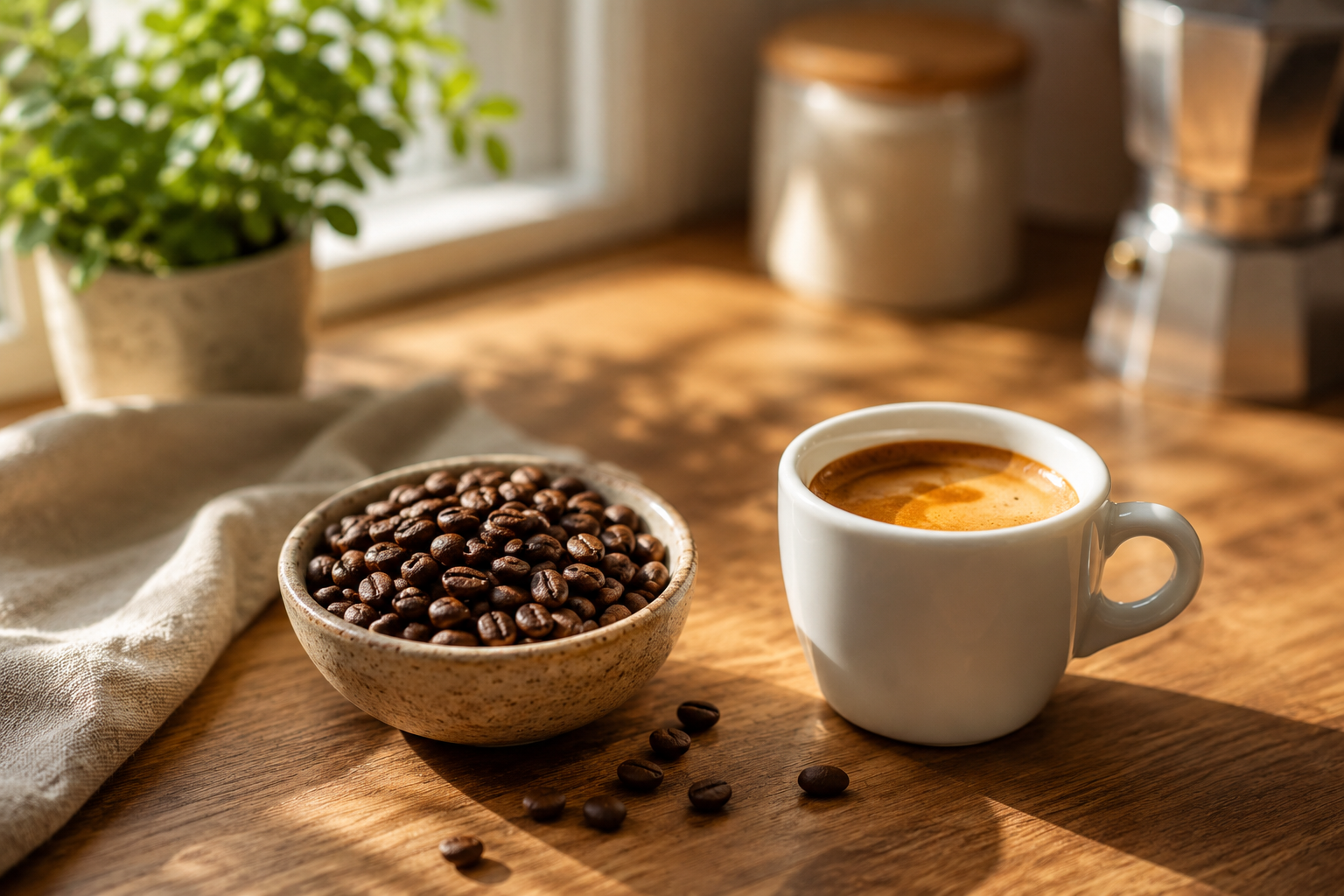
The best coffee beans for espresso are not defined by one origin, roast level, or expensive label. The right beans are the ones that suit your preferred drink, work with your equipment, and produce flavors you genuinely enjoy.
A person who drinks straight espresso may enjoy a bright, fruit-forward single-origin coffee. Someone who prepares large milk drinks may prefer a chocolatey blend with more body. Both can be excellent choices.
Instead of searching for a mythical “perfect espresso bean,” learn how to read the information on the bag and match it to the result you want in the cup.
This guide explains roast level, freshness, blends, single-origin coffees, Arabica and Robusta, processing methods, storage, and the practical signs of a bag worth buying.
The Quick Answer
For an approachable first purchase, look for:
- Whole coffee beans
- A clearly displayed roast date
- A medium or medium-dark roast
- Chocolate, caramel, nut, or brown-sugar tasting notes
- An espresso blend or coffee recommended for espresso
- A bag small enough to finish while the flavor remains enjoyable
- Brewing guidance provided by the roaster
This is a dependable starting point rather than a universal formula.
If you enjoy brighter acidity, floral aromas, or fruit-forward flavors, a lighter single-origin coffee may suit you better. If you mostly make cappuccinos and lattes, a fuller-bodied blend may remain more noticeable after milk is added.
Are Espresso Beans Different From Regular Coffee Beans?
“Espresso bean” is not a separate botanical variety.
Espresso describes a concentrated brewing method. Many coffees sold for filter brewing can also be prepared as espresso, while a bag labeled “espresso roast” can often be used with other brewing methods.
The label usually indicates that the roaster designed or tested the coffee with espresso preparation in mind. It may have:
- A roast profile intended to extract easily
- Enough sweetness and body for concentrated brewing
- Flavor notes that remain clear in milk
- A blend created for consistency
- A recommended starting recipe for espresso
The word espresso on a package can be helpful, but it does not guarantee that you will like the coffee. The roast date, tasting notes, roast description, and roaster’s brewing recommendations provide more useful information.
If you are new to concentrated coffee, our guide explaining what espresso is covers the brewing method, pressure, grind size, and basic shot structure.
Match the Beans to the Drink You Make
Before comparing countries or processing methods, consider what you normally drink.
For Straight Espresso
Straight espresso exposes the coffee’s acidity, sweetness, bitterness, texture, and aftertaste without milk or extra water.
Good options include:
- Balanced medium-roast blends
- Sweet single-origin coffees
- Light-to-medium roasts for experienced brewers
- Coffees with fruit, floral, cocoa, or caramel notes
If you are sensitive to acidity, begin with a coffee described as round, sweet, smooth, or chocolate-forward rather than one promoted as vibrant or intensely citrusy.
For Cappuccinos and Flat Whites
Milk softens acidity and bitterness while adding sweetness. A coffee needs enough flavor and body to remain noticeable.
Look for descriptions such as:
- Chocolate
- Caramel
- Toasted nuts
- Molasses
- Brown sugar
- Dried fruit
- Full-bodied
- Syrupy
Medium and medium-dark roasts are common choices, although a well-developed lighter roast can also work.
For Large Lattes
A small espresso shot can disappear beneath a substantial amount of milk. Choose a coffee with a confident flavor profile rather than a delicate one.
Blends containing a small amount of Coffea canephora—commonly called Robusta—may provide additional intensity and body. This is a stylistic choice, not an automatic sign of low quality.
For Americanos
Adding water makes subtle flavors easier to notice while reducing the espresso’s concentration.
Balanced medium roasts are versatile, but fruit-forward coffees can also produce expressive Americanos. Avoid assuming that only dark roasts will taste strong enough.
How Roast Level Changes Espresso
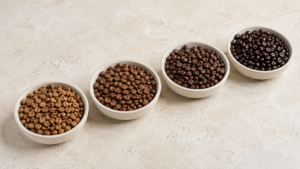
Roast labels are not standardized across every coffee company. One roaster’s medium roast may resemble another roaster’s medium-dark roast.
Treat the label as a general guide and pay attention to the tasting notes and appearance of the beans.
| Roast Style | Common Cup Characteristics | Espresso Difficulty | Often Suits |
|---|---|---|---|
| Light | Bright acidity, floral or fruit notes, lighter body | Higher | Straight espresso and adventurous drinkers |
| Medium | Sweetness, balanced acidity, caramel or fruit | Moderate | Espresso, Americanos, and smaller milk drinks |
| Medium-dark | Lower perceived acidity, fuller body, cocoa and nuts | Lower to moderate | Cappuccinos, flat whites, and everyday espresso |
| Dark | Roast-forward, smoky, bittersweet, low perceived acidity | Often easy to extract but easy to overdo | Traditional-style espresso and large milk drinks |
Light Roast Espresso
Light-roasted beans preserve more characteristics associated with the coffee’s origin, variety, and processing.
They can produce flavors resembling citrus, berries, flowers, tea, or tropical fruit. They may also require:
- A capable espresso grinder
- Smaller grind adjustments
- Careful temperature management
- A longer beverage yield
- More practice during dial-in
A sharp or sour light-roast shot does not necessarily mean the coffee is bad. The recipe may not be extracting enough from the beans.
Medium Roast Espresso
Medium roast is a practical middle ground. It can retain recognizable origin character while developing more caramelized sweetness and body.
This makes it a useful choice for people who alternate between straight espresso and milk drinks.
Medium-Dark Espresso
Medium-dark beans often produce familiar cocoa, toasted nut, caramel, and dark-sugar flavors. They tend to be approachable and are commonly used in traditional-style blends.
They may require a shorter yield or slightly lower brewing temperature than a lighter coffee, depending on the machine and roast.
Dark Roast Espresso
Dark roasts can produce heavy body and strong bittersweet flavors, but “strong” does not automatically mean better extracted.
Very dark coffee can become ashy, smoky, or harsh when brewed too hot or allowed to run too long. Beans with substantial surface oil can also leave residue in the hopper and grinder chute.
Choose dark roast because you enjoy its flavor—not because espresso supposedly requires it.
Single-Origin Coffee vs Espresso Blend
Neither option is automatically better.
Single-Origin Coffee
Single-origin coffee comes from a defined country, region, cooperative, producer, or farm, depending on how the roaster uses the term.
It may highlight distinctive characteristics such as:
- Floral aromas
- Berry or stone-fruit flavors
- Citrus-like acidity
- Tea-like texture
- Fermented or tropical notes
- A recognizable regional profile
Single-origin espresso can be rewarding, but it is not necessarily more difficult simply because it comes from one origin. Difficulty depends on roast development, bean density, solubility, processing, equipment, and recipe.
Espresso Blends
A blend combines different coffees to create a chosen flavor profile.
Roasters may blend coffees to improve:
- Seasonal consistency
- Sweetness
- Body
- Aroma
- Crema
- Performance with milk
- Price stability
A good blend is not a place to hide inferior beans. Thoughtful blending can produce a balanced espresso that would be difficult to achieve with one component alone.
For a first purchase, a blend with chocolate, caramel, and nut notes is often easier to understand and adjust. Once you have a repeatable routine, trying a single-origin coffee can reveal how dramatically espresso changes from one bag to another.
Arabica and Robusta in Espresso
Most specialty coffees emphasize Coffea arabica, but espresso does not have to contain 100% Arabica.
Arabica
Arabica coffees can offer:
- Greater aromatic complexity
- Fruit, floral, sugar, and nut characteristics
- Softer bitterness
- A wide range of acidity and texture
Quality still varies enormously. The word Arabica alone does not guarantee freshness or good flavor.
Robusta
Robusta is the common commercial name for Coffea canephora. It is often associated with:
- More pronounced bitterness
- Heavier body
- Earthy or woody flavors
- Higher caffeine content
- Persistent crema
Poor-quality Robusta can taste harsh, but carefully produced Robusta can contribute useful body and intensity to an espresso blend.
A small Robusta component may appeal to people who enjoy traditional Italian-style espresso or milk drinks with a strong coffee presence.
How Processing Method Can Affect Flavor
The way coffee fruit is processed after harvesting can influence the flavors described on the package.
Washed Coffee
Washed coffees often emphasize clarity and acidity. Depending on origin and roast, the espresso may taste clean, citrusy, floral, or refined.
Choose this style if you enjoy clearly separated flavors and a cleaner finish.
Natural Coffee
Natural processing dries the coffee seed inside the fruit before removal.
These coffees may produce:
- Berry-like flavors
- Ripe fruit sweetness
- Fuller body
- Fermented or wine-like aromas
Natural coffees can create expressive espresso, although intensely fermented examples may be polarizing.
Honey or Pulped-Natural Coffee
These methods leave some fruit material around the seed during drying. The resulting coffee may combine the clarity of washed processing with some of the sweetness and body associated with natural processing.
Processing descriptions suggest a direction, but they do not predict the exact flavor. Origin, variety, roast, storage, and brewing recipe still matter.
Freshness Matters—But There Is No Universal Date
Coffee changes continuously after roasting.
Initially, roasted beans release carbon dioxide through degassing. Brewing extremely fresh coffee may produce unstable flow, excessive foam, or difficulty achieving a repeatable espresso.
The Specialty Coffee Association’s review of roasted coffee shelf life explains how degassing, aroma loss, oxygen, packaging, and storage conditions all influence freshness.
Over time, aromatic compounds decline and oxygen contributes to staling. The coffee may eventually taste flat, papery, woody, or dull.
However, there is no single freshness window that applies to every coffee.
The ideal rest period depends on:
- Roast level
- Bean density
- Packaging
- Roasting equipment
- Storage conditions
- Espresso recipe
- The roaster’s intended flavor profile
Some darker coffees become easier to brew within several days. Dense, lightly roasted specialty coffees may benefit from a longer rest.
Use the roaster’s recommendation when one is provided. Otherwise, start tasting after the first several days and observe how the coffee changes.
A roast date is valuable because it gives you context. It should not become a countdown timer that declares a bag undrinkable on an arbitrary day.
Buy Whole Beans Whenever Possible
Grinding greatly increases the coffee’s exposed surface area, accelerating aroma loss.
Whole beans allow you to grind immediately before brewing and adjust particle size as the coffee changes. That adjustment is essential for non-pressurized espresso baskets.
Pre-ground coffee can still be practical when:
- Your machine uses a pressurized basket
- You do not own an espresso-capable grinder
- The coffee shop grinds specifically for your equipment
- Convenience is more important than fine adjustment
The limitation is that one fixed grind cannot adapt to different baskets, machines, bean ages, or room conditions.
If your machine uses a single-wall basket, buying whole beans and using an espresso-capable burr grinder provides substantially more control.
Our blade grinder vs burr grinder comparison explains why consistent particle size and precise adjustment are especially important when brewing espresso.
Check Whether the Beans Suit Your Equipment
The best coffee beans for espresso must also work with your machine and grinder.
Pressurized or Dual-Wall Basket
A pressurized basket creates resistance through the basket design and is more forgiving of:
- Pre-ground coffee
- Less precise grinders
- Older beans
- Small preparation inconsistencies
Medium and darker roasts often work comfortably in these systems, but they are not mandatory.
Single-Wall Basket
A single-wall basket relies on the ground coffee to create resistance.
It requires:
- A sufficiently fine grind
- Small, repeatable grinder adjustments
- Accurate dosing
- Even distribution
- Consistent tamping
Light roasts can be especially demanding when the grinder offers only large adjustment steps.
Super-Automatic Machine
Super-automatic machines may struggle with extremely oily beans. Surface oil can contribute to buildup inside the hopper and grinder mechanism.
Check the machine manual before buying a very dark, shiny roast. A dry-surfaced medium or medium-dark coffee is often a safer starting point.
Do Not Overlook Decaf Espresso Beans
Decaf coffee can make excellent espresso.
Decaffeination and roasting change the bean’s structure, so decaf may grind and extract differently from regular coffee. It can also require more frequent grinder adjustment.
When buying decaf, look for:
- A recent roast date
- A stated decaffeination method
- Tasting notes that suit your drinks
- Espresso brewing guidance
- Packaging that protects the beans from air and light
Buy smaller quantities if you use decaf only occasionally. Keeping one large bag open for months will do the flavor no favors—decaf deserves better than being the forgotten cousin in the cupboard.
How to Read an Espresso Coffee Bag
A useful package should help you answer several practical questions.
Roast Date
A roast date shows when the coffee was roasted. A distant expiration date alone tells you little about peak flavor.
Tasting Notes
Tasting notes are descriptions, not added ingredients unless the package specifically says the coffee is flavored.
Use them as a preference guide:
| If You Enjoy | Look for These Descriptions |
|---|---|
| Classic and comforting | Chocolate, caramel, hazelnut, brown sugar |
| Bold and traditional | Dark chocolate, molasses, toasted nuts, spice |
| Bright and lively | Citrus, apple, berry, stone fruit |
| Floral and delicate | Jasmine, tea, bergamot, honey |
| Fruit-forward and unusual | Tropical fruit, wine-like, fermented fruit |
Recommended Brewing Method
A bag marked for espresso has usually been tested with concentrated brewing in mind. Some roasters provide both espresso and filter recipes for the same coffee.
Origin and Processing
These details can help you compare coffees and recognize your preferences over time. They should not be treated as a guaranteed flavor formula.
Dose and Yield Recommendation
A suggested recipe gives you a useful starting point. For example:
18 g coffee → 38 g espresso in approximately 28 seconds
The recipe will still need adjustment for your grinder, basket, water, and machine.
A Practical First-Bag Buying Checklist
Use this checklist before purchasing:
- Is the coffee sold as whole beans?
- Is a roast date displayed?
- Does the flavor description appeal to me?
- Will I drink it mainly straight or with milk?
- Does the roast suit my grinder and machine?
- Does the roaster recommend it for espresso?
- Is the bag small enough to finish reasonably soon?
- Are there starting instructions for dose and yield?
- Are the beans extremely oily?
- Can I buy the same coffee again if I like it?
Repeat availability matters more than many beginners realize. A dependable house blend lets you learn how aging, grind size, and recipe changes affect the same coffee.
How Much Coffee Should You Buy?
For learning espresso, a very small sample can disappear before you finish adjusting the grinder. A huge bag may lose its best qualities before you finish it.
A 250-gram bag provides roughly thirteen doses at 18 grams each, before accounting for grinder purging and small spills. That may be enough for an experienced brewer but restrictive for a beginner dialing in unfamiliar equipment.
Choose an amount based on:
- The number of espresso drinks you prepare each day
- Whether other people use the same beans
- How much coffee your grinder retains
- Your experience with dial-in
- Whether the bag can be resealed effectively
Buying two smaller bags can preserve flexibility better than immediately opening one very large bag.
How to Dial In a New Bag
Do not judge new beans from one uncontrolled shot.
Begin with a repeatable baseline:
- Use a dose appropriate for the basket.
- Select a starting brew ratio.
- Weigh both the dry dose and espresso yield.
- Record the grinder setting and brew time.
- Stir the espresso before tasting.
- Change only one main variable.
- Repeat until the flavor improves.
Follow our complete guide on how to dial in espresso when you need a repeatable process for adjusting grind size, dose, yield, time, and flavor.
A common starting point is:
18 g coffee → 36 g espresso
This 1:2 ratio is a reference, not a rule.
If the espresso tastes sharp, thin, or unpleasantly sour, a finer grind or longer yield may help. If it tastes harsh, drying, or excessively bitter, try a coarser grind or shorter yield.
Roast level also affects the recipe. A light coffee may perform better with a longer ratio, while a dark coffee may taste more balanced with a shorter one.
How to Store Espresso Beans
Protect coffee from oxygen, heat, moisture, and strong odors.
The National Coffee Association also recommends protecting coffee from air, light, moisture, and heat while grinding only what you need before brewing.
For everyday use:
- Keep the beans in a tightly sealed container
- Use an opaque or dark container
- Store them in a cool, dry cabinet
- Keep them away from ovens and direct sunlight
- Grind only the amount needed for each session
- Avoid repeatedly leaving the hopper full for long periods
For a more detailed storage routine, read our guide on how to store coffee beans without exposing them unnecessarily to air, light, heat, or moisture.
A well-designed resealable coffee bag with a one-way valve can be perfectly suitable. Moving beans into a decorative container does not automatically improve storage.
Should Coffee Beans Be Refrigerated?
Routine refrigerator storage is inconvenient because opening a cold container may introduce condensation. Coffee can also absorb surrounding odors when poorly sealed.
If you use the beans daily, a cool cabinet is usually simpler.
Can Espresso Beans Be Frozen?
Freezing can preserve coffee effectively when done carefully.
Divide the beans into airtight portions, remove excess air, and allow a sealed portion to reach room temperature before opening it. Avoid repeatedly thawing and refreezing the same container.
Freezing is most useful for excess coffee that will not be consumed soon, not as a compulsory step for every bag.
Buying Mistakes That Waste Money
Choosing Beans Only by the Word “Espresso”
The label does not tell you whether the coffee matches your taste or equipment.
Assuming Darker Means Stronger or Better
Dark roasting changes flavor and solubility, but it does not automatically produce superior espresso.
Buying a Large Bag Before Tasting It
A bargain stops being a bargain when you dislike the coffee for the next two kilograms.
Ignoring the Grinder
Excellent beans cannot compensate fully for a grinder that cannot produce or adjust an espresso grind.
Changing Coffee Constantly
Using one repeatable coffee for several bags helps you understand your equipment and recognize meaningful adjustments.
Treating Crema as Proof of Quality
Crema is affected by freshness, roast, coffee species, pressure, and other variables. A thick crema can sit on an unpleasant espresso, while a delicious shot may have relatively little.
Rejecting a Coffee After One Shot
The first grind setting may simply be wrong. Give the coffee several controlled attempts before deciding whether its flavor profile suits you.
Frequently Asked Questions
What are the best coffee beans for espresso?
The best beans match your preferred flavor, drink style, machine, and grinder. Fresh whole beans with clear tasting notes and espresso guidance provide a useful starting point. Many beginners enjoy medium or medium-dark blends with chocolate, caramel, and nut characteristics.
Can any coffee beans be used for espresso?
Yes. Espresso is a brewing method rather than a special bean variety. However, some coffees are easier to extract or better suited to particular drink styles.
Is medium or dark roast better for espresso?
Neither is universally better. Medium roast often balances sweetness and acidity, while dark roast provides more roast-forward bitterness and body. Choose according to taste and adjust the brewing recipe accordingly.
Is single-origin coffee better than a blend?
Single-origin coffees may provide distinctive flavors, while blends can offer balance and consistency. Quality depends on the coffee and roasting—not whether the bag contains one origin or several.
How long should espresso beans rest after roasting?
There is no universal resting period. Darker coffees may become ready sooner, while some lightly roasted coffees benefit from more time. Follow the roaster’s guidance and evaluate how the espresso behaves and tastes.
Should espresso beans look oily?
Some dark-roasted beans develop surface oil, but oil is not proof of quality or freshness. Extremely oily beans may leave more residue in grinders and can be unsuitable for certain super-automatic machines.
Are 100% Arabica beans always best?
No. Arabica can provide excellent complexity, but high-quality Robusta can add body, intensity, caffeine, and crema to a blend. The producer, processing, roasting, and final flavor matter more than a single marketing phrase.
Can I use pre-ground coffee for espresso?
Yes, particularly with a pressurized basket. A single-wall basket usually performs better with beans ground immediately before brewing because the grind size can be adjusted precisely.
Should I buy beans from a local roaster?
A reputable local roaster may offer recent roast dates, smaller quantities, and specific brewing advice. Online roasters can provide the same advantages. Transparency and quality matter more than distance alone.
What flavors are easiest for espresso beginners?
Chocolate, caramel, nuts, brown sugar, and dried fruit are approachable starting points. They often work well both straight and with milk, but personal preference remains the deciding factor.
Final Thoughts
Choosing the best coffee beans for espresso becomes easier when you stop looking for one universally perfect product.
Begin with the drink you prepare most often. Choose a flavor description you actually enjoy, check the roast date, buy whole beans when possible, and make sure the roast is practical for your grinder and machine.
A medium or medium-dark espresso blend with chocolate, caramel, or nut notes is a forgiving first choice. It is not the only correct choice. Lighter single-origin coffees, traditional blends containing Robusta, and well-roasted decaf can all produce excellent espresso.
Most importantly, give each new bag a fair dial-in process. Keep the dose stable, measure the yield, adjust one variable at a time, and judge the result by taste.
The best bag is not necessarily the rarest, darkest, or most expensive. It is the coffee that works reliably in your setup and makes you look forward to the next shot.