
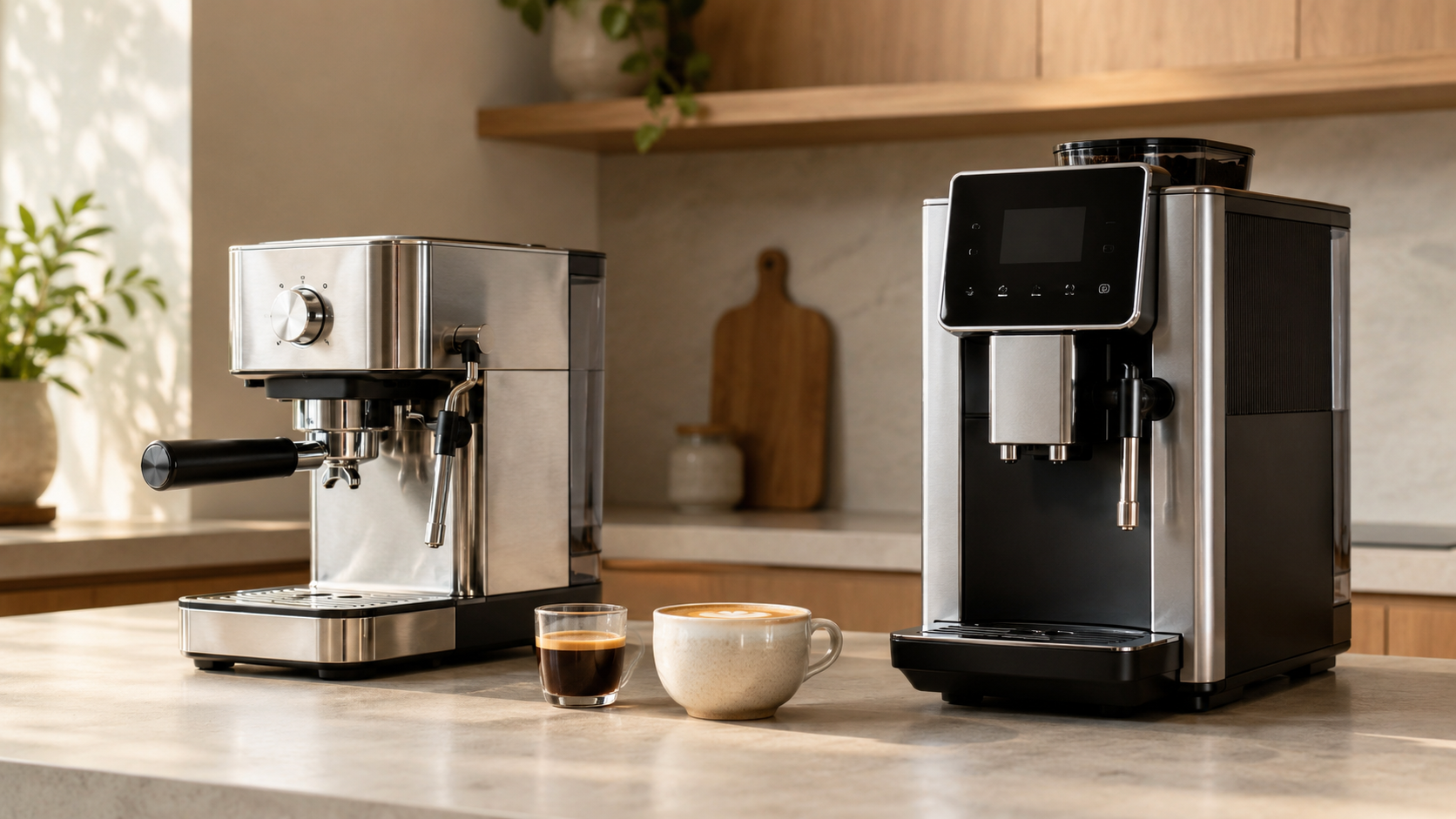
The best espresso machines for beginners make it easier to learn espresso without removing every opportunity to improve. A suitable first machine should offer stable brewing, manageable controls, practical cleaning, and a milk system that matches the drinks you actually enjoy.
For most beginners, the Breville Bambino offers the best overall balance. It heats quickly, uses both beginner-friendly and traditional filter baskets, and leaves room to develop real espresso and milk-steaming skills.
However, it is not the right answer for everyone. A small kitchen, an interest in hands-free milk, or a desire for one-touch coffee may lead you toward a different machine.
This guide compares five beginner-friendly options using official specifications, everyday usability, required accessories, cleaning demands, and long-term learning potential.
Editorial note: These recommendations are based on published manufacturer specifications, machine design, workflow, and suitability for different beginners. Prices and availability can change, so confirm current details before purchasing.
Best Beginner Espresso Machines at a Glance
| Machine | Best For | Grinder | Milk System | Learning Curve |
|---|---|---|---|---|
| Breville Bambino | Best overall | Separate grinder required | Manual steam wand | Moderate |
| De’Longhi Dedica Duo | Small kitchens and lower budgets | Separate grinder required | Manual steam wand | Easy to moderate |
| Breville Bambino Plus | Beginners who want easier milk drinks | Separate grinder required | Automatic steam wand | Easy |
| Gaggia Classic Pro E24 | Learning traditional espresso skills | Separate grinder required | Manual commercial-style wand | Steeper |
| Philips 3300 LatteGo | One-touch convenience | Built in | Automatic LatteGo system | Very easy |
All five can suit a first-time owner, but they provide very different experiences. The best choice depends on whether you want to learn the craft of espresso or simply make coffee with minimal effort.
1. Breville Bambino — Best Overall
The Breville Bambino is our best overall choice for beginners who want genuine hands-on espresso without a large machine or complicated interface.
It uses simple controls for single espresso, double espresso, steam, and hot water. Breville’s ThermoJet heating system reaches its operating temperature in approximately three seconds, making it practical for busy mornings.
The 54 mm portafilter is designed around an 18-gram coffee dose. The machine also includes both single-wall and dual-wall filter baskets. Dual-wall baskets are more forgiving when using pre-ground coffee or an entry-level grinder, while single-wall baskets provide more control once your grinding and preparation improve.
Why Beginners May Like It
- Approximately three-second heat-up
- Compact countertop footprint
- Simple volumetric shot buttons
- Manual steam wand for learning milk texture
- Single-wall and dual-wall baskets included
- Low-pressure pre-infusion followed by 9-bar extraction
- Hot-water function for Americanos
- Considerable room for skill development
Potential Drawbacks
- No built-in grinder
- Manual milk steaming requires practice
- Lightweight construction compared with heavier boiler machines
- Preparing several milk drinks consecutively can feel slower than using a dual-boiler machine
The Bambino is particularly suitable for someone who wants to learn espresso but does not want a machine that takes a long time to warm up.
Its quick start does not eliminate the need to preheat the portafilter and cup. Running a blank shot before brewing can help warm the parts that contact the coffee.
Best for: A beginner who wants compact dimensions, quick operation, and meaningful control over espresso.
View the Breville Bambino specifications
For a closer look at its brewing performance, controls, and limitations, read our complete Breville Bambino review.
2. De’Longhi Dedica Duo — Best Compact Choice
The De’Longhi Dedica Duo is a slim manual espresso machine designed for kitchens where counter space is limited.
It offers preset controls for espresso, double espresso, and cold-brew-style coffee. Its updated steam wand is intended to create smooth microfoam for drinks such as lattes and cappuccinos.
The Dedica range has traditionally appealed to beginners because its pressurized brewing system can produce acceptable results without demanding a perfectly calibrated espresso grinder from the first day.
Why Beginners May Like It
- Very narrow footprint
- Straightforward digital controls
- Espresso and double-espresso presets
- Cold coffee setting
- Manual steam wand
- Removable drip tray for taller cups
- Lower initial cost than many enthusiast machines
- Suitable for small apartments and crowded countertops
Potential Drawbacks
- A compact machine can feel less stable during portafilter installation
- Smaller components offer fewer standard upgrade options than a 58 mm system
- Manual steaming still requires practice
- A dedicated espresso grinder is needed for the best results
The Dedica Duo makes sense when size and accessibility matter more than building a traditional enthusiast setup.
A less expensive machine should not encourage you to ignore the grinder. Pairing it with a capable burr grinder will usually improve shot consistency more than buying decorative espresso accessories. Tiny stainless-steel distribution tool number seven can wait.
Best for: Beginners who want a small and relatively affordable machine for espresso and milk drinks.
View the De’Longhi Dedica Duo specifications
3. Breville Bambino Plus — Best for Easy Milk Drinks
The Bambino Plus shares many brewing characteristics with the standard Bambino but adds an automatic steam wand.
The user can select milk temperature and foam level, position the milk pitcher on the sensor, and allow the machine to texture the milk automatically. This removes one of the more difficult early skills involved in preparing lattes and cappuccinos.
It still uses a 54 mm portafilter and an 18-gram dose, while the ThermoJet system provides the same approximately three-second startup.
Why Beginners May Like It
- Automatic hands-free milk texturing
- Adjustable milk temperature and foam
- Very fast heating
- Compact dimensions
- Simple espresso controls
- Easier transition from pod coffee to fresh espresso
- Capable of producing fine microfoam
- Includes beginner-friendly filter options
Potential Drawbacks
- More expensive than the standard Bambino
- No integrated grinder
- Automatic steaming offers less hands-on practice
- Extra convenience may not justify the price for people who rarely drink milk beverages
The Bambino Plus is not automatically better than the standard Bambino. Its main advantage is milk convenience.
Choose the Plus if you regularly make lattes, cappuccinos, or flat whites and want consistent milk without immediately mastering steam-wand positioning. Choose the standard model if you want to learn manual steaming or would rather put the price difference toward a grinder.
Best for: Beginners who primarily drink milk-based espresso beverages and value repeatable, hands-free foam.
View the Breville Bambino Plus specifications
4. Gaggia Classic Pro E24 — Best for Learning Traditional Espresso
The Gaggia Classic Pro E24 is designed for beginners who want a more traditional, hands-on espresso machine and expect their skills to grow.
Unlike compact thermocoil machines, the E24 uses a lead-free brass boiler and brass group head. It also has a commercial-size 58 mm stainless-steel portafilter, a three-way solenoid valve, mechanical rocker switches, and a commercial-style steam wand.
Its pump is calibrated to deliver 9-bar brewing pressure, according to Gaggia.
Why Beginners May Like It
- Solid brass boiler and group head
- Standard 58 mm portafilter
- Durable stainless-steel body
- 9-bar brewing pressure
- Commercial-style two-hole steam wand
- Three-way solenoid valve
- Broad accessory compatibility
- Strong potential for long-term use
Potential Drawbacks
- Steeper learning curve
- Longer warm-up routine than a Bambino
- No built-in grinder
- Brewing and steaming cannot occur simultaneously
- Temperature management requires more attention
- Included accessories are fairly basic
The E24 is a single-boiler, dual-use machine. The same boiler supplies brewing water and steam, so the user must switch modes and wait when moving between espresso extraction and milk steaming.
This is less convenient when preparing several lattes, but it provides a more traditional introduction to espresso workflow.
The Classic Pro E24 is not the easiest machine on this list. It is the better choice for someone who views espresso as a hobby and wants to understand grinding, dosing, distribution, temperature, extraction, and milk technique.
Best for: A committed beginner who values construction, traditional controls, and long-term skill development over immediate convenience.
View the Gaggia Classic Pro E24 specifications
5. Philips 3300 LatteGo — Best Fully Automatic Option
The Philips 3300 LatteGo takes a different approach from the four portafilter machines above.
It is a fully automatic bean-to-cup machine with an integrated grinder. The machine grinds the beans, portions the coffee, brews the drink, and prepares milk through the removable LatteGo system.
It offers six hot and cold beverage selections, depending on the exact regional model. Strength, drink volume, and milk settings can be adjusted through its control panel.
Why Beginners May Like It
- Built-in grinder
- One-touch drink preparation
- Automatic milk frothing
- Multiple black and milk-based drinks
- Adjustable coffee settings
- Minimal tamping or dosing knowledge required
- LatteGo milk container has no internal tubes
- Fast milk-system cleanup
Potential Drawbacks
- Higher purchase price
- Less control over puck preparation
- Espresso may not match a carefully dialed-in semi-automatic setup
- Larger countertop footprint
- More internal components require routine care
- Provides fewer opportunities to learn barista techniques
Philips states that the LatteGo milk system can be cleaned in as little as ten seconds. The removable brew group and milk components still need regular cleaning, and the machine must be descaled according to its instructions.
The 3300 is a strong choice when convenience matters more than manually preparing espresso. It is particularly useful in a household where several people want different drinks without learning how to grind, dose, tamp, and steam.
Best for: Beginners who want fresh-bean coffee and automatic milk drinks with as few manual steps as possible.
View the Philips 3300 LatteGo specifications
How We Selected These Machines
Beginner-friendly does not simply mean “has fewer buttons.” A machine can be easy to start but frustrating to maintain, or inexpensive to purchase but costly after adding essential equipment.
The recommendations were compared using these factors:
Ease of Use
Controls should be understandable without forcing a new owner to study an engineering diagram before breakfast.
Automatic dosing, programmable shot volumes, pressurized baskets, and assisted milk systems can make the first weeks easier. Fully manual controls offer more freedom but demand additional practice.
Espresso Learning Potential
A good first machine should either produce convenient coffee consistently or provide a clear path toward better technique.
Semi-automatic machines generally offer more control over:
- Coffee dose
- Grind size
- Distribution
- Tamping
- Shot time
- Beverage yield
- Milk texture
Fully automatic machines handle most of these variables internally.
Heating and Workflow
Fast heating is helpful for one or two morning drinks. Boiler capacity and recovery become more important when several milk beverages must be prepared consecutively.
Single-heater machines typically require a pause between brewing and steaming. This is normal for many affordable home models, but buyers should understand the limitation.
Milk Performance
Someone who drinks straight espresso has different needs from a daily latte drinker.
Manual wands provide control but require practice. Automatic systems reduce the learning curve but can limit how much the user controls milk texture.
Cleaning and Maintenance
Every espresso machine needs maintenance. Beginner-friendly designs should make daily rinsing, steam-wand wiping, drip-tray cleaning, and periodic descaling reasonably accessible.
A one-touch machine does not mean a no-cleaning machine. Coffee oils and milk residue remain stubbornly unimpressed by marketing departments.
Total Ownership Cost
The machine price is only part of the setup.
Depending on the model, you may also need:
- Espresso-capable burr grinder
- Digital scale
- Replacement water filters
- Cleaning tablets or powder
- Descaling solution
- Milk pitcher
- Better tamper
- Replacement group gasket
- Fresh coffee beans
Do You Need a Separate Espresso Grinder?
You need a separate grinder for the Bambino, Dedica Duo, Bambino Plus, and Gaggia Classic Pro E24 if you want to use fresh whole beans.
Espresso requires small and precise grind adjustments. A standard blade grinder cannot provide the consistency or control needed to dial in traditional espresso.
Look for a burr grinder with:
- Fine espresso settings
- Small adjustment steps
- Low grind retention
- Repeatable dosing
- Suitable portafilter workflow
- Replacement parts and manufacturer support
Pressurized filter baskets can work with pre-ground coffee, making the first setup less demanding. However, a capable grinder and a single-wall basket provide greater control and usually better flavor once you are ready to learn.
The Philips 3300 includes its own grinder, so a separate unit is unnecessary.
Semi-Automatic vs Fully Automatic: Which Is Better?
Neither type is universally better.
Choose a semi-automatic machine if you want to:
- Learn espresso preparation
- Adjust the grind and dose
- Control shot yield
- Practice milk steaming
- Experiment with different beans
- Upgrade individual accessories
Choose a fully automatic machine if you want to:
- Press one button for coffee
- Avoid manual tamping
- Use an integrated grinder
- Prepare several drink styles quickly
- Minimize daily coffee preparation
- Prioritize consistency and convenience
A fully automatic machine is easier to operate, but a semi-automatic machine offers greater control and learning potential.
Our guide to espresso machine types explains how manual, semi-automatic, automatic, and super-automatic designs differ.
Features That Matter More Than Pump Pressure
Entry-level machines often advertise a 15-bar or 19-bar pump. The larger number does not automatically produce better espresso.
Traditional espresso extraction normally occurs around 9 bars at the coffee puck. A machine may contain a higher-rated pump while regulating the actual brewing pressure.
More useful features include:
- Consistent brewing temperature
- Controlled extraction pressure
- Pre-infusion
- Appropriate filter baskets
- Reliable shot-volume controls
- Serviceable components
- Effective steam performance
- Accessible cleaning programs
- Readily available replacement parts
Pump pressure alone is a poor way to compare machines.
Common First-Machine Mistakes
Buying the Machine but Ignoring the Grinder
A costly espresso machine cannot compensate for an unsuitable grind. If the machine lacks an integrated grinder, include one in the original budget.
Choosing According to Appearance Alone
A beautiful machine may have a slow workflow, awkward water tank, weak steam system, or controls that do not suit your routine.
Check its dimensions, including the clearance required above the machine and the space needed to remove the water tank.
Assuming Every Machine Is Fully Automatic
Programmable espresso buttons do not mean the machine grinds or tamps the coffee. The Bambino, Bambino Plus, Dedica Duo, and Gaggia Classic Pro E24 still require puck preparation.
Expecting Perfect Espresso Immediately
Dialing in involves adjusting grind size, dose, distribution, and beverage yield. Early shots may run too quickly, choke the machine, or taste distinctly like regret. That is part of learning.
Neglecting Water Quality
Very hard water can cause mineral buildup, while completely demineralized water may produce flat-tasting coffee and may not suit every machine.
Follow the manufacturer’s water and filtration instructions rather than assuming any bottled or filtered water is appropriate.
Forgetting Daily Cleaning
After each session:
- Knock out the used coffee puck
- Rinse the basket and portafilter
- Purge and wipe the steam wand
- Empty the drip tray when necessary
- Flush the group according to the manual
- Rinse removable milk components
For a complete maintenance routine, follow our step-by-step guide on how to clean an espresso machine.
Regular maintenance protects flavor and reduces preventable problems.
Which Beginner Espresso Machine Should You Buy?
Choose the Breville Bambino if you want the strongest overall combination of simplicity, speed, and hands-on learning.
Choose the De’Longhi Dedica Duo if counter space and initial cost are your main concerns.
Choose the Breville Bambino Plus if you frequently make milk drinks and want automatic milk texturing.
Choose the Gaggia Classic Pro E24 if you are prepared for a steeper learning curve and want a traditional 58 mm espresso platform.
Choose the Philips 3300 LatteGo if convenience matters more than manual espresso technique.
Before purchasing, consider the entire household’s routine. A hobbyist may enjoy manually dialing in every shot, while a tired family at 7 a.m. may vote decisively for one-touch coffee.
Frequently Asked Questions
What is the best espresso machine for a complete beginner?
The Breville Bambino is the best overall starting point for many beginners because it combines quick heating, uncomplicated controls, forgiving dual-wall baskets, and enough manual control for skill development.
Someone who does not want to grind or tamp coffee may prefer a fully automatic machine such as the Philips 3300 LatteGo.
How much should a beginner spend?
The right budget must include both the machine and grinder. A lower-cost machine paired with a capable espresso grinder may provide better results than an expensive machine paired with an unsuitable grinder.
Also reserve money for fresh beans, a scale, cleaning supplies, and water treatment when required.
Can I make good espresso without a grinder?
You can use pre-ground coffee with a pressurized or dual-wall basket, but freshness and control will be limited. A burr grinder designed for espresso provides more consistent results with single-wall baskets.
Is a manual machine suitable for beginners?
A lever-operated manual machine can suit a patient beginner, but it adds control over pressure and often temperature to an already demanding workflow. Most first-time owners will find a semi-automatic machine easier.
Is a super-automatic machine real espresso?
A super-automatic machine brews coffee under pressure and can produce espresso-style beverages. Its preparation, dose, extraction profile, and flavor may differ from espresso made with a carefully adjusted semi-automatic machine.
Does a more expensive machine make better coffee?
Not automatically. Beans, grinder quality, water, puck preparation, and technique all affect the result. Higher prices may provide stronger construction, better temperature management, greater convenience, or faster multi-drink workflow.
Which machine is easiest to clean?
The easiest routine depends on the drink. Manual machines have fewer milk components but require steam-wand and portafilter cleaning. The Philips LatteGo system is designed for quick removal and rinsing, although the internal brew group and machine still require scheduled maintenance.
Final Thoughts
The best espresso machines for beginners are not necessarily the machines that automate the most steps. They are the ones that fit the owner’s preferred drinks, available time, kitchen space, and interest in learning.
The Breville Bambino is the most balanced choice for many first-time owners. It is compact and quick, yet it still teaches the fundamental relationship between grinding, dosing, extraction, and milk texture.
The Dedica Duo saves space, the Bambino Plus simplifies milk preparation, the Gaggia Classic Pro E24 offers a more traditional learning platform, and the Philips 3300 LatteGo prioritizes one-touch convenience.
Decide first whether you want espresso to become a hobby or simply appear in your cup every morning. That answer will narrow the field faster than any intimidating wall of machine specifications.