
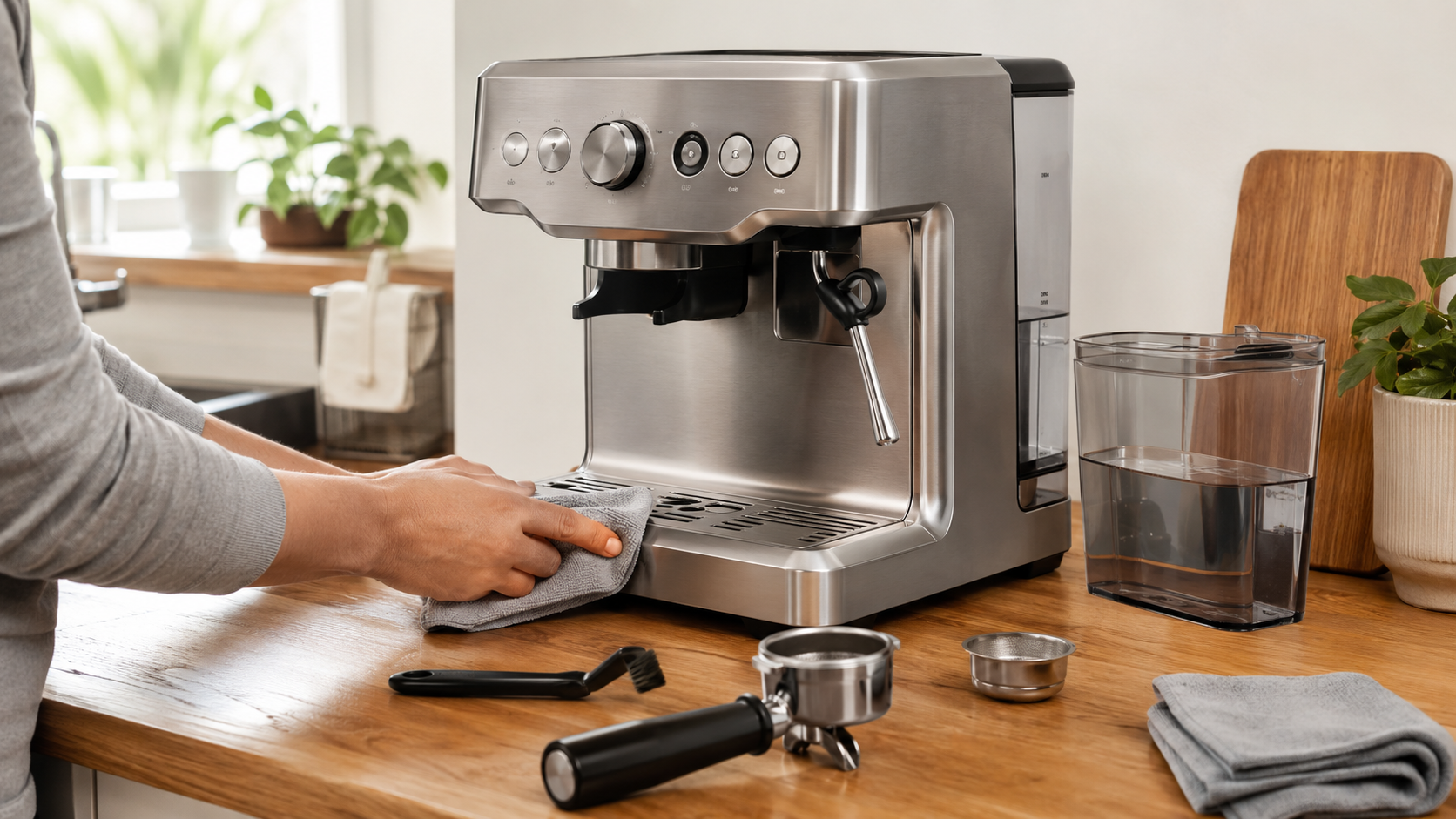
Learning how to clean an espresso machine begins with identifying what type of machine you own. A manual espresso machine, a semi-automatic model, and a super-automatic machine may require completely different cleaning procedures.
Coffee oils collect around the basket, portafilter, shower screen, and brew group. Milk residue can harden inside a steam tip or milk tube. Minerals from water may form scale inside boilers and internal plumbing.
These problems require different solutions:
- Rinsing removes loose coffee grounds
- Coffee-machine detergent removes coffee oils
- Milk-system cleaner removes milk residue
- Descaling solution dissolves mineral deposits
- Backflushing cleans compatible brew circuits
One product or procedure cannot safely replace all the others. Your machine’s instruction manual should always take priority over a general cleaning schedule.
Start by Identifying Your Machine
Before using cleaning tablets, removing parts, or starting a descale cycle, determine which machine design you have.
Our guide to different espresso machine types explains how manual, semi-automatic, automatic, and super-automatic systems differ in operation and maintenance.
Manual or Semi-Automatic Espresso Machine
These machines usually have a removable portafilter and a separate steam wand. The user grinds, doses, tamps, and inserts the portafilter manually.
If you are still comparing equipment, our guide to the best espresso machines for beginners considers cleaning requirements alongside brewing performance and ease of use.
Common cleaning areas include:
- Portafilter and basket
- Group head and shower screen
- Steam wand
- Drip tray
- Water reservoir
- Backflush system, if supported
Super-Automatic Espresso Machine
A super-automatic machine grinds the beans, prepares the coffee puck, and brews at the press of a button.
It may contain:
- A removable or fixed brew group
- Internal rinse programs
- Coffee-oil cleaning cycles
- Automatic milk tubes or carafes
- A built-in grinder
- Water filters and descale alerts
Do not apply semi-automatic backflushing instructions to a super-automatic machine.
Capsule Machine
Capsule machines generally do not have a traditional group head or portafilter. Cleaning usually involves emptying the capsule container, washing removable components, running a rinse cycle, cleaning the milk system, and descaling when required.
Use the instructions for the exact capsule system and model.
Cleaning, Backflushing, and Descaling Are Different
These terms are often used interchangeably, but they describe separate maintenance jobs.
| Procedure | What It Removes | Typical Area | Product |
|---|---|---|---|
| Rinsing | Loose grounds and fresh residue | Basket, portafilter, group outlet | Clean water |
| Detergent cleaning | Coffee oils and baked-on residue | Brew group and compatible parts | Approved coffee-machine cleaner |
| Milk-system cleaning | Milk proteins and fat | Steam tip, tubes, or carafe | Approved milk cleaner |
| Backflushing | Residue inside a compatible brew circuit | Group and three-way valve system | Water or approved detergent |
| Descaling | Mineral deposits | Boiler, thermoblock, and water paths | Approved descaling solution |
A descaler is not a substitute for coffee detergent. Coffee detergent does not replace descaling solution.
Mixing products or using the wrong chemical can damage seals, coatings, valves, sensors, or internal tubing.
What You Need
Your exact cleaning kit will depend on the machine, but common supplies include:
- Clean microfiber cloths
- Dedicated damp cloth for the steam wand
- Group-head cleaning brush
- Soft bottle brush
- Nonabrasive sponge
- Approved coffee-machine detergent
- Manufacturer-approved descaling solution
- Milk-system cleaner, when required
- Blind basket or cleaning disc, if supplied
- Steam-tip cleaning pin, if supplied
- A container large enough for rinse water
- Fresh water
Keep the steam-wand cloth separate from cloths used on the counter or drip tray.
Avoid steel wool, abrasive powders, bleach, harsh household cleaners, and sharp improvised tools.
Safety Before You Begin
Routine rinsing can be performed while the machine is operating, but deeper cleaning may involve hot water, steam, electricity, and removable metal components.
Before disassembling anything:
- Turn the machine off.
- Unplug it if the manual instructs you to do so.
- Allow hot components to cool.
- Release pressure according to the manual.
- Remove only parts designed for user removal.
- Keep electrical connectors and the machine body dry.
Never immerse the espresso machine in water or open its casing for routine cleaning.
Steam wands, group heads, and portafilters can remain hot after use. Handle them carefully and keep hands away from steam outlets during purging.
The Essential After-Use Routine
The most effective cleaning routine starts immediately after brewing. Fresh residue is much easier to remove than dried coffee oil or hardened milk.
Breville’s official cleaning guide similarly recommends removing the puck, rinsing the portafilter, flushing the group head, and cleaning the steam wand after brewing.
1. Remove the Coffee Puck
Unlock the portafilter and knock out the used puck while it is still warm.
Do not leave wet coffee inside the basket overnight. It can create stains, odors, and stubborn residue.
Check that no grounds remain stuck to the basket rim.
2. Rinse the Basket and Portafilter
Remove loose coffee under warm running water. Check the holes in the basket for trapped particles.
Wipe the portafilter dry before the next dose. A wet basket can cause grounds to stick unevenly during preparation.
Do not automatically soak the entire portafilter handle. Some handles contain materials or internal components that should not remain submerged.
3. Rinse the Group Outlet
If the manufacturer recommends it, run a brief blank shot without coffee to remove loose grounds from the shower screen.
Use a group-head brush around the gasket only when the machine design permits it. Keep fingers away from hot metal and flowing water.
Excessive flushing is not always beneficial. Machines manage heat differently, so use the flushing procedure recommended for your model.
4. Clean the Steam Wand Immediately
Milk should never be allowed to dry on the steam wand.
After steaming:
- Move the pitcher away safely.
- Wipe the wand with a clean, damp cloth.
- Purge it briefly according to the manual.
- Check that the steam holes remain open.
The wand may be extremely hot. Hold the cloth in a way that keeps your fingers away from the tip.
Do not scrape dried milk with a knife or metal tool. If the tip becomes blocked, use the supplied cleaning pin or follow the manufacturer’s removal and soaking procedure.
5. Empty the Drip Tray When Necessary
Standing water mixed with coffee and milk quickly develops unpleasant odors.
Remove the tray carefully, empty it, rinse it, and clean the grate. Dry the surrounding area before reinstalling it.
Some trays are dishwasher-safe, while others may warp or discolor. Check the manual before using a dishwasher.
End-of-Day Cleaning
If you prepare several drinks throughout the day, perform a slightly more thorough routine after the final session.
- Rinse and inspect the basket
- Wash approved removable parts
- Brush loose grounds from the group area
- Clean and purge the steam wand
- Empty and rinse the drip tray
- Empty the used-puck container on automatic machines
- Wipe the machine exterior
- Remove beans scattered around the grinder
- Refill with fresh water if appropriate
Do not spray cleaner directly onto the machine. Apply it to a cloth first, keeping moisture away from controls, vents, electrical connectors, and grinder openings.
How to Deep-Clean the Portafilter and Baskets
Coffee oils can cling to metal even when the parts appear clean.
If your manual permits detergent soaking:
- Separate the basket from the portafilter.
- Prepare approved coffee cleaner at the stated concentration.
- Submerge only the approved metal sections.
- Soak for the specified time.
- Brush away loosened residue.
- Rinse repeatedly with clean water.
- Dry the parts completely.
- Reassemble the portafilter.
Avoid soaking wooden, painted, rubber, plastic, or electronic components unless the manufacturer explicitly allows it.
Check basket holes against a light source. Blocked holes can affect water distribution and shot flow.
Never enlarge basket holes with a needle that is wider than the original opening.
Cleaning the Group Head and Shower Screen
The group head is exposed to loose grounds, coffee oils, and moisture during every extraction.
For accessible areas:
- Run the recommended rinse
- Brush gently around the gasket
- Wipe the group exterior
- Remove loose grounds from the locking area
- Inspect the shower screen for visible buildup
Some shower screens can be removed by the owner. Others should remain installed unless serviced by a technician.
If the manual provides removal instructions, note the direction and order of every screw, screen, and dispersion component. Reinstall them securely without overtightening.
A leaking portafilter is not always caused by dirt. A worn group gasket, damaged basket rim, incorrect dose, or improperly locked portafilter may require separate attention.
How to Clean the Steam Wand
A quick wipe and purge should follow every milk drink. Periodic cleaning may also be necessary.
Proper steaming technique also reduces dried milk buildup, so review our guide on how to froth milk for espresso if the wand frequently becomes difficult to clean.
For a Traditional Steam Wand
When the tip is removable and the manual permits it:
- Turn off the machine and let the wand cool.
- Remove the steam tip using the supplied tool.
- Soak only the approved removable tip.
- Clear each opening with the supplied pin.
- Rinse it thoroughly.
- Reattach it securely.
- Purge steam before preparing another drink.
Do not leave an entire steam wand soaking in a cup of liquid unless the manufacturer specifically instructs you to do so. Liquid may travel into components that were not designed for immersion.
For an Automatic Steam Wand
Automatic steam systems may contain temperature sensors, air-intake holes, or removable covers.
Run the automatic purge function and clean each removable part exactly as instructed. Do not push sharp objects into sensor openings.
For Milk Tubes and Carafes
Milk tubes and carafes require more than an exterior wipe.
Depending on the model, you may need to:
- Run an automatic milk-rinse cycle
- Disassemble the carafe
- Rinse milk tubes
- Soak approved parts in milk-system cleaner
- Clean air-intake channels
- Refrigerate or empty the milk container
- Replace worn tubes or seals
Coffee detergent and descaler are not substitutes for milk-system cleaner.
Backflushing: Only for Compatible Machines
Backflushing redirects pressurized water through part of the brew circuit to remove residue. It normally uses a blind basket or cleaning disc that prevents water from flowing through the portafilter normally.
Not every espresso machine can be backflushed.
A three-way solenoid valve is commonly associated with backflush-capable machines, but you should still confirm compatibility in the manual. Performing the procedure on an unsupported machine can cause damage or create dangerous pressure.
Water Backflush vs Detergent Backflush
A water-only backflush removes loose residue and may be recommended more frequently.
A detergent backflush targets coffee oils and is normally performed less often. It requires:
- The correct blind basket or cleaning disc
- Approved detergent
- The prescribed amount
- The exact pump cycle
- Thorough rinsing afterward
Do not invent a universal sequence such as running the pump for ten seconds five times. Cycle length and automated programs vary among machines.
If the machine displays a cleaning alert, follow the on-screen or manual procedure instead of substituting a generic routine.
Descaling an Espresso Machine
Scale forms when minerals in water remain inside heated components.
Descaling dissolves mineral deposits in areas such as:
- Thermoblocks
- Boilers
- Valves
- Internal tubing
- Hot-water paths
It does not remove coffee oil from the group head, and it does not sanitize a milk system.
How Often Should You Descale?
There is no reliable universal schedule such as every two or three months.
De’Longhi’s official machine-care guide also advises cleaning milk components promptly and running the descaling procedure when the machine indicates that it is required.
Descaling frequency depends on:
- Water hardness
- Water-filter effectiveness
- Number of drinks prepared
- Machine design
- Boiler and heating materials
- Manufacturer programming
- Filter replacement schedule
The safest approach is to descale when the machine prompts you or at the interval stated in its manual.
If the machine asks you to enter a water-hardness setting, test the water and configure it correctly. An inaccurate setting may cause the descale reminder to appear too early or too late.
How to Descale Safely
Use only a product and concentration approved for the machine.
The general process may involve:
- Removing the water filter when instructed
- Emptying the drip tray
- Mixing descaler at the specified ratio
- Filling the reservoir to the required level
- Positioning a sufficiently large container
- Starting the designated descale program
- Allowing all pauses and rinse stages to finish
- Rinsing the reservoir
- Completing the required fresh-water cycles
- Reinstalling or replacing the water filter
Do not switch the machine off halfway through an automatic program unless instructed. An interrupted cycle may leave descaling solution inside the water path or prevent the machine from resetting its maintenance alert.
Should You Use Vinegar?
Do not use vinegar merely because it is inexpensive or widely recommended online.
Some manufacturers allow a particular vinegar dilution, while others recommend only their approved descaler. Vinegar may leave an odor, rinse poorly, or be unsuitable for certain internal materials.
Follow the instructions for your exact model. When the manual specifies a branded or chemically compatible product, use that product.
Cleaning the Water Reservoir
Old water and residue can affect odor and appearance. Empty and refresh the reservoir regularly.
When the tank is removable:
- Disconnect it from the machine
- Remove the water filter if required
- Rinse it with fresh water
- Use detergent only if the manual permits it
- Clean corners with a soft brush
- Rinse away all residue
- Dry the exterior
- Reinstall it correctly
Do not place the reservoir in a dishwasher unless it is explicitly marked dishwasher-safe.
Never pour soap into the installed reservoir and run it through the machine.
Cleaning a Super-Automatic Espresso Machine
Super-automatic machines require a model-specific routine because coffee travels through an internal brew group and dispensing system.
Common tasks include:
- Emptying the puck container
- Emptying and washing the drip tray
- Running automatic rinse cycles
- Cleaning coffee outlets
- Cleaning milk tubes or the carafe
- Running a coffee-oil tablet cycle
- Rinsing a removable brew group
- Lubricating approved moving points
- Replacing the water filter
- Descaling when prompted
Instructions for removable brew groups differ substantially. Some manufacturers instruct users to rinse the brew group with water only. Others prescribe detergent during specific maintenance procedures.
Never assume that another brand’s video applies to your machine.
Allow a washed brew group to dry as directed before reinstalling it. Never force it back into place when the machine is in the wrong mechanical position.
Cleaning a Capsule Espresso Machine
Capsule systems collect residue around the piercing plate, capsule holder, coffee outlet, and used-capsule bin.
A typical routine includes:
- Ejecting the used capsule
- Emptying the capsule container
- Rinsing the drip tray
- Cleaning the coffee outlet
- Running a water-only rinse
- Cleaning an attached milk system
- Descaling through the programmed cycle
Do not insert brushes or sharp objects into the capsule-piercing mechanism while the machine is connected to power.
Some capsule machines use cleaning capsules, while others do not permit them. Check the manufacturer’s guidance.
A Practical Maintenance Schedule
Use this table only as a planning framework. Replace it with your machine’s official intervals whenever they differ.
| Timing | Maintenance Task |
|---|---|
| After each espresso | Remove puck, rinse basket and portafilter, perform recommended group rinse |
| After each milk drink | Wipe and purge steam wand or run the milk-rinse function |
| End of session | Empty drip tray as needed, clean work area, wipe machine |
| Regularly | Deep-clean approved removable parts and inspect the shower screen |
| When instructed | Run coffee-oil cleaning cycle or detergent backflush |
| According to water conditions | Replace water filter and descale |
| As specified | Clean or lubricate a removable brew group |
| When worn | Replace seals, tubes, brushes, and filters |
Usage matters more than the calendar. A household preparing ten drinks each day will accumulate residue faster than one making two drinks on weekends.
Signs Your Machine Needs Attention
Maintenance may be due when you notice:
- Rancid or stale flavors despite fresh coffee
- Coffee grounds collecting around the group gasket
- Uneven water flow from the shower screen
- A steam wand that sputters or loses power
- Dried milk around the steam tip
- Persistent odors from the drip tray
- A cleaning or descale warning
- Reduced water flow
- Unusual pump sounds
- Water leaking around the portafilter
- A brew group that moves stiffly
These symptoms do not prove that cleaning will solve the problem. Grind size, water supply, seals, pumps, valves, sensors, and heating components can produce similar symptoms.
Stop using the machine and contact qualified support if you notice electrical smells, damaged wiring, uncontrolled leaking, repeated circuit trips, or water entering the housing.
Common Cleaning Mistakes
Using Descaler as Coffee Cleaner
Scale and coffee oil are different deposits. Use the correct product for each task.
Backflushing an Unsupported Machine
Confirm the procedure in the manual before installing a blind basket.
Descaling on an Arbitrary Calendar
Water hardness and machine design determine the appropriate interval more accurately than a generic online schedule.
Leaving Milk on the Wand
Milk residue is easiest to remove immediately and can block small steam openings when allowed to harden.
Using Too Much Detergent
A stronger mixture is not necessarily more effective. Excess product can be difficult to rinse and may affect seals or flavor.
Submerging the Entire Portafilter
Some handles and components are not designed for prolonged soaking.
Putting Every Removable Part in the Dishwasher
Heat and detergent can discolor, crack, or warp components that appear dishwasher-safe.
Forcing a Blocked Opening
Use the supplied cleaning tool. Oversized needles and metal objects can damage precisely sized holes.
Ignoring Rinse Cycles
Cleaner left inside the machine can contaminate the next drink. Complete every rinse stage required by the manufacturer.
Opening the Machine Housing
Routine owner maintenance does not include working around electrical wiring, pressurized boilers, or internal heating components.
Frequently Asked Questions
Should I clean my espresso machine every day?
Parts exposed to coffee or milk should receive basic cleaning after use. Deeper cleaning intervals depend on the machine, usage, and manufacturer’s instructions.
How often should I descale an espresso machine?
Descale when prompted or at the interval specified for your water hardness and model. There is no schedule that safely applies to every machine.
Can I use dish soap on a portafilter?
Only when the manufacturer permits it. Approved coffee detergent is more effective against coffee oils. Rinse all parts thoroughly and avoid soaking handles that are not designed for immersion.
Can every espresso machine be backflushed?
No. Backflush only when the manual confirms that the machine supports it and specifies the required basket, disc, cleaner, and cycle.
Is a cleaning tablet the same as descaler?
No. Cleaning tablets generally target coffee oils, while descaler targets mineral deposits. They are not interchangeable.
Why does my espresso still taste bad after cleaning?
The cause may be stale beans, unsuitable water, incorrect grind size, an imbalanced recipe, grinder retention, scale, or a mechanical issue. Clean equipment is essential, but it cannot correct every extraction problem.
If the equipment is clean but the coffee remains unbalanced, our guide on how to brew better espresso at home can help you troubleshoot dose, yield, grind size, water, and puck preparation.
Should I remove the water filter before descaling?
Some machines require filter removal, while others use a different procedure. Follow the instructions for the exact model and filter system.
Can I clean a grinder with water?
Do not put water into a grinder unless the manufacturer identifies a removable component as washable. Burrs and internal mechanisms are generally cleaned dry with an approved brush or grinder-cleaning method.
Final Thoughts
Knowing how to clean an espresso machine means understanding which type of residue you are removing and which procedure your machine supports.
After brewing, remove the puck, rinse the basket and portafilter, clean the group area as directed, and wipe the steam wand before milk can dry. Empty the drip tray regularly and keep removable parts clean.
Reserve detergent cleaning, backflushing, brew-group maintenance, and descaling for the intervals and procedures specified by the manufacturer. Never assume that a method demonstrated on one espresso machine is safe for another.
A consistent routine protects flavor and reduces preventable buildup. More importantly, following the manual protects the machine from a very enthusiastic cleaning session becoming an equally enthusiastic repair bill.