
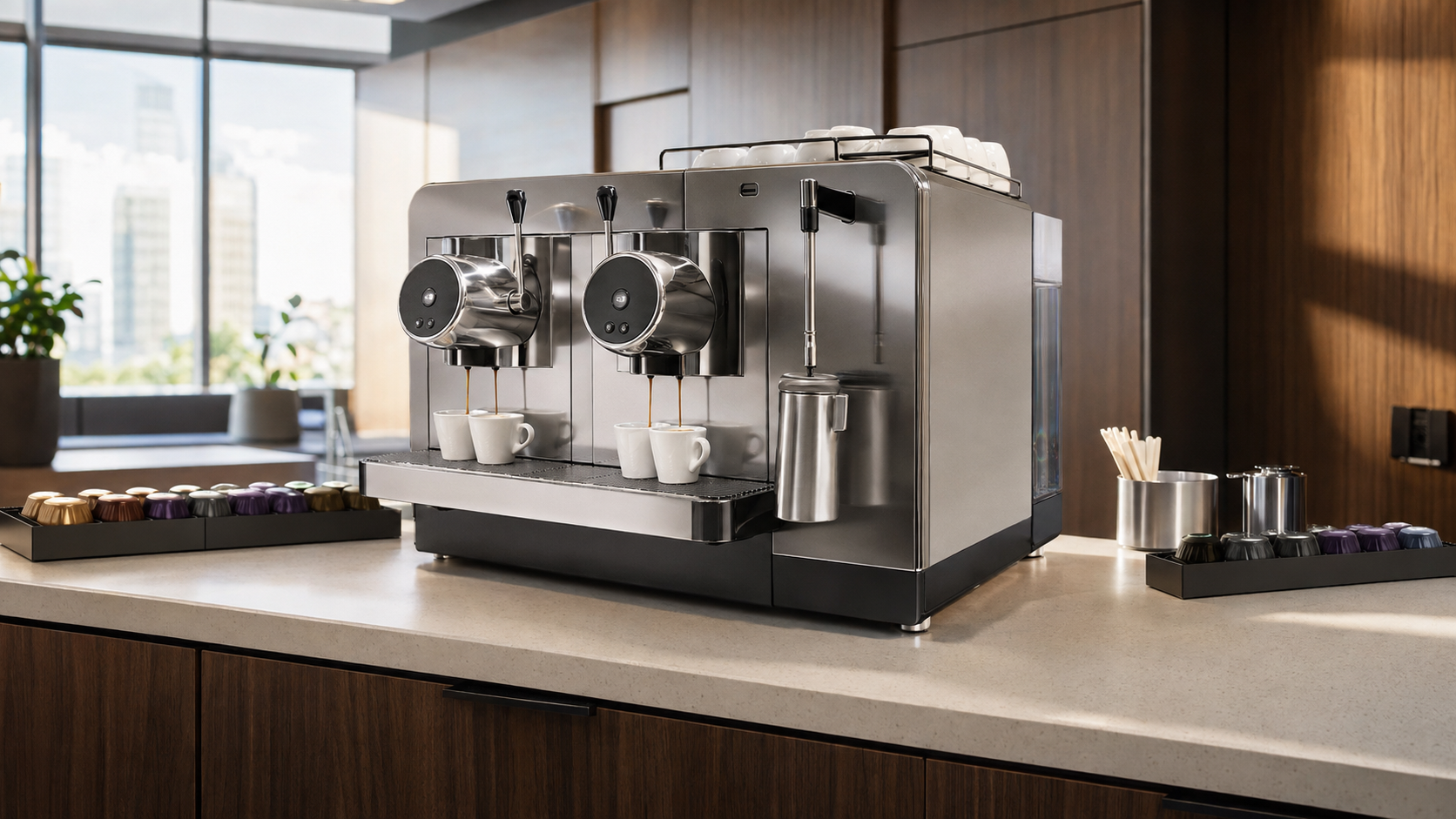
Nespresso Gemini CS 220 Pro review findings show that this dual-head commercial capsule machine is designed for offices, meeting spaces, hotels, and hospitality venues that need fast, consistent coffee without operating a traditional espresso bar. It combines two simultaneous coffee extraction positions with a dedicated milk-frothing system, hot-water function, large water capacity, and simple programmable controls.
Unlike compact single-head machines, the Gemini CS 220 Pro can prepare two coffees at the same time. This reduces queues during morning rushes, conference breaks, and catered events while allowing users to select different capsules and cup sizes independently.
The milk system can also prepare cappuccinos and latte macchiatos without requiring employees to operate a traditional steam wand. However, the disposable milk components, cleaning procedure, capsule costs, and machine size must all be considered before installation.
Quick Verdict
Nespresso Gemini CS 220 Pro Rating: 4.4/5
The Gemini CS 220 Pro is best for businesses needing:
- Two simultaneous coffee extractions
- Consistent capsule coffee
- Cappuccino and latte preparation
- Minimal employee training
- Large removable water capacity
- Optional direct water connection
- Fast hot-water dispensing
- Simple self-service operation
- No grinder or manual tamping
- Reliable peak-period performance
It may not be suitable when:
- Daily coffee demand is low
- Counter space is limited
- Freshly ground specialty coffee is essential
- Several milk alternatives must be accommodated
- Disposable milk components are undesirable
- Nespresso Professional capsules are difficult to obtain locally
- Staff cannot complete the required daily cleaning
- A newer touchscreen interface is preferred
Businesses wanting a newer dual-head system focused mainly on black coffee should compare it with our Nespresso Momento 200 review. Smaller offices may find the single-head machine covered in our Nespresso Zenius review more practical.
What Is the Nespresso Gemini CS 220 Pro?
The Nespresso Gemini CS 220 Pro is a commercial coffee machine that uses flat, disc-shaped Nespresso Professional capsules. It does not accept Nespresso Original or Vertuo capsules intended for domestic machines.
Its principal features include:
- Two independent coffee extraction heads
- Simultaneous preparation of two coffees
- Three programmable coffee sizes
- Dedicated milk-frothing system
- High-speed hot-water outlet
- Six-liter removable water capacity
- Optional direct water connection
- Digital multilingual display
- Cup-warming surface
- Semi-automatic capsule insertion and ejection
- Used-capsule storage for approximately 70 capsules
- Descaling and maintenance alerts
The machine is intended for locations that need more capacity than a standard single-head office brewer but do not require the enormous output of the four-head Aguila 440.
Typical locations include:
- Medium and large offices
- Hotel meeting rooms
- Conference facilities
- Corporate reception areas
- Staff break rooms
- Premium retail showrooms
- Training centers
- Coworking spaces
- Small hospitality venues
- Executive lounges
Current regional availability can vary because the Gemini range has been replaced by newer systems in some markets while remaining available in others. Specifications and business purchasing arrangements can be checked on the official Nespresso Professional Gemini 220 page.
Nespresso Gemini CS 220 Pro Specifications
Specifications can differ slightly according to region and machine version. The following table provides a practical overview of commonly published Gemini 220 information.
| Specification | Nespresso Gemini CS 220 Pro |
|---|---|
| Machine Type | Commercial capsule coffee machine |
| Capsule System | Nespresso Professional |
| Coffee Extraction Heads | Two |
| Simultaneous Coffees | Up to two |
| Coffee Sizes | Ristretto, espresso, and lungo |
| Milk System | Dedicated milk-frothing function |
| Hot-Water Function | Yes |
| Water Capacity | Approximately 6 liters total |
| Water Supply | Removable tanks or supported direct connection |
| Used-Capsule Capacity | Approximately 70 capsules |
| Pump Pressure | Up to 19 bar, depending on regional specification |
| Power Rating | Approximately 2,410 watts |
| Dimensions | Approximately 56 × 39.2–42 × 37 cm |
| Weight | Approximately 18 kg |
| Interface | Digital multilingual display and dedicated buttons |
| Cup Warming | Yes |
| Descaling Alert | Yes |
| Energy-Saving Mode | Yes |
The dimensions make the Gemini CS 220 Pro considerably wider than most domestic Nespresso machines. Businesses must allow additional space for cups, capsules, milk preparation, waste disposal, and access to both extraction heads.
The approximately 18 kg weight is manageable for commercial equipment, but the machine should remain on a strong, level, moisture-resistant counter. It is not designed to be moved around the office every time someone wants the good meeting room.
1. Dual-Head Extraction Reduces Coffee Queues
The most important feature identified in this Nespresso Gemini CS 220 Pro review is its dual-head extraction system. Two users can prepare separate coffees at the same time, or one trained employee can operate both sides during a busy period.
Each extraction position allows an individual capsule and drink selection. This means one side can prepare an espresso while the other produces a lungo using a completely different capsule variety.
When Two Extraction Heads Matter
Dual-head operation is especially useful during:
- Morning arrival periods
- Conference refreshment breaks
- Staff lunch breaks
- Large internal meetings
- Hotel breakfast service
- Training events
- Client presentations
- Corporate receptions
- Showroom events
- Catered functions
Consider an office that needs to prepare 30 black coffees in a short period. A single-head machine must complete 30 consecutive extractions. The Gemini can theoretically process them in 15 pairs, reducing the extraction portion of the wait considerably.
Actual service speed still depends on:
- Coffee size
- Capsule-loading speed
- Cup placement
- User experience
- Water availability
- Milk-drink demand
- Hot-water use
- Waste-container capacity
- Cleaning or rinse interruptions
Businesses needing four extraction positions for much larger crowds should read our Nespresso Aguila 440 review. The Gemini is better suited to moderate commercial demand where two heads provide sufficient capacity.
Independent Coffee Selection
Users do not have to prepare identical drinks. One person may select a decaffeinated espresso while another prepares a full-strength lungo.
This independence provides several benefits:
- Shorter waiting times
- Greater capsule variety
- Separate drink sizes
- Easier decaffeinated service
- Better peak-period workflow
- Less dependence on one operator
- Improved self-service convenience
The dual-head format provides more practical capacity than simply increasing the size of a water tank. A large tank reduces refilling, but a second extraction head directly increases the number of coffees that can be prepared during a short rush.
2. It Uses Nespresso Professional Capsules
The Gemini CS 220 Pro uses Nespresso Professional capsules rather than Original or Vertuo capsules.
Professional capsules have a flatter, disc-like shape and are developed for Nespresso’s commercial machines. They are generally ordered through Nespresso’s business service or an authorized regional supplier.
Available selections may include:
- Mild espresso
- Medium-roast coffee
- Intense espresso
- Lungo varieties
- Decaffeinated capsules
- Single-origin options
- Flavored coffee
- Capsules intended for milk recipes
The exact range varies by country. Capsule pricing, minimum-order requirements, delivery schedules, and recycling services can also depend on the local commercial agreement.
Why the Capsule Format Works in Offices
Capsules simplify beverage preparation because each one contains a measured quantity of ground coffee.
Operational advantages include:
- No grinder calibration
- No weighing coffee
- No manual tamping
- Consistent serving volumes
- Minimal loose grounds
- Faster employee training
- Predictable capsule inventory
- Less preparation mess
- Easy switching between coffee varieties
- Consistent results across many users
The main disadvantage is limited control. Users cannot change grind size, coffee dose, tamping pressure, or extraction time as they could with a traditional espresso machine.
Our guide explaining how Nespresso machines work covers the capsule-puncturing and extraction process in greater detail.
Professional Capsules Are Not Interchangeable
The Gemini cannot use:
- Nespresso Original capsules
- Nespresso Vertuo capsules
- Keurig K-Cups
- Dolce Gusto capsules
- ESE coffee pods
- Loose ground coffee
- Whole coffee beans
Businesses should confirm that Professional capsules are readily available and understand the ordering agreement before acquiring a used Gemini machine.
A pre-owned machine offered at an attractive price may become an expensive countertop ornament if compatible capsules and technical support are unavailable. It would still look impressively corporate, but coffee production is generally considered the more useful feature.
3. Coffee Quality Focuses on Repeatability
This Nespresso Gemini CS 220 Pro review finds that coffee quality is consistent and practical rather than highly customizable.
The sealed capsule format protects the coffee from prolonged exposure to air, moisture, and light before use. The machine then controls water delivery and beverage volume according to the selected recipe.
Depending on the capsule, flavor notes may include:
- Cocoa
- Roasted cereal
- Caramel
- Nuts
- Wood
- Spice
- Red fruit
- Mild floral tones
- Toasted aromas
Coffee strength depends on both capsule selection and programmed beverage volume. A strong capsule may taste balanced as an espresso but become too diluted when extracted into an oversized cup.
Ristretto, Espresso, and Lungo
The three standard programmable sizes serve different preferences:
- Ristretto: A short, concentrated drink with an intense aroma
- Espresso: A balanced small coffee suitable alone or with milk
- Lungo: A longer and generally milder black coffee
Businesses should program volumes to match their actual cups. Incorrect settings may create weak coffee, overflowing cups, or inconsistent presentation.
The Gemini does not offer the same extraction control as a bean-to-cup or traditional espresso system. Businesses deciding between capsules and freshly ground coffee can read our Nespresso vs espresso machine comparison.
4. The Milk System Expands the Beverage Menu
The CS 220 version adds a dedicated milk-frothing function that distinguishes it from coffee-focused Gemini variants.
It can support drinks such as:
- Cappuccino
- Latte macchiato
- Caffè latte
- Espresso macchiato
- Hot milk
- Milk foam
- Customized coffee-and-milk combinations
The system uses a milk container together with model-specific milk components. Some configurations use disposable straws and frothing nozzles to simplify hygiene and reduce milk residue inside reusable parts.
Easier Than Manual Steam Frothing
A traditional steam wand requires the operator to control aeration, temperature, texture, and pitcher position. The Gemini system reduces those skills, making milk beverages more accessible to office employees and hospitality staff.
Benefits include:
- Shorter training time
- More consistent milk portions
- Faster cappuccino preparation
- No separate countertop frother
- Less manual milk handling
- Easier self-service operation
- Reduced dependence on barista skills
However, the milk texture is unlikely to match the fine microfoam produced by an experienced barista. The Gemini prioritizes reliable workplace drinks over elaborate latte art.
Businesses requiring fully automated fresh-milk recipes and greater commercial capacity should compare it with our Nespresso Aguila 220 review.
Milk Alternatives Require Testing
Oat, soy, and almond products vary considerably in protein, fat, sugar, and stabilizer content. These differences affect foam volume, stability, temperature, and flavor.
Before introducing plant-based milk, businesses should confirm:
- Product compatibility
- Frothing performance
- Correct milk temperature
- Disposable component requirements
- Cleaning procedure
- Allergen cross-contact risks
- Local food-safety obligations
Barista-style plant-based products often foam more reliably, but the results should be tested with the exact machine and intended recipes.
5. Six-Liter Water Capacity Supports Busy Service
The Gemini CS 220 Pro commonly provides approximately six liters of total removable water capacity. This is significantly larger than the tanks found in most domestic capsule machines and helps reduce interruptions in offices, meeting facilities, and hospitality environments.
A larger water supply is useful when preparing:
- Consecutive espresso and lungo drinks
- Two coffees simultaneously
- Multiple milk-based beverages
- Hot water for tea
- Drinks during conference breaks
- Coffee for large internal meetings
- Morning beverages for an entire department
Actual drink capacity depends on the programmed coffee volume, rinsing cycles, hot-water use, and milk-system operation.
For example, six liters could theoretically provide:
- Approximately 150 servings at 40 ml each
- Approximately 60 servings at 100 ml each
- Approximately 30 servings at 200 ml each
These figures do not account for rinsing, cleaning, steam, or other water consumption. The practical number of drinks will therefore be lower.
Removable Tanks Versus Direct Water Connection
The removable water tanks make the machine easier to install where permanent plumbing is unavailable. Staff can refill the machine manually without modifying the building’s water supply.
Manual filling works best when:
- Daily demand is moderate
- The sink is located nearby
- Staff regularly monitor water levels
- Permanent plumbing is not permitted
- The machine may need to be relocated
- Coffee is served mainly during limited periods
However, carrying several liters of water repeatedly can become inconvenient during busy service. A supported direct water connection may offer a more practical solution for high-volume locations.
Direct plumbing can:
- Reduce manual refilling
- Maintain service during busy periods
- Improve staff efficiency
- Prevent queues caused by empty tanks
- Support frequent hot-water use
- Simplify operation in staffed hospitality areas
Professional installation is essential. Water pressure, filtration, hose routing, shutoff access, local plumbing regulations, and drainage requirements must all be checked before connecting the machine.
Water Filtration Affects Flavor and Reliability
Coffee consists primarily of water, so poor water quality can noticeably affect the cup.
Suitable filtration may help reduce:
- Chlorine-related flavors
- Unpleasant odors
- Excessive mineral buildup
- Inconsistent coffee taste
- Scale inside heating components
- Maintenance interruptions
The correct filtration system depends on local water hardness and daily consumption. A filter cartridge must also be replaced on schedule; an exhausted filter is essentially a decorative plumbing accessory.
6. Dedicated Hot Water Makes the Machine More Versatile
A dedicated hot-water function allows the Gemini CS 220 Pro to serve users who want more than capsule coffee.
Hot water may be used for:
- Tea
- Herbal infusions
- Americano-style beverages
- Preheating ceramic cups
- Other approved workplace drinks
Separating the hot-water outlet from the coffee extraction heads helps prevent users from running excessive water through a capsule to create a longer drink. This can produce a cleaner Americano-style beverage and reduce over-extraction.
Our guide to Americano vs drip coffee explains how espresso-based Americanos differ from conventional filtered coffee.
Tea Service Still Needs Planning
Although the hot-water function adds flexibility, one temperature may not be ideal for every tea. Delicate green tea generally benefits from cooler water than black tea or many herbal infusions.
Businesses should consider:
- Available water-temperature settings
- Cup size
- Tea-bag disposal
- Separate stirrers
- Milk and sugar placement
- Queue congestion
- Cross-contamination around the outlet
If many employees primarily drink tea, a separate commercial hot-water dispenser may be more efficient than placing all demand on the coffee machine.
7. Controls Are Designed for Shared Use
The digital display and dedicated beverage buttons are intended to make operation manageable for employees who have little coffee-making experience.
A typical black-coffee workflow involves:
- Position a cup beneath an available extraction head.
- Open the capsule mechanism.
- Insert a Nespresso Professional capsule.
- Close the mechanism securely.
- Select ristretto, espresso, or lungo.
- Wait for the programmed extraction to finish.
- Remove the drink and check the outlet area.
Because the two coffee heads operate independently, another user can follow the same process on the opposite side.
Programmable Coffee Volumes
Drink volumes can generally be programmed to suit the venue’s cups and preferred recipes. Correct programming is important because a mismatch may produce:
- Weak coffee
- Overflowing cups
- Insufficient room for milk
- Inconsistent serving sizes
- Poor flavor balance
- Unnecessary capsule complaints
Businesses should choose a limited set of clearly labeled cup sizes and test each programmed volume before allowing self-service use.
Programming access should be restricted to trained staff. If every employee adjusts the lungo button according to personal preference, the machine will soon offer less consistency than the office microwave.
Multilingual Display and Alerts
Depending on the regional version, the display may provide several language options and operational alerts.
Messages may relate to:
- Empty water tanks
- Full used-capsule containers
- Required descaling
- Cleaning procedures
- Heating status
- Machine faults
- Maintenance requirements
Staff should understand common alerts and know which problems they can safely resolve. Persistent fault messages, leaks, electrical issues, or internal failures should be referred to authorized service personnel.
8. The Milk-Frothing Workflow Requires Organization
The dedicated milk function makes cappuccino and latte preparation easier, but it introduces additional steps compared with black coffee.
A typical workflow may require:
- Filling or positioning the approved milk container
- Attaching the correct milk straw or component
- Placing the cup beneath the milk outlet
- Selecting the required frothing function
- Extracting coffee from one of the two coffee heads
- Combining coffee and milk in the correct order
- Removing or discarding designated milk components
- Cleaning the milk-contact area
The exact procedure varies by configuration, so operators must follow the official instructions supplied with their machine.
Disposable Milk Components
Some Gemini CS 220 Pro configurations use disposable milk straws and nozzles. These can reduce the amount of milk residue remaining in reusable pathways and simplify parts of the hygiene process.
Potential advantages include:
- Convenient replacement
- Reduced manual washing
- More predictable milk contact
- Easier staff training
- Lower risk of reusing a dirty component
- Faster preparation between certain drinks
Potential disadvantages include:
- Ongoing supply costs
- Additional plastic waste
- Storage requirements
- Risk of running out during service
- Dependence on compatible replacement parts
- Staff using components incorrectly
Before purchasing a used machine, confirm that the correct disposable milk parts remain available locally. The machine’s milk feature offers little value if its essential components have vanished into the great warehouse in the sky.
Dairy and Plant-Based Milk Management
Serving several milk types can complicate the workflow. Each product may require its own container, straw, nozzle, labeling, and cleaning routine.
Businesses should avoid making an allergen-free claim unless the complete milk pathway and operating procedure support it. Using a clean straw does not necessarily guarantee that every internal or external contact point is fully separated.
Where strict allergen control is required, a separate approved frother may be safer and easier to manage.
9. Peak Demand Matters More Than Daily Volume
A venue might serve only 80 drinks per day yet still need a dual-head machine if 40 of those drinks are ordered within one short meeting break.
This Nespresso Gemini CS 220 Pro review recommends measuring demand during the busiest 15–30 minutes rather than relying only on the daily total.
Useful questions include:
- How many people request coffee simultaneously?
- What percentage choose espresso or lungo?
- How many order milk drinks?
- How frequently is hot water used?
- Will one employee operate both extraction heads?
- Can two users stand comfortably at the machine?
- How often must water be replenished?
- When will the capsule container become full?
- Are cups and capsules positioned efficiently?
- Could milk preparation become the bottleneck?
Example Office Rush
Suppose an office needs 36 beverages during a 20-minute client break:
- 18 lungos
- 8 espressos
- 6 cappuccinos
- 4 teas
The dual heads can process the 26 black coffees efficiently, but milk preparation and hot-water use may slow the overall workflow.
A practical station could include:
- Cups beside both extraction heads
- Capsules organized by intensity
- Decaffeinated capsules clearly separated
- Milk supplies on one side
- Tea supplies beyond the coffee area
- Sugar and stirrers near the collection point
- A waste bin away from waiting users
- One employee monitoring water and capsule waste
Two extraction heads improve capacity, but an unplanned counter can still create a queue worthy of an airport security checkpoint.
10. A Well-Designed Coffee Station Improves Performance
The Gemini CS 220 Pro is approximately 56 cm wide, but the complete station requires more space than the machine alone.
The surrounding counter should accommodate:
- Access to both extraction heads
- Ceramic or disposable cups
- Professional capsule storage
- Milk container and components
- Sugar and sweeteners
- Stirrers and napkins
- Tea supplies
- Used packaging disposal
- Cleaning materials
- Safe access for refilling water
- Technician service clearance
Users should be able to collect completed drinks without blocking people loading capsules.
Recommended Workflow
A practical left-to-right arrangement might be:
- Select a cup.
- Choose a capsule.
- Prepare coffee or milk.
- Collect the finished drink.
- Add sugar or a lid.
- Dispose of waste beyond the collection area.
This layout separates preparation from customization and reduces congestion around the controls.
Cup-Warming Surface
The upper warming area can help prevent hot coffee from losing temperature immediately when poured into cold ceramic.
Cups should be:
- Clean and completely dry
- Suitable for warming
- Stacked within recommended limits
- Positioned without blocking ventilation
- Removed carefully when hot
Plastic cups, sealed items, food, and unrelated office supplies should not be stored on the warming surface.
11. Used-Capsule Capacity Reduces Frequent Emptying
The Gemini CS 220 Pro commonly stores approximately 70 used capsules before its container requires emptying.
This capacity is convenient for offices because employees do not need to remove capsule waste after every short service period. However, the container should be checked before large meetings or events.
Staff should:
- Follow full-container alerts
- Empty the bin before peak periods
- Check for accumulated liquid
- Wear appropriate gloves
- Clean the waste compartment regularly
- Avoid compressing capsules by hand
- Follow local recycling arrangements
Nespresso Professional recycling services vary by country and commercial agreement. Businesses should confirm collection procedures directly with their regional provider.
A machine containing 70 used capsules is technically demonstrating strong productivity. It is also politely requesting that someone empty it.
12. Installation Is Easier Than the Aguila Range
At approximately 18 kg, the Gemini CS 220 Pro is much lighter and more compact than machines such as the Aguila 220 or Aguila 440. Nevertheless, it still requires a stable commercial installation area.
The counter should be:
- Level and structurally sound
- Resistant to heat and moisture
- Deep enough for the machine
- Convenient for water refilling
- Close to an appropriate electrical outlet
- Clear of sink splashes
- Accessible for cleaning
- Suitable for service and ventilation clearances
Electrical specifications may differ by region. The correct voltage, plug, current, and rated power must be confirmed from the machine label and official regional documentation.
Extension leads, overloaded power strips, and unsuitable adapters should not be used with high-powered commercial coffee equipment.
Buying a Used Gemini CS 220 Pro
Because availability varies by market, some businesses may encounter the machine primarily through used-equipment sellers.
Before purchasing, check:
- Exact model and serial number
- Regional electrical compatibility
- Professional capsule availability
- Milk-component availability
- Water-tank condition
- Direct-connect accessories
- Extraction from both heads
- Hot-water performance
- Milk-frothing operation
- Error-message history
- Scale and leakage
- Service records
- Authorized technical support
- Warranty or return policy
A low purchase price does not compensate for unavailable parts, incompatible electricity, or a failed milk system. Commercial coffee equipment can be wonderfully economical—right up until it develops an expensive personality.
Cleaning and Maintenance Requirements
Daily maintenance is one of the most important considerations in this Nespresso Gemini CS 220 Pro review. The capsule system reduces loose coffee grounds and eliminates grinder cleaning, but it does not make the machine maintenance-free.
The required routine may vary by regional model and milk-system configuration. Staff should always follow the official instructions supplied with the exact machine.
Suggested Daily Cleaning Routine
A practical closing routine may include:
- Remove and discard used milk straws or nozzles where applicable.
- Clean reusable milk-contact components according to the instructions.
- Wipe the milk outlet and surrounding area.
- Empty and wash the milk container.
- Run the required milk-system cleaning or rinsing procedure.
- Empty the used-capsule container.
- Remove and wash the drip trays and grids.
- Wipe both coffee outlets.
- Clean the hot-water outlet carefully.
- Wipe the display, buttons, handles, and exterior surfaces.
- Refill or clean the water tanks as required.
- Check for leaks, warnings, or damaged components.
Only approved cleaning products should be used. Abrasive pads, harsh chemicals, and excessive water around electrical components may damage the machine.
Cleaning During the Day
Busy locations may also need shorter maintenance checks between major service periods.
Staff should monitor:
- Milk temperature and freshness
- Milk spills and residue
- Coffee splashes around both heads
- Drip-tray levels
- Used-capsule capacity
- Water levels
- Hot-water outlet cleanliness
- Cup-warming area
- Countertop hygiene
- Disposable milk-component supplies
Milk should not remain at unsafe temperatures, and fresh milk should not continually be poured on top of old milk. Any unused product must be handled according to local food-safety requirements.
Assign Responsibility
A written schedule should identify who is responsible for:
- Opening inspection
- Water refilling
- Milk preparation
- Capsule restocking
- Midday cleaning
- Waste-container checks
- Closing cleaning
- Fault reporting
- Ordering disposable components
- Arranging professional service
Shared equipment often suffers when everyone is responsible in theory and nobody is responsible in practice. Coffee machines, like houseplants and office printers, notice this immediately.
Descaling and Water-System Care
Minerals in water can accumulate inside heating components, valves, pipes, and outlets. This scale may reduce performance and eventually cause faults.
Possible warning signs include:
- Reduced coffee flow
- Lower drink temperature
- Increased heating time
- Unusual machine noise
- Inconsistent serving volumes
- Hot-water problems
- Descaling alerts
- Changes in coffee flavor
The Gemini CS 220 Pro commonly provides a descaling alert, but businesses should not wait for performance to deteriorate before taking action.
Follow the Correct Descaling Procedure
Use only the approved descaling product and the official procedure for the exact machine. The process may involve both extraction heads and the hot-water circuit.
Household vinegar is not an appropriate substitute unless the manufacturer specifically approves it. It may leave odors, damage components, or fail to remove scale effectively.
Our general guide on how to clean a Nespresso machine explains basic capsule-machine maintenance, although a commercial Gemini must be serviced according to its dedicated instructions.
Water Filters Need Replacement
A suitable filter may reduce chlorine-related flavors and control mineral buildup, but it has a limited operating life.
Replacement frequency depends on:
- Local water hardness
- Daily beverage volume
- Hot-water use
- Cartridge capacity
- Manufacturer recommendations
- Direct-plumbing configuration
- Previous scale problems
Record each filter-installation date and planned replacement date. An expired cartridge cannot protect the machine merely through positive thinking.
Professional Servicing and Replacement Parts
The Gemini CS 220 Pro contains pumps, heating elements, valves, electronic controls, extraction mechanisms, and milk-system components that should not be dismantled by untrained employees.
Professional assistance may be required for:
- One extraction head failing
- Slow or inconsistent coffee flow
- Water leaks
- Persistent error messages
- Hot-water failure
- Milk-frothing problems
- Damaged capsule mechanisms
- Electrical faults
- Unusual noises
- Repeated overheating
- Internal blockages
- Worn seals or hoses
- Display or button failure
Before buying a new or used machine, confirm whether authorized service remains available for the exact model and serial number.
Older commercial equipment can become difficult to maintain when:
- Original parts are discontinued
- Disposable milk components are unavailable
- Local technicians no longer support the model
- Software or control boards cannot be replaced
- Regional electrical specifications differ
- Service history is missing
A used Gemini should ideally be inspected and tested by a qualified commercial coffee-machine technician before purchase.
Nespresso Gemini CS 220 Pro Operating Costs
The purchase price represents only part of the total expense. This Nespresso Gemini CS 220 Pro review recommends calculating both the initial investment and ongoing costs.
Recurring expenses may include:
- Nespresso Professional capsules
- Dairy or plant-based milk
- Disposable milk straws and nozzles
- Cleaning products
- Descaling solution
- Water-filter cartridges
- Electricity
- Preventive servicing
- Replacement parts
- Emergency repairs
- Disposable cups and lids
- Sugar, stirrers, and napkins
- Capsule delivery charges
- Recycling or waste collection
- Staff cleaning time
- Staff restocking time
Commercial capsule prices and service arrangements vary by location, order volume, supplier, and contract. Request current written pricing rather than relying on old listings for a discontinued or regionally limited machine.
Illustrative Cost per Cappuccino
The figures below are examples only and do not represent current Nespresso pricing.
| Cost component | Example cost |
|---|---|
| Professional capsule | $0.70 |
| Fresh milk | $0.30 |
| Disposable milk components | $0.12 |
| Cup and lid | $0.20 |
| Cleaning and filtration allowance | $0.10 |
| Service allowance | $0.18 |
| Estimated cost per drink | $1.60 |
Using reusable ceramic cups may reduce packaging expenses. Plant-based milk, premium capsules, frequent servicing, and higher-cost replacement components may increase the final amount.
Calculate Total Ownership Cost
Before making a decision, estimate:
- Purchase or rental price
- Installation expenses
- Capsule cost per month
- Average milk use
- Disposable-component consumption
- Filter and cleaning costs
- Annual servicing
- Expected repair expenses
- Staff time
- Expected equipment life
- Residual or resale value
- Cost of a newer alternative
A low used-machine price can appear attractive until discontinued parts, service visits, and milk accessories enter the conversation wearing expensive shoes.
Nespresso Gemini CS 220 Pro Pros and Cons
Pros
- Two independent coffee extraction heads
- Up to two simultaneous coffees
- Suitable for concentrated office demand
- Dedicated milk-frothing system
- Cappuccino and latte preparation
- Three programmable coffee sizes
- Large total water capacity
- Optional direct water connection in supported configurations
- Dedicated hot-water function
- Digital multilingual display
- Cup-warming surface
- Approximately 70-capsule waste capacity
- No grinder calibration
- No manual dosing or tamping
- Minimal loose coffee grounds
- Consistent capsule portions
- Straightforward shared operation
- Lower training demands than a traditional espresso machine
Cons
- Large footprint compared with domestic machines
- Uses only Nespresso Professional capsules
- Cannot grind fresh coffee beans
- Limited extraction control
- Milk texture may not match barista microfoam
- Disposable milk components create ongoing waste
- Replacement milk parts may be difficult to source
- Daily milk cleaning is necessary
- Plant-based milk performance varies
- Allergen separation requires careful management
- Capsule costs accumulate quickly
- Current availability differs by region
- Older machines may have limited service support
- A newer interface may be easier for self-service users
- Excessive capacity for small offices
Nespresso Gemini CS 220 Pro vs Momento 200
Both machines provide two extraction positions, but their design and beverage capabilities differ.
| Feature | Gemini CS 220 Pro | Momento 200 |
|---|---|---|
| Coffee extraction heads | Two | Two |
| Simultaneous coffees | Up to two | Up to two |
| Integrated milk function | Yes | No integrated fresh-milk system |
| Interface | Buttons and digital display | Newer touchscreen interface |
| Water supply | Tanks or supported direct connection | Commercial installation options vary |
| Best use | Coffee and milk drinks | Primarily black coffee |
| Milk maintenance | Required | Lower |
| Disposable milk parts | May be required | No |
| Model generation | Older | Newer |
| Ideal location | Offices needing cappuccinos | Busy self-service offices |
The Gemini CS 220 Pro is more practical when automated milk preparation is essential and compatible components remain available.
The Momento 200 is likely the better choice when most users prefer espresso, lungo, or Americano-style drinks and the business wants a newer user interface with less milk-related cleaning.
Read our complete Nespresso Momento 200 review for its capacity, operating requirements, and ideal users.
Nespresso Gemini CS 220 Pro vs Aguila 220
The Aguila 220 is a substantially larger and more sophisticated fresh-milk commercial system.
| Feature | Gemini CS 220 Pro | Aguila 220 |
|---|---|---|
| Coffee extraction heads | Two | Two |
| Coffee format | Professional capsules | Professional capsules |
| Milk preparation | Dedicated frothing function | Integrated refrigerated milk system |
| Approximate milk capacity | External container-dependent | Around 5 liters |
| Automated milk recipes | More limited | Extensive |
| Cold milk foam | Configuration-dependent | Yes |
| Installation complexity | Moderate | High |
| Approximate weight | 18 kg | About 90 kg |
| Counter requirement | Substantial | Very substantial |
| Cleaning workload | Moderate to high | Intensive |
| Best use | Offices and meeting facilities | High-volume hospitality venues |
Choose the Gemini when beverage demand is moderate, removable water tanks are useful, and the venue does not require a large refrigerated milk system.
Choose the Aguila 220 when automated fresh-milk recipes, large milk capacity, and intensive commercial service justify the greater installation and maintenance requirements.
Our Nespresso Aguila 220 review provides a detailed analysis of that machine.
Nespresso Gemini CS 220 Pro vs Zenius
The Zenius is a compact, single-head Nespresso Professional machine designed for lower-volume workplaces.
| Feature | Gemini CS 220 Pro | Zenius |
|---|---|---|
| Coffee extraction heads | Two | One |
| Simultaneous coffees | Two | One |
| Milk system | Dedicated frothing function | Separate solution required |
| Water capacity | Approximately 6 liters | Approximately 2.3 liters |
| Used-capsule capacity | Approximately 70 | Approximately 25 |
| Footprint | Large | Compact |
| Peak-period speed | High | Moderate |
| Best use | Medium and large offices | Small offices and meeting rooms |
| Cleaning complexity | Higher | Lower |
| Portability | Limited | Better |
The Gemini is the stronger option when queues occur regularly and milk drinks are important.
The Zenius may provide better value when employees mostly drink black coffee, demand is gradual, and counter space is limited. See our full Nespresso Zenius review for more information.
Nespresso Gemini CS 220 Pro vs Traditional Espresso Machine
The Gemini emphasizes convenience and consistency, while a traditional espresso setup offers greater control and specialty-coffee potential.
| Consideration | Gemini CS 220 Pro | Traditional espresso machine |
|---|---|---|
| Coffee format | Professional capsules | Freshly ground beans |
| Grinder required | No | Yes |
| Manual tamping | No | Yes |
| Extraction control | Limited | Extensive |
| Milk preparation | Assisted frothing | Manual steam wand |
| Training requirement | Relatively low | Moderate to extensive |
| Drink consistency | High | Operator-dependent |
| Latte-art potential | Limited | High |
| Loose coffee waste | Minimal | Greater |
| Peak workflow | Dual extraction | Depends on equipment and staff |
| Coffee customization | Limited | High |
| Best use | Offices and shared spaces | Cafés and skilled hospitality teams |
A specialty café should normally choose a traditional espresso system because customers expect freshly ground coffee, customized extraction, and finely textured milk.
The Gemini is more appropriate for offices, meeting centers, and hospitality areas where many users must prepare predictable drinks with limited training.
Who Should Buy the Nespresso Gemini CS 220 Pro?
The machine may be a good fit for:
- Medium or large offices
- Corporate meeting centers
- Conference facilities
- Hotel meeting rooms
- Training venues
- Executive lounges
- Coworking spaces
- Premium staff break rooms
- Showrooms serving clients
- Locations experiencing short coffee queues
- Businesses needing two simultaneous coffees
- Venues wanting cappuccinos without a steam wand
- Teams able to maintain the milk system
- Buyers with reliable access to capsules, parts, and servicing
Its strongest advantage is not simply the number of drinks served each day. It is the ability to prepare two coffees during concentrated periods while also supporting milk beverages.
Who Should Skip It?
Consider another machine if:
- Fewer than a few people request coffee at once
- Counter space is limited
- Most users drink only occasional black coffee
- Freshly ground beans are essential
- Manual flavor control is a priority
- Staff cannot complete daily cleaning
- Compatible milk components are unavailable
- Authorized local service cannot be confirmed
- Several allergen-separated milk choices are required
- Disposable plastic components conflict with sustainability goals
- A current touchscreen system is preferred
- Repairing an older unit would exceed the budget
Small workplaces may find the Nespresso Zenius sufficient. Larger venues needing highly automated refrigerated milk service should compare the Nespresso Aguila 220.
Frequently Asked Questions
Is the Nespresso Gemini CS 220 Pro discontinued?
Availability differs by country. The Gemini range has been replaced by newer Nespresso Professional machines in some markets, while the Gemini 220 may still be supplied or supported in others.
Before purchasing, confirm current availability, capsule supply, replacement milk components, technical service, and warranty coverage with the regional Nespresso Professional representative.
Can the Gemini CS 220 Pro make two coffees simultaneously?
Yes. Its two independent extraction heads can prepare up to two coffees at the same time. Each side can use a different Nespresso Professional capsule and beverage size.
This dual-head design is particularly useful during morning arrivals, meetings, conferences, and other concentrated service periods.
Does it use regular Nespresso capsules?
No. The Gemini CS 220 Pro uses flat, disc-shaped Nespresso Professional capsules.
It is not compatible with:
- Nespresso Original capsules
- Nespresso Vertuo capsules
- Dolce Gusto capsules
- Keurig K-Cups
- ESE pods
- Loose ground coffee
- Whole coffee beans
Businesses considering a used machine should verify Professional capsule availability before purchasing.
What drinks can the Gemini CS 220 Pro prepare?
The machine can support drinks including:
- Ristretto
- Espresso
- Lungo
- Cappuccino
- Latte macchiato
- Caffè latte
- Espresso macchiato
- Hot milk
- Milk foam
- Americano-style coffee
- Hot water for tea
Available functions may vary slightly according to the exact regional configuration.
Does the Gemini CS 220 Pro have a milk system?
Yes. The CS 220 Pro includes a dedicated milk-frothing function designed to simplify cappuccino and latte preparation.
Some configurations use disposable milk straws and nozzles. Owners must verify that compatible components remain available and follow the official cleaning and food-safety procedures.
Can it froth oat or soy milk?
The machine may froth certain plant-based products, but results depend on their protein, fat, sugar, and stabilizer content.
Barista-style oat, soy, or almond milk often performs more reliably. Test the intended product with the machine before adding it to the permanent menu.
Using separate disposable components may reduce direct contact, but it does not automatically guarantee complete allergen separation.
How large is the water capacity?
The Gemini CS 220 Pro commonly provides approximately six liters of total removable water capacity.
Some configurations may also support a direct water connection. Installation requirements and included accessories should be confirmed for the exact machine.
How many used capsules does it hold?
The used-capsule container commonly holds approximately 70 Professional capsules.
Staff should empty it before large meetings or service periods instead of waiting for the full-container alert.
How often should the machine be cleaned?
Coffee outlets, milk-contact components, drip trays, used-capsule storage, controls, and surrounding surfaces require regular cleaning.
The milk system should receive particular attention every day. Exact procedures depend on the machine configuration, so staff must follow the official operating and cleaning instructions.
Does the Gemini CS 220 Pro require plumbing?
Not necessarily. Its removable water tanks allow manual filling where permanent plumbing is unavailable.
A supported direct connection may be preferable in busy locations, but it should be installed professionally after checking water pressure, filtration, hose routing, shutoff access, and regional plumbing requirements.
Is it suitable for a small office?
Usually, the Gemini CS 220 Pro is more machine than a small office needs. A compact single-head model may cost less, occupy less counter space, and require simpler maintenance.
Our Nespresso Zenius review covers a smaller Professional capsule machine designed for lighter workplace demand.
Is buying a used Gemini CS 220 Pro a good idea?
A used Gemini can provide value if it has been properly maintained and local support remains available. Before purchasing, verify:
- Both extraction heads operate correctly
- The milk system works
- Water tanks and connections do not leak
- The hot-water function operates correctly
- Compatible capsules are available
- Milk straws and nozzles can still be sourced
- Electrical specifications match the building
- Authorized servicing is available
- Error and maintenance histories are provided
- The seller offers a warranty or return period
A technician’s inspection is advisable. “It turned on in the listing photo” is not quite a service history.
Final Verdict: Is the Nespresso Gemini CS 220 Pro Worth Buying?
This Nespresso Gemini CS 220 Pro review finds that the machine remains a capable commercial option for offices, conference venues, hotel meeting areas, and shared hospitality spaces requiring two simultaneous coffees and convenient milk preparation.
Its strongest advantages are the independent dual extraction heads, approximately six-liter water capacity, dedicated hot-water outlet, programmable coffee sizes, milk-frothing function, and relatively simple capsule workflow.
It can reduce queues without requiring employees to grind beans, weigh coffee, tamp grounds, or operate a traditional steam wand. The Professional capsule system also provides predictable portions and consistent results across many users.
However, the Gemini CS 220 Pro is an older commercial design in some markets. Buyers must carefully investigate:
- Regional machine availability
- Professional capsule supply
- Disposable milk-component supply
- Authorized repair support
- Replacement-part availability
- Cleaning responsibilities
- Electrical compatibility
- Total operating cost
Coffee quality is consistent but offers limited customization. Businesses seeking freshly ground beans, detailed extraction control, refined microfoam, and latte art should choose a traditional commercial espresso system instead.
Final Rating: 4.4/5
Choose the Gemini CS 220 Pro if your business needs:
- Two simultaneous coffee extractions
- Fast service during short rush periods
- Cappuccino and latte preparation
- Minimal barista training
- A large removable water supply
- Hot water for tea and Americanos
- Consistent capsule-based drinks
- Reliable access to parts and servicing
- Staff assigned to daily milk cleaning
Choose another machine if your location has:
- Low or gradual coffee demand
- Very limited counter space
- No reliable source of Professional capsules
- No access to compatible milk components
- Strict milk-allergen separation requirements
- A strong preference for freshly ground beans
- No staff available for daily cleaning
- A preference for a newer touchscreen interface
The Nespresso Momento 200 review covers a newer dual-head option for locations focused mainly on black coffee. The Nespresso Aguila 220 review examines a substantially larger machine with an integrated refrigerated fresh-milk system.
Ultimately, the Gemini CS 220 Pro is worthwhile only when its two extraction heads and milk function solve an actual service problem. If compatible supplies and professional support remain available, it can still provide fast, consistent workplace coffee without the complexity of a traditional espresso bar.
Related Articles
- Nespresso Momento 200 Review: Dual-Head Office Coffee Machine
- Nespresso Aguila 220 Review: Commercial Coffee Machine Guide
- Nespresso Aguila 440 Review: 12 Key Facts
- Nespresso Zenius Review: Is It Right for Your Office?
- Best Office Coffee Machines
- How Do Nespresso Machines Work?
- How to Clean a Nespresso Machine
- Nespresso vs Espresso Machine: Which Is Better?