
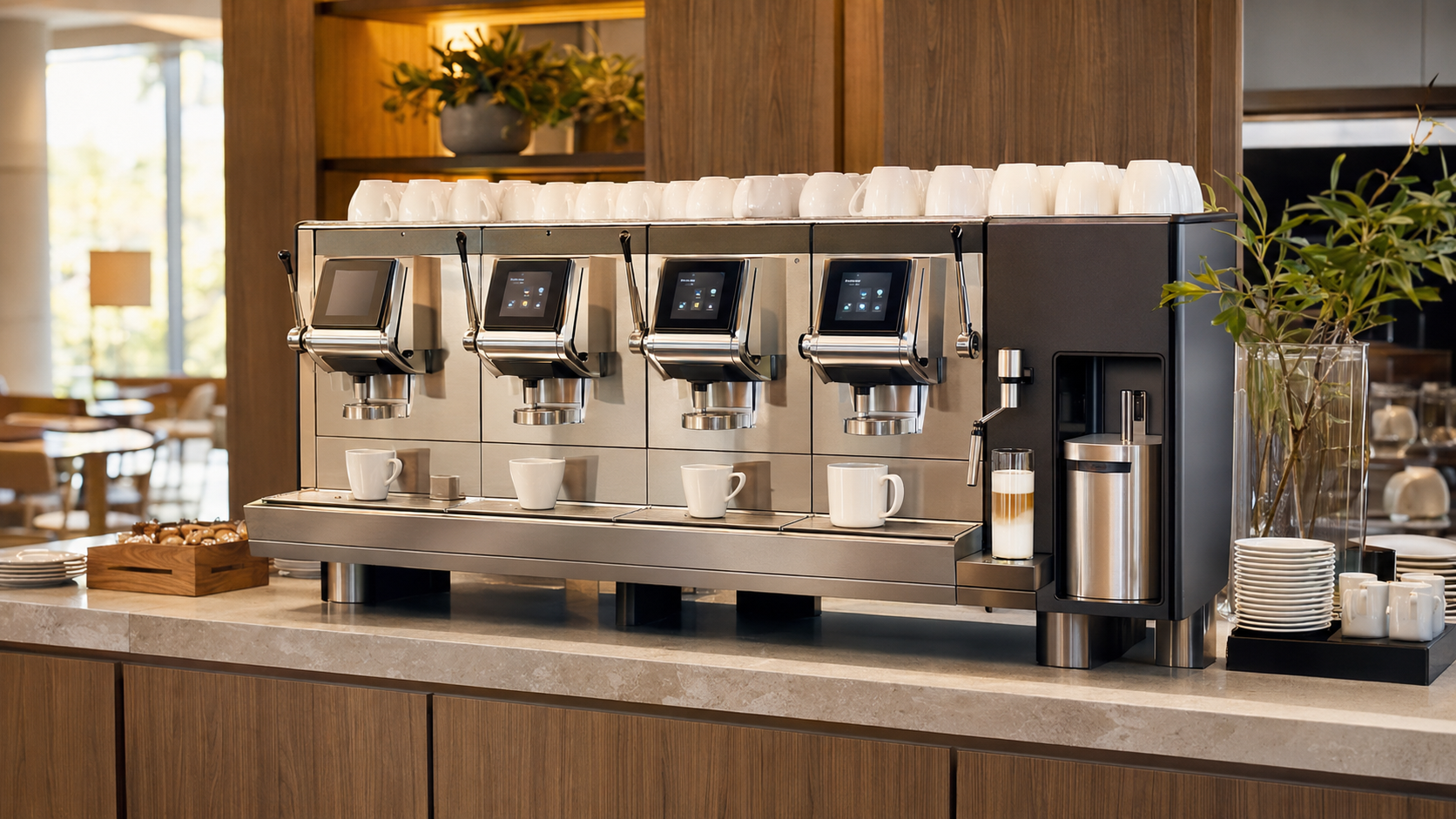
Nespresso Aguila 440 review findings show that this four-head commercial coffee machine is designed for hotels, conference venues, restaurants, executive lounges, and large workplaces that need to serve many drinks in a short period. It combines four simultaneous coffee extraction positions with an integrated refrigerated milk system and programmable one-touch recipes.
The Aguila 440 is not simply an office capsule machine with a few extra buttons. It is a large, approximately 100 kg professional appliance requiring a direct water connection, commercial electrical supply, sufficient drainage, and carefully assigned daily cleaning.
Its four extraction heads can significantly improve black-coffee service during busy periods. Automated hot and cold milk functions also allow staff to prepare cappuccinos, lattes, flat whites, and other milk recipes without operating a traditional steam wand.
However, greater capacity brings greater responsibility. Installation is demanding, operating costs can be substantial, and its milk system requires disciplined daily cleaning. Smaller offices may pay for capacity they never use.
Quick Verdict
Nespresso Aguila 440 Rating: 4.7/5
The Aguila 440 is best for high-volume businesses needing:
- Four coffee extraction heads
- Fast peak-period service
- Consistent capsule coffee
- Automated fresh-milk beverages
- Minimal barista training
- Programmable one-touch recipes
- Hot and cold milk foam
- High used-capsule capacity
- Reliable commercial servicing
It may not be suitable when:
- Daily coffee demand is moderate or low
- Counter space is limited
- Commercial plumbing is unavailable
- The electrical supply cannot support the machine
- Staff cannot perform daily milk-system cleaning
- Freshly ground specialty coffee is essential
- Several milk alternatives must remain completely separate
- Purchase and operating costs must be kept low
Businesses needing similar milk-beverage automation with two rather than four coffee heads should first read our Nespresso Aguila 220 review.
What Is the Nespresso Aguila 440?
The Nespresso Aguila 440 is a high-capacity professional capsule coffee machine created for demanding commercial environments. It uses Nespresso Professional capsules rather than the Original or Vertuo capsules designed for domestic machines.
Its principal systems include:
- Four independent coffee extraction heads
- An integrated refrigerated fresh-milk system
- Two milk containers in supported configurations
- Programmable one-touch drink controls
- Dedicated hot-water outlets
- Large used-capsule containers
- Heated cup-storage areas
- Automatic cleaning and energy-saving programs
The machine can prepare as many as four black coffees simultaneously. This is its most important distinction from the Aguila 220, which has two coffee extraction heads.
Depending on regional programming, available drinks may include:
- Ristretto
- Espresso
- Lungo
- Americano-style coffee
- Cappuccino
- Latte
- Latte macchiato
- Flat white
- Espresso macchiato
- Hot milk
- Hot milk foam
- Cold milk foam
- Hot water
- Customized coffee-and-milk recipes
The precise button layout and recipe selection can vary by country, contract, and installation. Prospective buyers should request a live demonstration using their preferred cups, capsules, and milk before signing an agreement.
Current regional features and purchasing arrangements can be checked on the official Nespresso Professional Aguila 440 product page. Keep this official outbound link set to dofollow when adding the article to WordPress.
Nespresso Aguila 440 Specifications
Commercial specifications differ between electrical markets, so the following figures should be treated as a practical overview rather than universal installation requirements.
| Specification | Nespresso Aguila 440 |
|---|---|
| Machine Type | High-capacity professional capsule machine |
| Capsule System | Nespresso Professional |
| Coffee Extraction Heads | Four |
| Simultaneous Black Coffees | Up to four |
| Milk System | Integrated refrigerated fresh-milk system |
| Milk Storage | Two approximately 2.5-liter containers in supported configurations |
| Total Milk Capacity | Approximately 5 liters |
| Used-Capsule Capacity | Two containers holding approximately 125–130 capsules each |
| Dimensions | Approximately 100 × 62–69 × 63–64 cm |
| Weight | Approximately 100 kg |
| Pump Pressure | Up to 19 bar in supported regional configurations |
| Power Rating | Approximately 7,300–9,400 watts, depending on region |
| Coffee Sizes | Ristretto, espresso, and lungo |
| Milk Functions | Hot milk, hot foam, and cold foam |
| Hot-Water Function | Yes |
| Cup Storage | Heated upper cup-storage areas |
| Water Supply | Direct water connection |
| Interface | Dedicated recipe buttons and digital displays |
| Cleaning Program | Automated guided cleaning cycle |
| Energy-Saving Mode | Yes |
The machine’s physical size deserves serious attention. At approximately one meter wide and around 100 kg before accounting for all operating conditions, it requires a strong commercial counter and generous service clearance.
Electrical requirements vary considerably. A business should never arrange installation using specifications from another country, even if the machine name is identical. An authorized technician must confirm voltage, phase, amperage, plug type, water pressure, filtration, and drainage requirements for the exact regional version.
1. Four Extraction Heads Deliver Exceptional Throughput
The defining advantage identified in this Nespresso Aguila 440 review is the four-head extraction system. Each position has its own capsule insertion slot, lever, coffee outlet, and drink controls.
During busy service, the Aguila 440 can prepare up to four black coffees simultaneously. One guest might select an espresso, another a lungo, while two additional users prepare different capsule varieties.
Why Four Heads Matter
A machine’s daily capacity does not reveal how well it can handle concentrated demand. A corporate office may serve 300 drinks gradually throughout the day, while a hotel might need most of its coffees during a two-hour breakfast period.
Four heads provide the greatest benefit when customers arrive together, such as during:
- Hotel breakfast service
- Conference refreshment breaks
- Large corporate meetings
- Catered events
- Restaurant dessert service
- Executive lounge peak periods
- Premium showroom events
- High-traffic workplace mornings
For example, preparing 40 black coffees on a single-head machine requires 40 sequential extraction cycles. A four-head machine can theoretically complete them in groups of four, reducing the extraction portion of the queue considerably.
Actual service speed still depends on:
- Selected drink sizes
- Percentage of milk beverages
- Capsule loading speed
- User familiarity
- Cup positioning
- Milk replenishment
- Cleaning or rinse cycles
- Available staff
- Space around the machine
The four heads cannot prevent every delay. If forty conference guests form one enthusiastic coffee mob, some queue management will still be required—the machine is powerful, but it has not yet learned crowd control.
Independent Beverage Selection
The extraction positions can generally prepare different black-coffee recipes at the same time. Users are not required to select identical capsule varieties or beverage sizes.
This flexibility is useful in self-service locations because one customer can choose decaffeinated espresso while another prepares a longer, more intense coffee.
Businesses that need two simultaneous coffees rather than four should compare the Aguila 440 with our Nespresso Aguila 220 review. For locations serving primarily black coffee without an integrated milk requirement, the Nespresso Momento 200 review explains a more compact dual-head alternative.
2. The Fresh-Milk System Supports a Full Café-Style Menu
The Aguila 440 combines its four coffee heads with an automated refrigerated milk system. Milk is drawn from internal containers and dispensed according to the programmed recipe, eliminating the need for users to steam milk manually.
The system can provide:
- Heated milk
- Hot milk foam
- Cold milk foam
- Different milk quantities
- Different foam proportions
- Programmed coffee-and-milk sequences
This allows relatively inexperienced employees to prepare consistent cappuccinos, lattes, latte macchiatos, and flat whites at the press of a button.
Consistency Without a Barista
Manual milk steaming requires the operator to control aeration, temperature, texture, and pouring. Results can vary considerably when several untrained employees share a traditional espresso machine.
The Aguila 440 automates those variables. Once the recipes are correctly configured, every user receives a similar milk volume and foam proportion.
Commercial advantages include:
- Shorter employee training
- Consistent drink presentation
- Faster preparation
- Reduced dependence on barista skill
- Predictable milk use
- Fewer manual preparation steps
- No separate countertop milk frother
- Easier self-service operation
Automated foam does not provide the artistic control of a commercial steam wand. A skilled barista can create silkier microfoam and more refined latte art. However, consistent automated texture is usually more practical in hotels and workplaces where speed matters more than decorative rosettas.
3. Two Milk Containers Improve Menu Flexibility
Supported Aguila 440 configurations use two milk containers of approximately 2.5 liters each, providing around five liters of total refrigerated capacity.
Two containers may offer more operational flexibility than the single-container arrangement commonly associated with smaller commercial systems. Depending on local programming, service guidance, and food-safety procedures, a business may be able to organize milk supplies more effectively.
Possible uses include:
- Separating two compatible dairy milk types
- Keeping additional milk ready for peak demand
- Managing replenishment during long service periods
- Supporting designated recipes
- Reducing complete service interruptions when one container needs attention
However, businesses should not assume that two containers automatically make the system appropriate for switching freely between dairy and plant-based products.
Plant-Based Milk and Allergens
Oat, soy, and almond drinks behave differently because their protein, fat, stabilizer, and sugar compositions vary. Barista-formulated versions may create more stable foam, but results must be tested with the installed machine.
Before using separate milk types, confirm:
- Whether the regional machine configuration supports them
- How the internal milk pathways operate
- Whether cross-contact can occur
- Which cleaning procedure is required
- How allergens must be communicated
- Whether local food-safety rules permit the intended setup
- Which plant-based products provide stable foam
A venue serving customers with serious allergies may require a separate approved milk system instead of relying on the Aguila’s internal containers. The two-container design improves capacity, but it should never be treated as automatic allergen isolation.
4. It Is Designed for High-Volume Commercial Locations
The Aguila 440 belongs in locations where its four heads and automated milk features will be used frequently. Suitable environments may include:
- Large hotels
- Convention and conference centers
- Busy restaurants
- Corporate headquarters
- Airport-style lounges
- Catering venues
- Premium coworking spaces
- Healthcare hospitality areas
- Large educational or institutional facilities
- High-traffic retail showrooms
A smaller workplace is unlikely to receive good value from this capacity. The machine requires more space, more power, more installation planning, and a more disciplined cleaning routine than compact office equipment.
Businesses with moderate demand should compare it with our Nespresso Momento 120 review, especially when one coffee head and automated milk recipes are sufficient.
Calculate Peak Demand, Not Just Daily Cups
Before purchasing, measure:
- Total drinks per day
- Drinks ordered during the busiest 30 minutes
- Percentage of black coffees
- Percentage of milk-based beverages
- Average milk quantity per drink
- Number of decaffeinated drinks
- Number of users operating the machine
- Time available for restocking
- Cup sizes and serving workflow
- Staff assigned to cleaning
A venue serving 400 drinks evenly across 12 hours may place less pressure on the machine than a hotel serving 250 drinks during a short breakfast window.
This Nespresso Aguila 440 review therefore recommends choosing the machine according to peak-period workflow, not an impressive daily cup estimate alone.
5. Coffee Quality Prioritizes Consistency
A practical Nespresso Aguila 440 review must examine whether capsule coffee can meet the expectations of a high-volume commercial venue. The Aguila 440 produces dependable and repeatable results, although it cannot match the extraction flexibility of a traditional espresso machine using freshly ground beans.
Each Nespresso Professional capsule contains a pre-measured quantity of ground coffee sealed to protect its aroma. The machine controls water temperature, pressure, and beverage volume according to the selected recipe.
This system provides several operational advantages:
- Consistent coffee strength
- Predictable serving volumes
- No grinder calibration
- No weighing or tamping
- Minimal loose coffee grounds
- Faster employee training
- Reduced preparation errors
- Predictable capsule consumption
The flavor depends mainly on the selected Professional capsule. Available varieties may include mild, intense, decaffeinated, single-origin, and flavored options, although the exact range varies by market.
Espresso, Lungo, and Americano-Style Coffee
Espresso delivers the most concentrated aroma and body. Depending on the capsule, flavor characteristics may include cocoa, cereal, roasted nuts, wood, spice, caramel, or fruit.
Lungo provides a larger and generally milder cup. An Americano-style recipe can combine extracted coffee with hot water, avoiding excessive extraction through a single capsule.
Businesses should match each recipe with the correct cup size. Poorly configured volumes may result in weak coffee, overflowing cups, or excessive bitterness.
For a clearer explanation of capsule extraction, read our guide to how Nespresso machines work.
Choosing Capsules for Milk Drinks
Milk softens bitterness, acidity, and roast intensity. A delicate capsule may become difficult to taste in a large latte, while a stronger coffee normally remains more noticeable.
A balanced commercial capsule selection could include:
- Mild coffee for espresso and lungo
- Medium-intensity coffee for smaller milk drinks
- Intense coffee for cappuccino and latte
- Decaffeinated options
- Clearly labeled flavor profiles
- Separate capsule storage for quick identification
The Aguila 440 does not allow users to adjust grind size, coffee dose, tamping pressure, or extraction time like a traditional espresso setup. Its strength is consistent output rather than manual experimentation.
Our Nespresso vs espresso machine comparison explains the differences in flavor control, convenience, maintenance, and staff training.
6. One-Touch Controls Simplify Staff Training
Despite its size, the Aguila 440 is designed to make beverage preparation relatively straightforward. Dedicated buttons and individual digital displays allow users to select recipes without mastering a commercial barista workflow.
A typical black-coffee process involves:
- Place a suitable cup beneath an available coffee outlet.
- Open the corresponding capsule lever.
- Insert a Nespresso Professional capsule.
- Close the lever securely.
- Select the required beverage.
- Remove the drink after extraction finishes.
Milk recipes may require the user to insert a capsule and press a programmed cappuccino, latte, or flat-white button. The machine then controls the coffee, milk, and foam sequence.
Programmable Beverage Recipes
The Aguila 440 can be configured with recipes suited to the venue’s menu and cups. Depending on the installation and operator permissions, programmable elements may include:
- Coffee volume
- Hot-water quantity
- Milk volume
- Foam quantity
- Milk temperature settings
- Ingredient sequence
- Beverage-button assignment
- Cup-size compatibility
Recipe programming should be handled according to Nespresso Professional guidance. Careless changes may create weak drinks, poor flavor balance, or overflowing cups.
The official Nespresso Professional Aguila 440 product page provides current regional product information and purchasing options.
Staff Operation Versus Self-Service
Although the Aguila 440 can support self-service, its capacity is often used more effectively by trained employees during busy periods.
A dedicated operator can:
- Load several capsules rapidly
- Position four cups correctly
- Start multiple extractions
- Monitor both milk containers
- Refill cups and capsules
- Empty waste before it becomes full
- Identify completed drinks
- Clean spills immediately
- Keep customers moving through the queue
For public self-service, drink labels and instructions must be clear. Otherwise, four extraction heads can produce four times the opportunities for someone to place one tiny espresso cup beneath the wrong outlet. Coffee machines are excellent equipment, but patient teachers they are not.
7. Four Coffee Heads Require a Well-Planned Station
The Aguila 440 is approximately one meter wide, so the surrounding service area affects its performance almost as much as the machine itself.
A poor layout can prevent users from accessing all four extraction positions. Cups, capsule displays, sugar, lids, and waste bins must therefore be arranged without blocking the controls.
A practical coffee station should provide:
- Clear access to all four heads
- Cups positioned near the correct outlets
- Capsules organized by flavor and intensity
- Decaffeinated capsules stored separately
- Milk-monitoring access for employees
- Sugar and stirrers beyond the preparation area
- Napkins near the drink collection point
- Waste disposal away from incoming users
- Staff-only storage for cleaning supplies
- Adequate lighting around the controls
Preventing Congestion
Allowing four guests to operate the machine simultaneously may sound efficient, but it can create congestion if the counter is too narrow.
For busy hotels or conference venues, a staffed workflow may perform better:
- Customers place or communicate their orders.
- One employee loads capsules and selects recipes.
- Cups move to a separate collection point.
- Another area provides sugar, lids, and napkins.
- Waste is discarded beyond the pickup station.
This prevents customers collecting finished drinks from colliding with those still choosing capsules.
Cup Storage and Warming
The heated upper storage areas help keep ceramic cups warm. A preheated cup can reduce the immediate temperature loss that occurs when hot espresso enters cold ceramic.
However, cup storage must not obstruct ventilation or technician access. Businesses should also confirm the supported cup quantity and avoid stacking cups beyond the recommended height.
8. Peak Demand Determines Real Capacity
The four-head design gives the Aguila 440 exceptional black-coffee throughput, but actual capacity depends on the beverage mix.
Four espressos can be prepared together. Four elaborate milk recipes may require more time because they depend on the shared automated milk system and programmed dispensing sequence.
This Nespresso Aguila 440 review recommends analyzing the busiest 15–30 minutes using realistic drink preferences.
Important questions include:
- How many customers arrive simultaneously?
- What percentage order black coffee?
- How many choose cappuccino or latte?
- How much milk does each recipe require?
- Can four users reach the machine comfortably?
- Will employees operate the machine?
- How frequently must capsules be replenished?
- When will milk containers need refilling?
- How often will waste containers be emptied?
- Could cleaning or rinse cycles interrupt service?
Example Peak-Period Calculation
Suppose a hotel needs to serve 80 drinks during a 30-minute conference break:
- 40 black coffees
- 25 cappuccinos
- 10 lattes
- 5 hot-water drinks
The four extraction heads can process black coffees efficiently, but milk beverages may become the limiting factor. The venue would still need organized cup placement, quick capsule loading, sufficient milk, and at least one trained operator.
During unusually concentrated demand, businesses may require:
- A second beverage station
- Staff-controlled service
- Pre-brewed filter coffee
- A simplified peak-time menu
- Separate hot-water equipment
- Cups prepared before guests arrive
- Clearly separated ordering and collection points
Four heads reduce extraction delays, but they do not eliminate the need for queue planning.
9. Five Liters of Milk Can Disappear Quickly
The two approximately 2.5-liter milk containers provide around five liters of total capacity in supported configurations. This is substantial, but high-volume milk service can consume it surprisingly quickly.
Consider 40 cappuccinos using an average of 100 ml of milk:
40 × 100 ml = 4 liters
Now consider 40 larger lattes using 180 ml each:
40 × 180 ml = 7.2 liters
In the second example, the containers would require replenishment during service.
Actual milk use varies according to recipe programming, foam quantity, cup size, and product characteristics. Businesses should measure consumption using their intended menu rather than estimating from customer numbers alone.
Milk Refrigeration and Food Safety
The integrated refrigeration system helps maintain suitable milk conditions, but it does not replace proper hygiene procedures.
Employees must:
- Use fresh milk within its safe date
- Monitor milk temperature
- Follow local food-safety requirements
- Avoid repeatedly mixing old and new milk
- Clean containers on schedule
- Keep disconnected parts refrigerated when required
- Discard milk when its safety is uncertain
- Record problems during shift changes
A named employee should be responsible for checking and replenishing milk during busy service. “Someone will notice” is not a milk-management system; it is merely optimism wearing an apron.
10. Installation Requires Commercial Infrastructure
The Aguila 440 is not a portable machine that can be placed on any available countertop. Its weight, width, water supply, drainage, ventilation, power requirements, and service clearances demand professional planning.
Counter Strength and Available Space
The installation surface must be:
- Strong enough for sustained commercial use
- Level and stable
- Deep enough for the machine
- Resistant to moisture
- Accessible for servicing
- Positioned away from unsafe traffic
- Large enough for cups and capsules
- Clear around required ventilation areas
A lightweight domestic cabinet or movable trolley is unsuitable. The counter must support the machine without flexing, tilting, or becoming unstable.
Direct Water and Drainage
The Aguila 440 normally requires a direct water connection. Depending on the regional installation, a fixed drainage arrangement may also be necessary.
A qualified technician should assess:
- Incoming water pressure
- Water hardness
- Filter requirements
- Drain location
- Hose routing
- Shutoff-valve access
- Backflow prevention
- Local plumbing regulations
- Distance from the water supply
- Future maintenance access
Suitable water filtration may improve beverage quality and reduce scale accumulation. Filters must still be replaced on schedule to remain effective.
Electrical Planning
Regional versions may have different voltage, phase, amperage, plug, and power requirements. The exact machine specification must be confirmed before any electrical work begins.
The Aguila 440 may require a dedicated commercial circuit. Extension cords, domestic adapters, and overloaded shared outlets are inappropriate for equipment with this level of power demand.
Installation planning should involve the Nespresso Professional representative, an authorized technician, and qualified local contractors where necessary.
11. Large Used-Capsule Containers Reduce Interruptions
The Aguila 440 commonly includes two used-capsule containers, each capable of holding roughly 125–130 capsules. Combined capacity may therefore approach 250 used capsules before both containers are full.
This is helpful during high-volume service because employees do not need to empty waste after every short rush.
However, the containers should be checked before peak periods rather than allowed to reach maximum capacity. An unexpectedly full capsule bin can disable an extraction position or interrupt service at the least convenient moment.
Staff should:
- Empty containers before busy periods
- Follow machine alerts
- Wear suitable gloves when handling waste
- Check for liquid accumulation
- Clean the waste area regularly
- Follow local capsule-recycling procedures
- Avoid compressing capsules by hand
Nespresso recycling availability varies by region and business contract. Commercial users should confirm collection arrangements directly with their local Nespresso Professional service.
12. Hot Water Adds Useful Menu Flexibility
Dedicated hot-water functions allow the Aguila 440 to support more than espresso and milk drinks.
Hot water may be used for:
- Americano-style recipes
- Tea
- Herbal infusions
- Preheating cups
- Limited food-service applications approved by the operator
Using a dedicated hot-water outlet avoids running excessive water through a coffee capsule. It may also reduce the need for a separate countertop kettle in some commercial stations.
Tea service still requires careful planning. Different teas perform best at different temperatures, and one programmed hot-water setting may not suit every variety. Businesses should also prevent coffee, milk, or capsule waste from contaminating the tea-preparation area.
For venues comparing machines according to volume and beverage variety, our best office coffee machines guide provides additional options.
13. Daily Milk-System Cleaning Is Non-Negotiable
A responsible Nespresso Aguila 440 review must emphasize the daily cleaning workload. The automated fresh-milk system expands the menu, but every component that comes into contact with milk requires careful hygiene management.
Milk residue left inside containers, tubes, outlets, or internal pathways may affect:
- Food safety
- Milk flavor
- Foam consistency
- Beverage temperature
- Machine reliability
- Unpleasant odors
- Repair costs
- Customer confidence
The Aguila 440 includes a guided automatic cleaning program. However, “automatic” does not mean the machine completes every task without human involvement. Staff must initiate the correct cycle, use approved cleaning products, handle removable parts, and confirm that cleaning finishes successfully.
Typical Daily Cleaning Tasks
The exact procedure must follow the official operating manual and local service agreement. Daily responsibilities may include:
- Emptying and cleaning both milk containers
- Running the complete milk-system cleaning cycle
- Adding approved cleaning tablets or solution
- Cleaning milk and coffee outlets
- Emptying both used-capsule containers
- Removing and washing drip trays
- Wiping buttons and digital displays
- Cleaning the hot-water outlets
- Inspecting accessible milk tubes and connectors
- Wiping the surrounding counter and splash areas
- Confirming that no warning message remains
- Recording cleaning completion on a checklist
Employees should never add fresh milk directly on top of milk left from the previous service period. Remaining milk must be handled according to official instructions and local food-safety rules.
Our guide explaining how to clean a Nespresso machine provides useful general maintenance principles, although the Aguila 440’s commercial milk system requires its own approved procedure.
Assign Clear Staff Responsibility
A written cleaning schedule should identify who is responsible for:
- Opening inspection
- Milk-temperature checks
- Midday cleaning and wiping
- Capsule and cup restocking
- Waste-container monitoring
- Closing cleaning cycle
- Fault reporting
- Contacting technical support
Without named responsibility, each employee may assume another person completed the job. “Probably cleaned” is not a recognized hygiene standard, though it remains strangely popular in shared kitchens.
14. Descaling and Water Filtration Protect the Machine
Scale forms when minerals in the water accumulate inside boilers, pipes, valves, and heating components. The rate of buildup depends on:
- Local water hardness
- Daily beverage volume
- Filter quality
- Filter replacement frequency
- Machine temperature
- Manufacturer recommendations
- Cleaning and servicing schedules
Excessive scale may reduce water flow, affect drink temperature, alter flavor, increase heating time, and place additional strain on internal parts.
Water Filtration Requirements
An appropriate commercial filtration system may help:
- Improve coffee flavor
- Reduce chlorine-related odors
- Control mineral buildup
- Protect heating components
- Maintain more consistent water quality
- Extend intervals between certain service procedures
A filter cannot simply be installed and forgotten. Its cartridge must be replaced according to water usage, local conditions, and the installer’s schedule.
The Aguila 440’s direct water connection makes professional water assessment especially important. A qualified technician should test the supply before installation and specify the correct filtration equipment.
Professional Maintenance
The Aguila 440 contains multiple extraction systems, boilers, pumps, valves, electronic controls, refrigeration components, milk pathways, and sensors. Some maintenance must therefore be completed by an authorized professional.
Technical service may be required for:
- Refrigeration faults
- Milk-temperature problems
- Boiler or heating failure
- Pump faults
- Leaking valves, hoses, or seals
- Blocked internal milk lines
- Inconsistent coffee volumes
- Digital display errors
- Drainage problems
- Water-pressure faults
- Persistent warning messages
- Damaged capsule mechanisms
- Worn coffee or milk outlets
Before signing a purchase, rental, or lease agreement, confirm whether preventive servicing, labor, replacement parts, emergency visits, and temporary replacement equipment are included.
Nespresso Aguila 440 Operating Costs
The quoted machine price represents only one part of the total investment. This Nespresso Aguila 440 review recommends calculating costs across the entire expected ownership or contract period.
Ongoing expenses may include:
- Nespresso Professional capsules
- Fresh dairy milk
- Plant-based milk products
- Cleaning tablets and supplies
- Water-filter cartridges
- Descaling and maintenance products
- Preventive servicing
- Emergency repairs
- Electricity
- Disposable cups and lids
- Sugar, stirrers, and napkins
- Staff cleaning time
- Staff restocking time
- Capsule delivery charges
- Rental or lease payments
- Waste and recycling arrangements
Commercial pricing can vary according to location, capsule-order volume, contract length, installation work, and service coverage. Businesses should request a written quotation separating initial costs from recurring expenses.
Illustrative Cost per Milk Drink
The following figures are examples only and do not represent current Nespresso pricing.
| Cost component | Example cost |
|---|---|
| Professional capsule | $0.70 |
| Fresh milk | $0.35 |
| Disposable cup and lid | $0.20 |
| Cleaning and filtration allowance | $0.12 |
| Service allowance | $0.20 |
| Estimated cost per drink | $1.57 |
Larger milk drinks, premium plant-based products, expensive disposable packaging, and comprehensive service coverage may increase the cost.
Black coffee served in a reusable ceramic cup may cost considerably less because it requires no fresh milk or disposable packaging.
Calculate the Cost of Unused Capacity
Four extraction heads provide excellent throughput only when a venue needs them. A business serving 40 drinks gradually throughout the day may pay for capacity that remains idle.
When comparing options, calculate:
- Average daily drink volume
- Peak 30-minute demand
- Cost per capsule
- Average milk use per beverage
- Staff time per day
- Monthly cleaning-product cost
- Filter replacement expenses
- Annual service charges
- Contract termination conditions
- Expected equipment life
- Cost of alternative machines
A smaller machine may cost more per drink during a queue but less overall if demand is modest. Capacity deserves applause only when it actually turns up for work.
Nespresso Aguila 440 Pros and Cons
Pros
- Four independent coffee extraction heads
- Up to four simultaneous black coffees
- Excellent peak-period throughput
- Automated fresh-milk beverages
- Approximately five liters of refrigerated milk capacity
- Two milk containers in supported configurations
- Hot milk, hot foam, and cold foam
- Consistent capsule extraction
- Minimal barista training
- Programmable beverage recipes
- Large combined used-capsule capacity
- No grinder calibration or manual tamping
- Less loose coffee waste
- Dedicated hot-water functions
- Heated cup-storage areas
- Suitable for hotels and major venues
- Predictable ingredient use
- Strong menu flexibility
Cons
- Very large footprint
- Approximately 100 kg in weight
- Requires a strong commercial counter
- Direct plumbing is necessary
- Suitable drainage may be required
- High electrical demand
- Professional installation is essential
- Daily milk-system cleaning is mandatory
- High initial or contractual cost
- Substantial capsule and milk expenses
- Limited extraction control
- Restricted to Nespresso Professional capsules
- Less milk-texture control than a steam wand
- Plant-based milk performance may vary
- Cross-contact requires careful management
- Requires trained staff for cleaning and replenishment
- Excessive for small or medium offices
Nespresso Aguila 440 vs Aguila 220
The Aguila 440 and Aguila 220 share automated milk capabilities, but their extraction capacity differs significantly.
| Feature | Aguila 440 | Aguila 220 |
|---|---|---|
| Coffee extraction heads | Four | Two |
| Simultaneous black coffees | Up to four | Up to two |
| Fresh-milk system | Yes | Yes |
| Approximate total milk capacity | 5 liters | 5 liters |
| Milk containers | Two in supported configurations | One commonly listed container |
| Hot and cold foam | Yes | Yes |
| Approximate width | 100 cm | 65 cm |
| Approximate weight | 100 kg | 90 kg |
| Installation complexity | Very high | High |
| Best use | Major high-volume venues | Large commercial venues |
| Peak black-coffee speed | Exceptional | High |
| Cleaning workload | Intensive | Intensive |
Choose the Aguila 440 when four simultaneous extractions will materially reduce queues during concentrated service periods.
Choose the Aguila 220 when two extraction heads provide enough capacity and the smaller footprint is more practical. Our complete Nespresso Aguila 220 review examines that machine’s features, cleaning needs, and ideal users.
Nespresso Aguila 440 vs Momento 200
Both machines have multiple coffee heads, but they serve different beverage requirements.
| Feature | Aguila 440 | Momento 200 |
|---|---|---|
| Coffee extraction heads | Four | Two |
| Integrated fresh milk | Yes | No |
| Automatic cappuccinos and lattes | Yes | No |
| Refrigerated milk storage | Yes | No |
| Black-coffee throughput | Extremely high | High |
| Installation complexity | Very high | Moderate |
| Daily cleaning workload | Intensive | Lower |
| Footprint | Very large | More compact |
| Ideal venue | Hotels and major hospitality sites | Busy offices and self-service areas |
The Momento 200 is the more practical choice when most users want espresso, lungo, or Americano-style coffee. It avoids refrigeration and internal milk-system cleaning while retaining dual-head speed.
Read our Nespresso Momento 200 review for a detailed comparison of its capacity and workplace suitability.
Nespresso Aguila 440 vs Traditional Espresso Machine
The Aguila 440 prioritizes consistency and simplified operation. A traditional commercial espresso station prioritizes fresh grinding and manual control.
| Consideration | Aguila 440 | Traditional espresso machine |
|---|---|---|
| Coffee format | Professional capsules | Freshly ground beans |
| Grinder required | No | Yes |
| Tamping required | No | Yes |
| Staff training | Relatively low | Moderate to extensive |
| Milk preparation | Automated | Manual steam wand |
| Drink consistency | Very high | Depends on barista skill |
| Extraction control | Limited | Extensive |
| Latte-art potential | Limited | High |
| Loose coffee waste | Minimal | Greater |
| Peak black-coffee workflow | Four extraction heads | Depends on group heads and staff |
| Specialty-coffee potential | Limited | High |
| Cleaning demands | Intensive milk-system care | Intensive espresso and grinder care |
A specialty café should generally choose a traditional espresso setup because customers expect freshly ground beans, customized extraction, skilled milk steaming, and higher flavor control.
The Aguila 440 is better suited to hotels, institutional venues, conference centers, and large workplaces where many employees must produce consistent drinks quickly.
Who Should Buy the Nespresso Aguila 440?
The strongest buying case exists when a venue experiences concentrated demand and needs both rapid black-coffee extraction and automated milk beverages.
The Aguila 440 may be suitable for:
- Large hotels with busy breakfast service
- Convention and conference centers
- Corporate headquarters
- Executive or airport-style lounges
- High-volume restaurants
- Catering and event facilities
- Premium coworking spaces
- Healthcare hospitality areas
- Institutional dining facilities
- Major retail showrooms
- Locations requiring up to four simultaneous coffees
- Businesses with trained cleaning staff
- Venues supported by reliable commercial servicing
Its four heads are particularly valuable when groups arrive together rather than ordering gradually throughout the day.
Who Should Skip It?
This Nespresso Aguila 440 review does not recommend the machine for every commercial location.
Consider another model if:
- Daily drink demand is low or moderate
- Peak periods rarely create queues
- Most customers drink only black coffee
- Counter width is limited
- The surface cannot support the machine safely
- Direct water and drainage are unavailable
- Electrical infrastructure is unsuitable
- Staff cannot complete daily milk cleaning
- Several allergen-separated milk options are necessary
- Freshly ground specialty coffee is essential
- Manual customization is a priority
- Commercial service costs exceed the budget
Medium-sized workplaces needing automatic milk recipes may receive better value from the Nespresso Momento 120. Businesses still comparing different commercial formats can consult our best office coffee machines guide.
Frequently Asked Questions
How many coffees can the Nespresso Aguila 440 make at once?
The Aguila 440 has four independent coffee extraction heads and can prepare up to four black coffees simultaneously. Users can generally select different capsule varieties and coffee sizes at each position.
This four-head system is the principal advantage highlighted in this Nespresso Aguila 440 review. It can reduce queues considerably in hotels, conference venues, corporate headquarters, and other locations with concentrated peak demand.
Milk-based drinks may take longer because their preparation also depends on the integrated milk system and programmed recipe sequence.
Can the Aguila 440 make four cappuccinos simultaneously?
The machine has four coffee extraction heads, but milk preparation relies on its shared automated fresh-milk system. Therefore, four coffee portions can be extracted concurrently, while the complete preparation time for four cappuccinos depends on the programmed milk sequence.
Businesses expecting intensive milk-drink demand should request a demonstration using their intended recipes, milk products, cups, and serving workflow.
Does the Nespresso Aguila 440 use regular capsules?
No. The Aguila 440 uses flat, disc-shaped Nespresso Professional capsules. It is not compatible with Nespresso Original or Vertuo capsules.
Professional capsules are generally purchased through Nespresso’s business channel or an authorized regional supplier. Available varieties, prices, minimum orders, delivery schedules, and recycling arrangements may vary by location and contract.
Does the Aguila 440 grind fresh coffee beans?
No. The machine does not contain a grinder and does not use whole coffee beans. Each beverage is extracted from a pre-portioned Nespresso Professional capsule.
This eliminates grinder adjustment, dosing, tamping, and loose coffee grounds. The trade-off is limited control over grind size, coffee dose, and extraction compared with a traditional commercial espresso machine.
What drinks can the Aguila 440 prepare?
Depending on its regional configuration and programmed menu, drinks may include:
- Ristretto
- Espresso
- Lungo
- Americano-style coffee
- Cappuccino
- Latte
- Latte macchiato
- Flat white
- Espresso macchiato
- Hot milk
- Hot milk foam
- Cold milk foam
- Hot water
- Customized coffee-and-milk recipes
Buyers should confirm the precise drink menu before installation because recipe buttons and programming may differ by market and service agreement.
Can the Aguila 440 use oat or plant-based milk?
A compatible barista-style oat, soy, or almond drink may work, but foam quality varies according to protein, fat, stabilizers, temperature, and product formulation.
The machine’s two milk containers should not automatically be treated as completely isolated allergen systems. Businesses must confirm milk-pathway operation, cleaning requirements, and cross-contact risks with their Nespresso Professional representative.
A separate approved frothing system may be necessary when strict allergen separation is required.
How much milk does the Aguila 440 hold?
Supported configurations commonly provide two approximately 2.5-liter refrigerated containers, giving a total capacity of around five liters.
That capacity may be sufficient for moderate service, but it can disappear quickly during a busy period. Forty large lattes using approximately 180 ml of milk each would require about 7.2 liters, meaning replenishment would be necessary.
Is milk refrigerated inside the machine?
Yes. The Aguila 440 incorporates refrigerated fresh-milk storage.
Refrigeration does not remove the need for safe milk handling. Staff must monitor temperature and freshness, follow local food-safety requirements, clean the containers, and avoid continually topping up old milk with new milk.
How often must the Nespresso Aguila 440 be cleaned?
Milk-contact components require daily cleaning according to the official operating instructions. The complete guided cleaning cycle should be performed with approved cleaning products.
Drip trays, coffee outlets, milk outlets, used-capsule containers, controls, hot-water outlets, and the surrounding counter also need regular cleaning.
Automated cleaning reduces manual effort but does not remove staff responsibility. Someone must start the cycle, handle removable components, verify completion, and report faults.
Does the Aguila 440 require plumbing?
Yes. Professional installation generally requires a direct water connection and may also require an appropriate fixed drainage arrangement.
A qualified technician should assess:
- Water pressure and hardness
- Filtration requirements
- Drainage access
- Electrical supply
- Counter strength
- Ventilation
- Machine clearance
- Local plumbing regulations
- Future service access
Installation requirements must be confirmed for the exact regional model rather than copied from an overseas specification sheet.
How much electricity does the Aguila 440 require?
Electrical requirements differ by country and machine version. Regional configurations may vary in voltage, phase, amperage, connection type, and rated power.
The machine may require a dedicated commercial circuit. Businesses should obtain the exact installation document from their Nespresso Professional representative before arranging electrical work.
Domestic extension cords and overloaded shared outlets are inappropriate for this type of high-powered commercial equipment.
How many used capsules can it hold?
The Aguila 440 commonly has two used-capsule containers holding approximately 125–130 capsules each. Combined capacity may therefore approach 250 capsules.
Actual usable capacity can vary, and employees should empty the containers before major service periods rather than waiting until both are completely full.
How much does the Nespresso Aguila 440 cost?
Public pricing is not always available because the final cost may depend on:
- Country and regional distributor
- Purchase, rental, or lease arrangement
- Contract length
- Capsule-order volume
- Installation work
- Plumbing and electrical preparation
- Water-filtration equipment
- Cleaning supplies
- Preventive maintenance
- Repair coverage
- Delivery and technician charges
- Temporary replacement-machine coverage
Request a detailed written quotation that separates equipment, installation, recurring supplies, and service expenses. The monthly payment is only the tip of the coffee iceberg—and this particular iceberg weighs roughly 100 kg.
Is the Nespresso Aguila 440 worth it?
The Aguila 440 can be worth the investment for a major commercial venue that regularly needs four simultaneous coffee extractions and automated fresh-milk drinks.
Its value is strongest when the machine reduces meaningful peak-period queues, replaces complicated barista workflows, and receives consistent support from trained staff.
It is unlikely to provide good value for a small office, a location with gradual demand, or a business unable to maintain its milk system properly.
Final Verdict: Is the Nespresso Aguila 440 Worth Buying?
This Nespresso Aguila 440 review finds that the machine is a powerful specialist solution for hotels, convention centers, major workplaces, lounges, restaurants, and institutional venues with high and concentrated beverage demand.
Its defining feature is the ability to prepare up to four black coffees simultaneously. The four extraction heads can considerably improve service during hotel breakfasts, conference breaks, large meetings, and other periods when many users arrive together.
The integrated refrigerated milk system further expands the menu with programmed cappuccinos, lattes, flat whites, hot milk, and hot or cold foam. Staff can produce relatively consistent drinks without grinding beans, adjusting an espresso grinder, tamping coffee, or manually steaming milk.
Those advantages come with significant commitments. The Aguila 440 requires substantial counter space, a strong installation surface, direct plumbing, suitable drainage, appropriate commercial electricity, water filtration, and professional servicing. Its milk pathways also require disciplined daily cleaning.
Coffee quality is consistent and practical rather than highly customizable. A specialty café seeking freshly ground beans, manual extraction control, and refined latte art should normally choose a traditional commercial espresso system.
Final Rating: 4.7/5
Choose the Aguila 440 if your business needs:
- Up to four simultaneous black coffees
- Strong peak-period throughput
- Automated fresh-milk beverages
- Consistent recipes across many users
- Minimal barista training
- Approximately five liters of refrigerated milk capacity
- Large used-capsule storage
- A professionally supported commercial system
Choose another machine if your location has:
- Low or moderate beverage demand
- Limited counter width
- No suitable plumbing or drainage
- Insufficient commercial electrical capacity
- No staff assigned to daily cleaning
- A strict specialty-coffee focus
- A requirement for completely separated milk allergens
- A limited equipment and operating budget
The Nespresso Aguila 220 review covers a two-head alternative with automated fresh milk. The Nespresso Momento 200 review explains a dual-head option for businesses that primarily serve black coffee.
Ultimately, the Aguila 440 earns its place only when a venue uses its exceptional capacity frequently. Four extraction heads are impressive, but the best commercial machine is the one whose capacity, maintenance requirements, and operating costs match the actual service environment.
Related Articles
- Nespresso Aguila 220 Review: Commercial Coffee Machine Guide
- Nespresso Momento 200 Review: Dual-Head Office Coffee Machine
- Nespresso Momento 120 Review: 10 Things to Know
- Nespresso Momento 100 Review: Is It Right for Your Office?
- Best Office Coffee Machines
- Nespresso vs Espresso Machine: Which Is Better?
- How Do Nespresso Machines Work?
- How to Clean a Nespresso Machine