
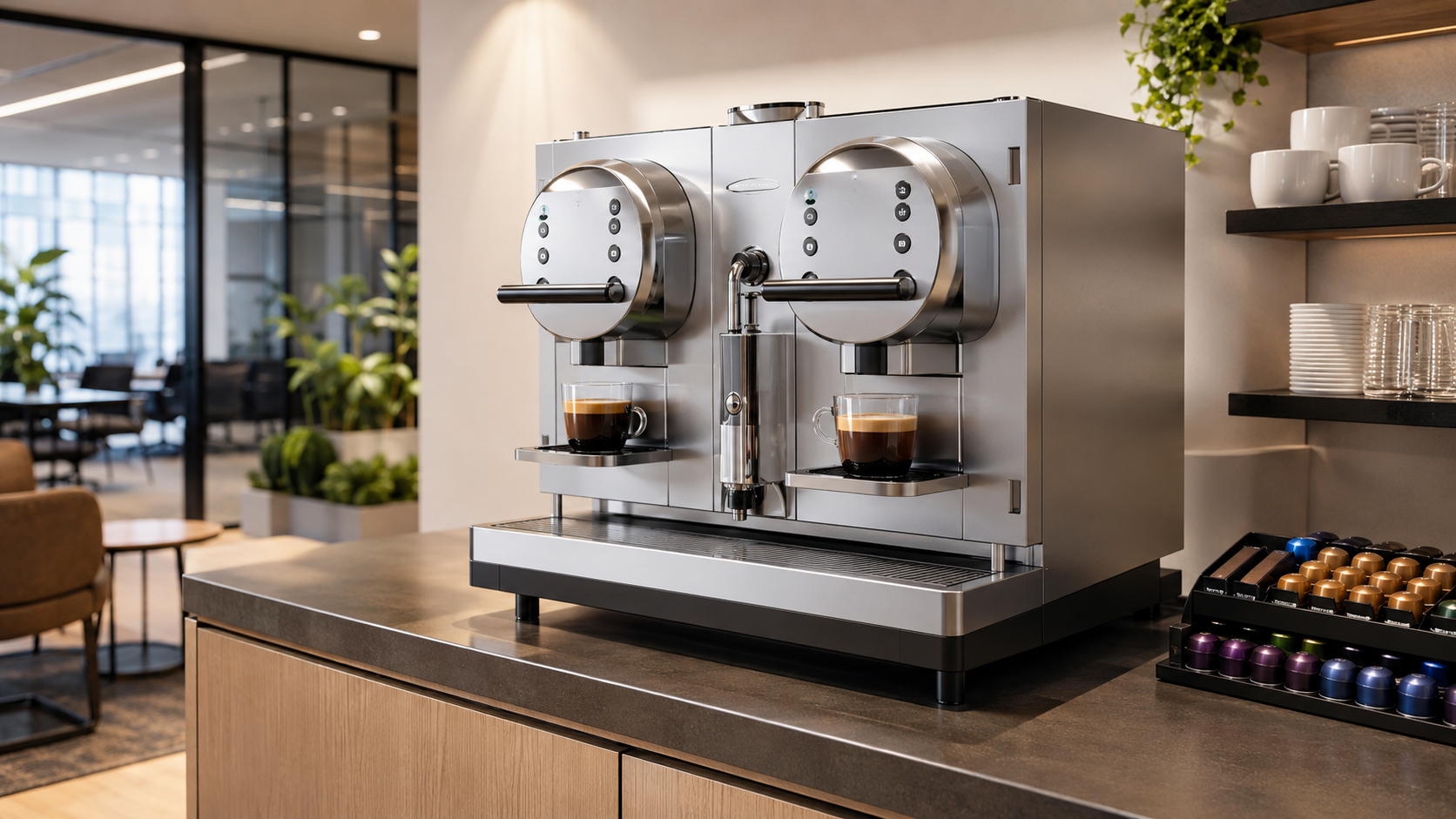
Nespresso Gemini CS 223 Pro review readers usually want to know whether this dual-head commercial capsule machine can serve a busy workplace without requiring trained baristas. Designed for offices and professional hospitality settings, the Gemini CS 223 Pro can prepare two coffees simultaneously and provides a dedicated milk-frothing function for cappuccinos, lattes, and other milk-based drinks.
Its principal strengths include:
- Two independent coffee extraction heads
- Simultaneous preparation of two drinks
- Nespresso Professional capsule compatibility
- Dedicated milk-frothing function
- Three programmable coffee volumes
- Six-liter removable water capacity
- Optional direct water connection
- Fast hot-water dispensing
- Approximately 70-capsule waste capacity
- Cup-warming surface
- Straightforward self-service operation
However, this is a large commercial machine with ongoing capsule, cleaning, milk-component, and servicing costs. It is unlikely to be economical for a small office where only a few coffees are prepared each day.
Nespresso Gemini CS 223 Pro Quick Verdict
Rating: 4.4/5
The Gemini CS 223 Pro is best suited to businesses with more than 20 employees or locations experiencing concentrated coffee demand during meetings, arrival periods, and scheduled breaks.
It may be a strong choice when you need:
- Two coffees prepared at the same time
- Consistent results across many users
- Cappuccino and latte preparation
- Minimal coffee-making training
- No grinder, dosing, or manual tamping
- A large removable water supply
- Hot water for tea and Americanos
- A machine suitable for shared self-service
- Optional direct plumbing
- Reliable access to Professional capsules
It may not be suitable when:
- Daily coffee consumption is low
- Counter space is restricted
- Freshly ground specialty coffee is required
- Users want extensive drink customization
- Several milk alternatives must remain separated
- Staff cannot complete daily milk cleaning
- Compatible disposable milk parts are difficult to obtain
- Authorized servicing is unavailable
- A modern touchscreen interface is preferred
Businesses serving mainly black coffee should also read our Nespresso Momento 200 review. Smaller workplaces may find the machine covered in our Nespresso Zenius review considerably more practical.
What Is the Nespresso Gemini CS 223 Pro?
The Gemini CS 223 Pro is a professional capsule coffee machine intended for offices, hospitality areas, conference venues, and other shared commercial environments. It uses Nespresso Professional capsules rather than Original or Vertuo capsules made for domestic machines.
The machine combines two independently operated extraction heads with a separate milk-frothing section. This arrangement allows users to prepare different black coffees simultaneously while also supporting milk-based beverages.
Typical installation locations include:
- Medium and large offices
- Corporate headquarters
- Hotel meeting rooms
- Conference facilities
- Executive lounges
- Training centers
- Coworking spaces
- Premium retail showrooms
- Staff dining areas
- Client reception spaces
- Small hospitality venues
Regional model names, purchasing arrangements, and available features can vary. Some Nespresso markets continue to list the Gemini CS 223 Pro, while others promote newer Professional systems. Current local availability should therefore be confirmed through the official Nespresso Professional Gemini CS 223 page.
Nespresso Gemini CS 223 Pro Specifications
Published details sometimes vary between regional Nespresso pages. The following table summarizes commonly listed specifications for the Gemini CS 223 Pro.
| Specification | Nespresso Gemini CS 223 Pro |
|---|---|
| Machine type | Commercial capsule coffee machine |
| Capsule system | Nespresso Professional |
| Coffee extraction heads | Two |
| Simultaneous coffees | Up to two |
| Standard coffee sizes | Ristretto, espresso, and lungo |
| Milk system | Dedicated milk-frothing function |
| Hot-water function | Yes |
| Water capacity | Approximately 6 liters |
| Water supply | Removable tanks or supported direct connection |
| Used-capsule capacity | Approximately 70 capsules |
| Pump pressure | Commonly listed at up to 19 bar |
| Power rating | Approximately 2,410 watts |
| Width | Approximately 56 cm |
| Weight | Approximately 15–18 kg, depending on regional listing |
| Cup warmer | Yes |
| Descaling alert | Yes |
| Energy-saving mode | Yes |
| Capsule handling | Semi-automatic insertion and ejection |
The machine itself is approximately 56 cm wide, but the complete coffee station needs substantially more room. Businesses must also provide space for capsules, cups, milk supplies, tea, sweeteners, waste disposal, cleaning materials, and access to both extraction heads.
The counter should be strong, level, moisture-resistant, and positioned near a suitable electrical outlet. A commercial machine weighing up to approximately 18 kg is not an appliance that should regularly migrate between meeting rooms like a particularly caffeinated office chair.
1. Dual-Head Brewing Is Its Most Valuable Feature
The key advantage identified in this Nespresso Gemini CS 223 Pro review is the independent dual-head extraction system.
Two users can prepare separate coffees simultaneously, or one employee can operate both sides during a busy service period. Each extraction head can accept its own capsule and produce its own programmed drink size.
For example, the machine can prepare:
- Two espressos using different capsules
- One ristretto and one lungo
- One regular coffee and one decaffeinated coffee
- Two lungos for waiting employees
- Coffee on one side while the other side begins a separate order
This flexibility is useful because workplace demand is rarely distributed evenly throughout the day.
When Two Extraction Heads Make a Difference
Dual-head brewing is particularly valuable during:
- Morning employee arrivals
- Conference refreshment breaks
- Large internal meetings
- Hotel breakfast periods
- Training-session intervals
- Client presentations
- Corporate events
- Lunch breaks
- Showroom appointments
- Executive functions
A workplace might prepare only 80 drinks in one day but need 30 of them within a 20-minute break. In that situation, peak-period capacity matters more than the total daily figure.
A single-head machine must complete each extraction consecutively. The Gemini CS 223 Pro can process black-coffee orders in pairs, reducing the brewing portion of the queue.
Businesses with much higher demand may need the four extraction heads discussed in our Nespresso Aguila 440 review.
Brewing Speed Is Not the Only Bottleneck
Two extraction heads do not guarantee a perfectly fast coffee station. Actual service speed also depends on:
- Capsule selection and loading
- Programmed beverage volume
- Cup placement
- User familiarity
- Milk-drink preparation
- Hot-water demand
- Water availability
- Drip-tray capacity
- Used-capsule storage
- Counter layout
- Cleaning interruptions
Milk drinks usually take longer than simple espresso or lungo servings. A poorly organized capsule display can also slow users even when both extraction heads are available.
The dual-head design is therefore most effective when cups, capsules, milk supplies, and waste disposal are positioned in a logical sequence.
2. It Uses Only Nespresso Professional Capsules
The Gemini CS 223 Pro uses flat, disc-shaped Nespresso Professional capsules. These are different from the dome-shaped Vertuo capsules and the smaller Original capsules sold for domestic machines.
It cannot use:
- Nespresso Original capsules
- Nespresso Vertuo capsules
- Keurig K-Cups
- Dolce Gusto capsules
- ESE coffee pods
- Loose ground coffee
- Whole coffee beans
Professional capsules are generally purchased through Nespresso’s business service or an authorized regional supplier. Available varieties may include:
- Mild espresso
- Medium-intensity blends
- Intense roasted coffee
- Lungo selections
- Decaffeinated capsules
- Single-origin coffees
- Flavored options
- Capsules intended for milk recipes
The exact range, capsule prices, delivery terms, minimum order requirements, and recycling services vary between countries and commercial agreements.
Why Capsules Work Well in Shared Offices
A Professional capsule contains a premeasured portion of ground coffee. This removes several preparation steps associated with a conventional espresso system.
Operational advantages include:
- No grinder adjustment
- No coffee weighing
- No manual dosing
- No tamping
- Minimal loose grounds
- Faster employee training
- Predictable serving portions
- Easy switching between varieties
- Simple decaffeinated preparation
- More consistent results among different users
- Cleaner shared counters
Our guide explaining how Nespresso machines work provides more detail about capsule puncturing, pressurized water delivery, and extraction.
Capsule Convenience Reduces Control
The disadvantage of the Professional capsule system is limited customization. Users cannot directly control:
- Grind size
- Coffee dose
- Bean freshness
- Tamping pressure
- Extraction time
- Brew temperature
- Coffee-to-water ratio beyond programmed volume
A traditional espresso machine allows a trained operator to change these variables. The Gemini CS 223 Pro instead prioritizes speed, repeatability, and accessibility.
Businesses comparing these approaches should read our Nespresso vs espresso machine guide.
3. Coffee Quality Is Consistent and Predictable
Coffee from the Gemini CS 223 Pro is designed to remain consistent across repeated servings. The sealed capsules help protect the ground coffee from prolonged exposure to oxygen, moisture, and light before brewing.
Depending on the selected capsule, flavor notes may include:
- Cocoa
- Toasted cereal
- Caramel
- Nuts
- Wood
- Spice
- Roasted grain
- Red fruit
- Mild floral tones
Coffee intensity depends on the capsule and selected beverage volume. A concentrated capsule may taste balanced as an espresso but noticeably weaker when extracted into an excessively large cup.
Three Programmable Coffee Sizes
The machine commonly offers three principal coffee selections:
- Ristretto: A short and concentrated serving with intense aroma
- Espresso: A balanced small coffee suitable alone or with milk
- Lungo: A longer black coffee with a milder perceived concentration
Programming these buttons to match the available cups is essential. Incorrect volumes may lead to weak coffee, overflowing cups, inconsistent recipes, or insufficient space for milk.
The Gemini CS 223 Pro cannot match the flavor control of freshly ground specialty coffee. Nevertheless, its repeatability is useful in an office where dozens of people have different skill levels and nobody wants Tuesday’s espresso to become an unexpected chemistry experiment.
4. The Milk System Supports Popular Office Drinks
The dedicated milk-frothing function expands the menu beyond ristretto, espresso, and lungo.
Depending on the operating procedure and regional configuration, it can support:
- Cappuccino
- Caffè latte
- Latte macchiato
- Espresso macchiato
- Hot milk
- Milk foam
- Customized coffee-and-milk drinks
This is a major difference between the Gemini CS 223 Pro and simpler Professional machines requiring a separate milk frother.
Easier Than Using a Steam Wand
A manual steam wand requires the operator to control milk aeration, pitcher position, temperature, and texture. The Gemini’s assisted system reduces the skill required to prepare an acceptable workplace cappuccino.
Benefits include:
- Shorter training time
- More consistent milk portions
- Faster drink preparation
- No manual steaming technique
- No separate countertop frother
- Easier self-service operation
- Reduced dependence on a trained barista
However, its foam should not be expected to equal the fine microfoam created by an experienced café barista. The machine focuses on convenient commercial service rather than intricate latte art.
Locations needing a much larger integrated refrigerated milk system should compare it with our Nespresso Aguila 220 review.
Plant-Based Milk Requires Testing
Oat, soy, and almond milk can produce very different results because their protein, fat, sugar, and stabilizer levels vary.
Before offering a plant-based option, test:
- Foam volume
- Foam stability
- Final temperature
- Flavor with the selected capsule
- Correct milk components
- Cleaning requirements
- Allergen cross-contact procedures
Barista-style plant-based products often foam more reliably, but performance should be tested using the exact machine and intended recipe.
Disposable straws or nozzles may reduce contact with reusable parts in some configurations. They do not automatically guarantee complete allergen separation throughout the entire preparation area.
5. Milk Components Simplify Service but Add Ongoing Costs
Some Gemini CS 223 Pro configurations use disposable milk straws and nozzles. These components help simplify milk handling by reducing the amount of residue left in reusable pathways.
Potential advantages include:
- Faster component replacement
- Less manual washing
- More predictable milk contact
- Easier employee training
- Reduced risk of reusing dirty components
- Convenient switching between milk containers
- Simpler preparation during busy periods
However, disposable parts also create several disadvantages:
- Recurring purchasing costs
- Additional plastic waste
- Storage requirements
- Dependence on compatible supplies
- Risk of running out during service
- Incorrect installation by users
- Possible difficulty sourcing parts for an older machine
Before purchasing a used unit, confirm the exact part numbers and current local availability. A functioning milk system is not particularly useful when its compatible straw has become a rare historical artifact.
Milk Hygiene Still Requires Daily Attention
Disposable milk components do not eliminate the need for proper cleaning. Staff must still monitor:
- Milk freshness
- Milk storage temperature
- External milk residue
- The frothing outlet
- Reusable containers
- Drip trays
- Countertop spills
- Cross-contact between milk varieties
- Required rinsing cycles
- Closing sanitation procedures
Fresh milk should not be continually poured over older milk. Any unused product must be stored or discarded according to local food-safety requirements.
Businesses should assign milk cleaning to specific employees. If responsibility is simply given to “everyone,” the milk outlet may soon discover that everyone has mysteriously gone home.
6. The Six-Liter Water Capacity Supports Busy Offices
The approximately six-liter total water capacity is another useful feature highlighted in this Nespresso Gemini CS 223 Pro review.
A large supply reduces how frequently employees must interrupt service to refill the machine. This is particularly useful during:
- Conferences
- Training sessions
- Large meetings
- Morning arrival periods
- Hotel breakfast service
- Corporate events
- Client presentations
- Busy staff breaks
Actual drink capacity depends on the selected serving sizes and water used for rinsing, heating, and tea.
For example, six liters theoretically represents:
- 150 servings at 40 ml
- 100 servings at 60 ml
- 55 servings at approximately 110 ml
- 40 servings at 150 ml
These figures are simplified estimates. The real number will be lower because the machine also consumes water during rinsing and maintenance.
Removable Tanks Offer Installation Flexibility
Removable water tanks can be convenient when permanent plumbing is unavailable.
This arrangement may suit:
- Leased offices
- Temporary conference facilities
- Historic buildings
- Meeting rooms without nearby water lines
- Locations where plumbing alterations are restricted
- Businesses testing a coffee station before permanent installation
The disadvantages are manual refilling, lifting filled tanks, possible spills, and service interruptions when users fail to monitor water levels.
Staff should refill tanks using fresh potable water and should not allow water to remain stagnant for extended periods. Tanks should be cleaned according to the official instructions.
Optional Direct Water Connection
Supported configurations may allow connection to a permanent water supply. This can reduce refilling work and improve availability in high-demand locations.
Professional installation should consider:
- Water pressure
- Shutoff-valve access
- Hose routing
- Leak protection
- Backflow requirements
- Water filtration
- Local plumbing regulations
- Drainage or drip management
- Technician access
- Maintenance procedures
A direct connection should not be improvised. Even excellent coffee loses some charm when accompanied by an unauthorized indoor water feature.
7. Water Quality Directly Affects Flavor and Reliability
The water placed in the machine influences both coffee flavor and internal scale accumulation.
Water containing excessive chlorine may produce unpleasant aromas. Very hard water can create mineral deposits inside heating elements, valves, pipes, and outlets. Extremely soft or poorly balanced water may also affect extraction.
Businesses should evaluate:
- Local water hardness
- Chlorine taste and odor
- Filter compatibility
- Mineral balance
- Filter capacity
- Daily beverage volume
- Hot-water consumption
- Replacement frequency
- Previous scale problems
A suitable commercial filter may improve flavor and reduce scale, but every filter has a limited operating life.
Record the installation and planned replacement dates. A forgotten filter does not become more effective with age—it merely gains confidence.
Watch for Scale-Related Warning Signs
Possible signs of scale buildup include:
- Reduced coffee flow
- Longer heating times
- Lower drink temperature
- Inconsistent beverage volumes
- Unusual operating noise
- Weak hot-water performance
- Descaling warnings
- Changes in coffee flavor
- Repeated operational faults
Use only an approved descaling product and follow the procedure intended for the exact regional model. Household vinegar should not be used unless the manufacturer specifically authorizes it.
Our guide on how to clean a Nespresso machine explains general capsule-machine care. Commercial Gemini owners should still follow their dedicated operating manual and service instructions.
8. The Dedicated Hot-Water Outlet Expands the Menu
The Gemini CS 223 Pro can provide hot water separately from its coffee extraction heads. This makes the station more useful for employees and guests who do not want capsule coffee.
Hot water may be used for:
- Tea
- Herbal infusions
- Americano-style drinks
- Preheating ceramic cups
- Other approved workplace beverages
A separate outlet is preferable to passing excessive water through a coffee capsule. Extending an espresso extraction too far can introduce bitterness and create a weak, unbalanced drink.
For an Americano-style beverage, prepare espresso first and add the desired quantity of hot water. Our comparison of Americano vs drip coffee explains how this drink differs from conventional filtered coffee.
Tea Service Needs Its Own Workflow
One hot-water temperature may not be suitable for every tea. Delicate green tea generally benefits from cooler water than many black teas and herbal infusions.
Businesses should also plan for:
- Tea-bag storage
- Cup selection
- Stirrer placement
- Milk and sugar
- Used tea-bag disposal
- Spill management
- Queue congestion
- Cleaning around the outlet
If a large percentage of employees primarily drink tea, a separate commercial hot-water dispenser may prevent the coffee machine from becoming a bottleneck.
9. The Controls Are Designed for Shared Operation
Dedicated beverage buttons and a digital display make the Gemini CS 223 Pro accessible to employees with limited coffee-making experience.
A typical black-coffee workflow involves:
- Select the correct cup.
- Position it beneath an available extraction head.
- Open the capsule mechanism.
- Insert a Nespresso Professional capsule.
- Close the mechanism securely.
- Select ristretto, espresso, or lungo.
- Wait for the programmed extraction to finish.
- Remove the completed drink.
- Check the outlet and counter for spills.
Because the coffee heads operate independently, a second user may prepare another drink on the opposite side.
Programmable Volumes Improve Consistency
The beverage buttons can generally be programmed to suit the venue’s cups and preferred recipes.
Correct volume settings help prevent:
- Weak coffee
- Overflowing cups
- Insufficient space for milk
- Inconsistent serving sizes
- Poor flavor balance
- Excessive water use
- User complaints
Programming access should be restricted to trained staff. Otherwise, different employees may repeatedly adjust the lungo setting until it measures somewhere between an espresso and a small swimming pool.
Use a limited range of clearly labeled cups and test every programmed drink before opening the station for self-service.
Display Alerts Support Daily Operation
Depending on the regional configuration, the display may communicate information about:
- Heating status
- Empty water tanks
- Full capsule containers
- Cleaning procedures
- Descaling requirements
- Machine faults
- Maintenance needs
Employees should understand which alerts they can safely resolve. Persistent error messages, leaks, electrical problems, or internal faults should be referred to authorized service personnel.
10. Peak Demand Determines Whether Dual Heads Are Necessary
Daily drink totals alone do not reveal whether a business needs a dual-head machine.
A venue serving 100 drinks gradually over ten hours may operate comfortably with a single-head model. Another venue serving only 70 drinks per day may experience serious queues if 35 beverages are requested during one short meeting break.
This Nespresso Gemini CS 223 Pro review recommends measuring demand during the busiest 15–30 minutes.
Ask:
- How many users arrive simultaneously?
- What percentage order black coffee?
- How many want milk drinks?
- How often is hot water used?
- Can two users reach the machine comfortably?
- Will one employee operate both heads?
- How quickly are capsules selected?
- When must the water tanks be refilled?
- How often does the waste container fill?
- Will milk preparation become the bottleneck?
Example Meeting-Break Demand
Suppose a venue must prepare 32 beverages during a 20-minute break:
- 14 lungos
- 8 espressos
- 6 cappuccinos
- 4 teas
The two extraction heads can process the 22 black coffees efficiently. However, the milk function and hot-water outlet may slow the complete service.
A practical station could provide:
- Cups near both extraction heads
- Capsules organized by intensity
- Decaffeinated capsules clearly separated
- Milk supplies on one side
- Tea beyond the main coffee-loading area
- Sugar and lids near the collection point
- Waste disposal away from waiting users
- One employee monitoring water and capsule capacity
Dual extraction improves throughput, but the surrounding layout determines whether users move smoothly or form a queue with the emotional complexity of airport security.
11. Counter Layout Can Improve or Restrict Performance
The Gemini CS 223 Pro is approximately 56 cm wide, but businesses must measure the entire coffee station rather than the machine alone.
Additional space is required for:
- Access to both extraction heads
- Cups and lids
- Professional capsules
- Milk containers and components
- Tea supplies
- Sugar and sweeteners
- Stirrers and napkins
- Used packaging
- Cleaning products
- Water-tank removal
- Technician access
- Ventilation clearance
The machine should sit on a stable, level, moisture-resistant counter near a correctly rated electrical outlet.
Recommended User Flow
A practical left-to-right arrangement may be:
- Select a cup.
- Choose a capsule.
- Prepare coffee or milk.
- Collect the finished beverage.
- Add sugar, a lid, or other extras.
- Dispose of packaging beyond the collection area.
Separating beverage preparation from final customization prevents people adding sugar from blocking the extraction heads.
Cup-Warming Surface
The upper warming surface can help reduce immediate heat loss when coffee is served in cold ceramic cups.
Cups placed there should be:
- Clean
- Completely dry
- Heat-resistant
- Stacked safely
- Positioned within recommended limits
- Kept clear of ventilation areas
Plastic cups, food, sealed containers, papers, and unrelated office items should not be stored on the warming surface.
12. The Used-Capsule Container Reduces Interruptions
The Gemini CS 223 Pro commonly accommodates approximately 70 used Professional capsules before the waste container requires emptying.
This capacity is useful during busy periods because employees do not need to remove capsules after every few drinks.
Staff should:
- Monitor full-container alerts
- Empty the container before large meetings
- Check for accumulated liquid
- Wear appropriate gloves
- Clean the surrounding compartment
- Avoid compressing capsules by hand
- Follow local recycling procedures
Nespresso Professional recycling arrangements differ by country and business contract. Confirm current collection options with the regional provider.
Seventy used capsules are evidence of an impressively productive coffee station. They are also the machine’s increasingly firm suggestion that somebody empty the bin.
13. Daily Cleaning Is Essential for Reliable Operation
Regular cleaning protects beverage quality, milk hygiene, and machine reliability. The Gemini CS 223 Pro may simplify coffee preparation, but it is not maintenance-free.
A daily routine should include:
- Rinsing both coffee outlets
- Cleaning the milk-frothing outlet
- Replacing disposable milk components when required
- Emptying and washing the drip trays
- Emptying the used-capsule container
- Removing spilled coffee and milk
- Wiping the controls and display
- Cleaning the cup platform
- Checking the hot-water outlet
- Washing removable water tanks as directed
- Drying reusable components before reassembly
- Inspecting the counter and surrounding area
Use a soft cloth and manufacturer-approved cleaning products. Abrasive pads, harsh chemicals, and excessive water may damage surfaces, seals, controls, or internal components.
Suggested Cleaning Schedule
| Frequency | Recommended task |
|---|---|
| After milk spills | Wipe and sanitize the affected surface immediately |
| Throughout the day | Check outlets, trays, water levels, milk condition, and capsule waste |
| After busy periods | Rinse outlets and clean visible residue |
| Every closing period | Clean milk-contact parts, trays, waste container, and exterior |
| According to alerts | Run approved cleaning or descaling procedures |
| According to filter capacity | Replace the water-filter cartridge |
| Periodically | Arrange preventive professional inspection |
Employees should never spray cleaner directly onto buttons, the display, openings, or electrical areas. Apply the product to a cloth first unless the official instructions state otherwise.
Our guide on how to clean a Nespresso machine provides general maintenance principles. The commercial Gemini must still be cleaned according to its dedicated manual.
Opening and Closing Checklists
An opening inspection can confirm:
- Both extraction heads are clear
- Water tanks are full
- The machine heats correctly
- Milk supplies are fresh and refrigerated
- Milk components are correctly installed
- Coffee and hot-water outlets operate
- Drip trays are empty
- Capsule containers have sufficient capacity
- Cups and capsules are stocked
- No leaks or fault messages are present
A closing checklist should cover:
- Removing or refrigerating milk safely
- Discarding milk when required
- Cleaning every milk-contact component
- Rinsing coffee outlets
- Emptying drip trays
- Emptying capsule waste
- Wiping controls and external surfaces
- Checking for leaks
- Recording faults
- Restocking supplies for the next service period
Written checklists improve consistency, especially when multiple employees share responsibility. Coffee machines have an uncanny ability to become invisible precisely when cleaning time arrives.
14. Milk Hygiene Requires Clear Staff Responsibility
The milk system deserves more attention than the coffee outlets because milk residue can spoil, create odors, obstruct components, and present food-safety risks.
Staff should monitor:
- Refrigerated storage temperature
- Milk expiration dates
- Time spent outside refrigeration
- Cleanliness of milk containers
- Frothing-outlet residue
- Disposable straw and nozzle condition
- Reusable component sanitation
- Countertop spills
- Cross-contact between milk varieties
- Required rinsing cycles
Fresh milk should not be poured repeatedly into containers holding older milk. Leftover milk must be stored or discarded according to local regulations and the machine’s operating instructions.
Managing Dairy and Plant-Based Milk
Offering dairy, oat, soy, and almond milk increases menu flexibility, but it also complicates cleaning and allergen management.
Businesses should determine:
- Whether separate components are required
- How milk containers will be labeled
- Where each product will be stored
- How staff will prevent incorrect selection
- Whether the machine’s internal path is shared
- How cross-contact will be communicated
- Which cleaning procedure is required between products
Disposable milk parts may reduce direct residue in reusable components, but they do not prove that a drink is completely free from allergens.
Locations serving customers with serious allergies should establish formal procedures rather than relying on visual cleanliness alone.
15. Descaling Protects Heating and Water Components
Minerals naturally present in water can accumulate inside heaters, valves, pipes, and outlets. This scale may gradually reduce performance and increase the likelihood of faults.
Warning signs may include:
- Slower coffee flow
- Longer heating time
- Reduced drink temperature
- Inconsistent serving volume
- Weak hot-water delivery
- Unusual operating sounds
- Changes in coffee flavor
- Repeated descaling alerts
- Unexpected machine errors
The correct schedule depends on water hardness, beverage volume, filtration, hot-water use, and the manufacturer’s recommendations.
Use the Approved Descaling Procedure
Commercial equipment should be descaled using the authorized product and procedure for the exact model.
Do not substitute household vinegar unless the manufacturer explicitly approves it. Vinegar may leave persistent odors, damage certain components, or fail to remove deposits effectively.
The procedure may require attention to:
- Both extraction heads
- The hot-water circuit
- Milk-related components
- Water tanks
- Approved solution quantities
- Rinsing cycles
- Display instructions
- Waste-water handling
Interrupting a descaling program or using incorrect concentrations may cause operational problems. Assign the procedure to trained staff or an authorized technician.
Replace Water Filters on Schedule
A compatible filter may reduce chlorine-related flavors and control mineral accumulation, but it does not last indefinitely.
Replacement timing depends on:
- Local water hardness
- Cartridge capacity
- Daily coffee volume
- Tea and hot-water demand
- Direct-plumbing configuration
- Previous scale accumulation
- Manufacturer guidance
Record the installation and planned replacement dates. A filter cartridge cannot negotiate an extension simply because nobody remembered to order its replacement.
16. Professional Servicing Is an Important Ownership Cost
The Gemini CS 223 Pro contains electrical controls, pumps, valves, heating components, extraction mechanisms, seals, hoses, and milk-system parts that untrained employees should not dismantle.
Professional assistance may be required for:
- One or both extraction heads failing
- Persistent error messages
- Water leaks
- Electrical faults
- Slow or irregular coffee flow
- Inconsistent beverage temperature
- Hot-water failure
- Milk-frothing problems
- Damaged capsule mechanisms
- Unusual internal noises
- Repeated overheating
- Internal blockages
- Worn seals or hoses
- Display or button failure
Before purchasing, confirm whether authorized service is available for the exact model and serial number.
Inspect a Used Gemini Carefully
A used machine may appear inexpensive, but condition and service availability matter more than cosmetic appearance.
Check:
- Both extraction heads
- Coffee volume consistency
- Heating speed
- Milk-frothing performance
- Hot-water delivery
- Water-tank condition
- Plumbing connections
- Drip trays
- Capsule-ejection mechanisms
- Waste-container sensors
- Display and buttons
- Error history
- Service records
- Electrical specifications
- Compatible milk-component availability
- Warranty or return conditions
A qualified commercial technician should ideally inspect the machine before purchase.
Older equipment can become expensive when replacement boards, pumps, seals, or milk accessories are no longer readily available. A bargain price is less exciting when the missing component costs more than the machine—or exists only in a warehouse guarded by legends.
Nespresso Gemini CS 223 Pro Operating Costs
This Nespresso Gemini CS 223 Pro review recommends calculating total ownership cost rather than focusing only on the purchase or rental price.
Recurring expenses may include:
- Nespresso Professional capsules
- Dairy and plant-based milk
- Disposable milk straws or nozzles
- Cleaning products
- Descaling solution
- Water filters
- Electricity
- Preventive servicing
- Replacement parts
- Emergency repairs
- Cups and lids
- Sugar, stirrers, and napkins
- Capsule delivery charges
- Waste or recycling services
- Staff cleaning time
- Restocking time
Prices vary by country, supplier, capsule order volume, service contract, and local labor rates. Request written current pricing before choosing the machine.
Illustrative Cost per Cappuccino
The following figures are examples only and do not represent current Nespresso pricing.
| Cost component | Example cost |
|---|---|
| Professional capsule | $0.70 |
| Fresh milk | $0.30 |
| Disposable milk components | $0.12 |
| Cup and lid | $0.20 |
| Cleaning and filtration allowance | $0.10 |
| Service allowance | $0.18 |
| Estimated cost per drink | $1.60 |
Using ceramic cups may reduce disposable packaging costs. Plant-based milk, premium capsules, frequent repairs, and higher local service rates may increase the actual cost.
Estimate Total Ownership Cost
Calculate:
- Purchase, lease, or rental price
- Delivery and installation
- Plumbing or filtration work
- Monthly capsule consumption
- Milk usage
- Disposable-component consumption
- Cleaning and descaling supplies
- Filter replacement
- Electricity
- Preventive maintenance
- Expected repair costs
- Staff labor
- Anticipated service life
- Residual value
- Cost of a newer alternative
A commercial machine should solve a measurable service problem. Paying for dual-head capacity makes sense when queues affect employees, guests, or event schedules—not merely because two extraction heads look impressively symmetrical.
Nespresso Gemini CS 223 Pro Pros and Cons
Pros
- Two independent extraction heads
- Up to two simultaneous coffees
- Useful during concentrated service periods
- Nespresso Professional capsule consistency
- Dedicated milk-frothing function
- Cappuccino and latte preparation
- Three programmable coffee volumes
- Approximately six-liter water capacity
- Optional direct water connection
- Dedicated hot-water outlet
- Approximately 70-capsule waste capacity
- Cup-warming surface
- No grinder adjustment
- No weighing or tamping
- Minimal loose coffee grounds
- Straightforward shared operation
- Lower training requirements than traditional espresso equipment
Cons
- Large footprint
- Uses only Nespresso Professional capsules
- Cannot brew freshly ground beans
- Limited extraction control
- Capsule costs accumulate quickly
- Milk cleaning is required every day
- Disposable components create additional waste
- Compatible milk parts may be difficult to source
- Plant-based milk results vary
- Allergen separation requires formal procedures
- Older units may have limited service support
- Buttons and digital display feel less modern than newer touchscreens
- Excessive capacity for many small offices
- Milk foam may not match café-quality microfoam
Nespresso Gemini CS 223 Pro vs Gemini CS 220 Pro
The two models share many central features, and regional documentation sometimes presents very similar specifications.
| Feature | Gemini CS 223 Pro | Gemini CS 220 Pro |
|---|---|---|
| Coffee extraction heads | Two | Two |
| Simultaneous coffees | Up to two | Up to two |
| Capsule format | Nespresso Professional | Nespresso Professional |
| Milk function | Dedicated frothing system | Dedicated frothing system |
| Coffee sizes | Three programmable sizes | Three programmable sizes |
| Water capacity | Approximately 6 liters | Approximately 6 liters |
| Hot-water outlet | Yes | Yes |
| Used-capsule capacity | Approximately 70 | Approximately 70 |
| Direct water option | Configuration-dependent | Configuration-dependent |
| Availability | Varies by region | Varies by region |
The most important differences may involve regional configuration, included accessories, electrical specifications, milk components, service contracts, and current availability rather than fundamental brewing performance.
Buyers should compare exact product codes and serial-number support instead of assuming that every CS 220 and CS 223 listing includes identical equipment.
See our complete Nespresso Gemini CS 220 Pro review for a separate evaluation.
Nespresso Gemini CS 223 Pro vs Momento 200
Both machines offer two extraction positions, but the newer Momento emphasizes an updated self-service experience.
| Feature | Gemini CS 223 Pro | Momento 200 |
|---|---|---|
| Extraction heads | Two | Two |
| Simultaneous coffees | Two | Two |
| Integrated fresh-milk function | Yes | No |
| Interface | Buttons and digital display | Touchscreen |
| Primary strength | Coffee and milk drinks | Modern black-coffee service |
| Milk maintenance | Required | Lower |
| Disposable milk components | May be required | No |
| Best setting | Offices wanting cappuccinos | Offices focused on black coffee |
| Model generation | Older | Newer |
Choose the Gemini CS 223 Pro when automated milk drinks are important and compatible milk parts remain reliably available.
Choose the Momento 200 when users mainly want espresso, lungo, or Americano-style beverages and a newer touchscreen interface is preferred.
Our Nespresso Momento 200 review explains its features, capacity, and ideal workplace applications.
Nespresso Gemini CS 223 Pro vs Aguila 220
The Aguila 220 is significantly larger and uses an integrated refrigerated milk system intended for demanding commercial service.
| Feature | Gemini CS 223 Pro | Aguila 220 |
|---|---|---|
| Coffee heads | Two | Two |
| Capsule system | Nespresso Professional | Nespresso Professional |
| Milk preparation | Dedicated frothing function | Refrigerated automated milk system |
| Milk capacity | External container-dependent | Approximately 5 liters |
| Automated milk recipes | Limited | Extensive |
| Installation | Moderate | Complex |
| Weight | Approximately 15–18 kg | About 90 kg |
| Cleaning workload | Moderate to high | Intensive |
| Best use | Offices and meeting venues | High-volume hospitality locations |
The Gemini is more practical for offices with moderate milk-drink demand and limited installation requirements.
The Aguila 220 is better suited to hotels, restaurants, event venues, and hospitality operations that can justify its larger milk capacity, extensive automated recipes, and demanding maintenance schedule.
Read our detailed Nespresso Aguila 220 review before comparing installation and operating requirements.
Nespresso Gemini CS 223 Pro vs Zenius
The Zenius is a compact single-head Professional machine intended for lighter workplace demand.
| Feature | Gemini CS 223 Pro | Zenius |
|---|---|---|
| Extraction heads | Two | One |
| Simultaneous coffees | Two | One |
| Milk system | Integrated frothing function | Separate solution required |
| Water capacity | Approximately 6 liters | Approximately 2.3 liters |
| Used-capsule capacity | Approximately 70 | Approximately 25 |
| Footprint | Large | Compact |
| Peak-period performance | Strong | Moderate |
| Cleaning complexity | Higher | Lower |
| Best use | Medium and large offices | Small offices and meeting rooms |
Choose the Gemini when short queues occur regularly and cappuccinos or lattes are important.
Choose the Zenius when demand is gradual, most users drink black coffee, and available counter space is limited. Our Nespresso Zenius review provides a complete comparison point.
Who Should Buy the Nespresso Gemini CS 223 Pro?
The Gemini CS 223 Pro may suit:
- Medium and large offices
- Corporate headquarters
- Conference facilities
- Training centers
- Hotel meeting rooms
- Executive lounges
- Coworking spaces
- Premium employee break rooms
- Client reception areas
- Showrooms serving visitors
- Venues experiencing concentrated coffee demand
- Businesses needing two simultaneous extractions
- Locations wanting milk drinks without a manual steam wand
- Teams able to complete daily cleaning
- Buyers with reliable access to capsules, parts, and service
Its greatest value comes from handling brief periods of concentrated demand while providing both black coffee and milk beverages.
Who Should Skip It?
Consider another machine if:
- Only a few coffees are prepared each day
- Coffee demand is spread evenly
- Counter space is limited
- Freshly ground beans are essential
- Advanced extraction control is required
- Staff cannot manage daily milk cleaning
- Compatible milk components are unavailable
- Authorized servicing cannot be confirmed
- Strict milk-allergen separation is necessary
- Disposable components conflict with sustainability policies
- A modern touchscreen is preferred
- Repair costs for an older unit would exceed its value
Small workplaces may find the Nespresso Zenius more economical. High-volume hospitality venues needing refrigerated milk automation should compare the Nespresso Aguila 220.
Frequently Asked Questions
Is the Nespresso Gemini CS 223 Pro suitable for a large office?
Yes. The machine is particularly useful for medium and large offices where many employees want coffee during short arrival, meeting, or break periods. Its two independent extraction heads can prepare two coffees simultaneously, while the milk function supports cappuccinos and lattes.
However, businesses should measure peak demand rather than relying only on daily coffee totals. A smaller single-head machine may be more economical when orders are distributed gradually throughout the day.
What capsules does the Gemini CS 223 Pro use?
The Gemini CS 223 Pro uses Nespresso Professional capsules. It does not accept Nespresso Original, Vertuo, Dolce Gusto, Keurig, or third-party domestic capsule formats.
Before buying the machine, confirm that Professional capsules can be ordered reliably in your region.
Can it prepare two coffees at the same time?
Yes. Two independent extraction heads allow the Gemini CS 223 Pro to prepare two black coffees simultaneously. Each side can use a different capsule and beverage volume.
For example, it can prepare an espresso on one side and a lungo on the other.
Can the Nespresso Gemini CS 223 Pro make cappuccino?
Yes. Its dedicated milk-frothing function can support cappuccino, latte, latte macchiato, hot milk, and milk foam.
The precise workflow depends on the machine’s configuration and compatible milk components. Its assisted foam is convenient for workplace drinks but should not be expected to match the refined microfoam produced by an experienced barista.
Does the Gemini CS 223 Pro have a direct water connection?
Some configurations support connection to a permanent water supply. The exact capability may depend on the regional model, installation kit, and service agreement.
A qualified professional should complete any direct-water installation and verify pressure, filtration, shutoff access, leak protection, and local plumbing requirements.
How large is its water capacity?
The machine is commonly listed with approximately six liters of total removable water capacity. This reduces refill interruptions during meetings and busy office periods.
Actual drink capacity will be lower than a simple volume calculation because water is also consumed during rinsing, heating, and maintenance.
How often should the Gemini CS 223 Pro be cleaned?
Coffee outlets, milk-contact components, drip trays, waste containers, and exterior surfaces require daily attention. Milk residue and spills should be cleaned immediately.
Descaling and filter replacement depend on water hardness, usage, machine alerts, and official maintenance instructions. A written opening and closing checklist is strongly recommended.
Can it froth oat or soy milk?
It may froth certain oat, soy, or almond products, but performance varies considerably. Barista-style plant-based milk often produces more stable foam.
Test the exact product before adding it to the workplace menu. Businesses must also establish clear procedures for allergen cross-contact and component cleaning.
How many used capsules can it hold?
The used-capsule container is commonly listed with capacity for approximately 70 Professional capsules. Staff should empty it before large meetings rather than waiting for a full-container alert during the busiest moment.
Is the Gemini CS 223 Pro better than the Momento 200?
The better choice depends on the drink menu.
Choose the Gemini CS 223 Pro when cappuccinos, lattes, and other milk beverages are important. Choose the newer Momento 200 when the workplace primarily serves black coffee and prefers a touchscreen interface with simpler milk maintenance.
See our Nespresso Momento 200 review for a detailed evaluation.
Is a used Nespresso Gemini CS 223 Pro worth buying?
A used unit may be worthwhile when:
- Both extraction heads work correctly
- Coffee volumes remain consistent
- The milk system operates properly
- Hot-water delivery is reliable
- Compatible capsules and milk parts remain available
- Electrical specifications suit the premises
- Authorized servicing can be obtained
- Maintenance records are included
- The seller provides a warranty or return period
A commercial technician should inspect the machine whenever possible. A low purchase price cannot compensate for unavailable control boards, pumps, milk accessories, or authorized repairs.
Final Verdict: Is the Nespresso Gemini CS 223 Pro Worth It?
This Nespresso Gemini CS 223 Pro review finds that the machine remains a capable option for medium and large workplaces requiring fast capsule coffee and convenient milk-drink preparation.
Its most valuable features are:
- Two independent extraction heads
- Two simultaneous coffee preparations
- Dedicated milk-frothing capability
- Three programmable coffee volumes
- Approximately six-liter water capacity
- Optional direct water connection
- Separate hot-water outlet
- Approximately 70-capsule waste capacity
- Simple operation for shared environments
The machine can reduce peak-period queues without requiring a grinder, manual dosing, tamping, or steam-wand training. Its Professional capsule system also provides consistent portions across users with very different coffee-making experience.
However, the Gemini CS 223 Pro is an older commercial model in some regions. Prospective buyers must verify capsule availability, disposable milk-component supply, technical support, replacement parts, electrical compatibility, and current service arrangements.
Daily milk cleaning is unavoidable. Businesses offering multiple milk varieties must also establish proper storage, sanitation, labeling, and allergen procedures.
Final Rating: 4.4/5
Choose the Gemini CS 223 Pro if your location needs:
- Two simultaneous coffee extractions
- Faster service during short rush periods
- Cappuccino and latte preparation
- Minimal user training
- Consistent capsule-based beverages
- A substantial removable water supply
- Hot water for tea and Americanos
- Staff assigned to daily cleaning
- Reliable access to Professional capsules
- Local servicing and replacement parts
Choose another machine if your location has:
- Low or gradually distributed demand
- Very limited counter space
- No reliable Professional capsule supply
- No source for compatible milk components
- No staff available for daily cleaning
- Strict milk-allergen separation requirements
- A preference for freshly ground beans
- A need for advanced extraction control
- No authorized technical support
- A preference for a modern touchscreen
For a smaller workplace, consider the Nespresso Zenius review. Businesses focused mainly on modern self-service black coffee should compare the Nespresso Momento 200 review.
The Gemini CS 223 Pro is ultimately worth considering when its dual extraction heads and milk system solve a genuine service problem. If the necessary capsules, milk components, and technical support remain available, it can provide fast and predictable office coffee without turning the break room into a barista training academy.
Related Articles
- Nespresso Gemini CS 220 Pro Review: Dual-Head Commercial Machine
- Nespresso Momento 200 Review: Dual-Head Office Coffee Machine
- Nespresso Aguila 220 Review: Commercial Coffee Machine Guide
- Nespresso Aguila 440 Review: 12 Key Facts
- Nespresso Zenius Review: Is It Right for Your Office?
- Best Office Coffee Machines
- How Do Nespresso Machines Work?
- How to Clean a Nespresso Machine
- Nespresso vs Espresso Machine: Which Is Better?