
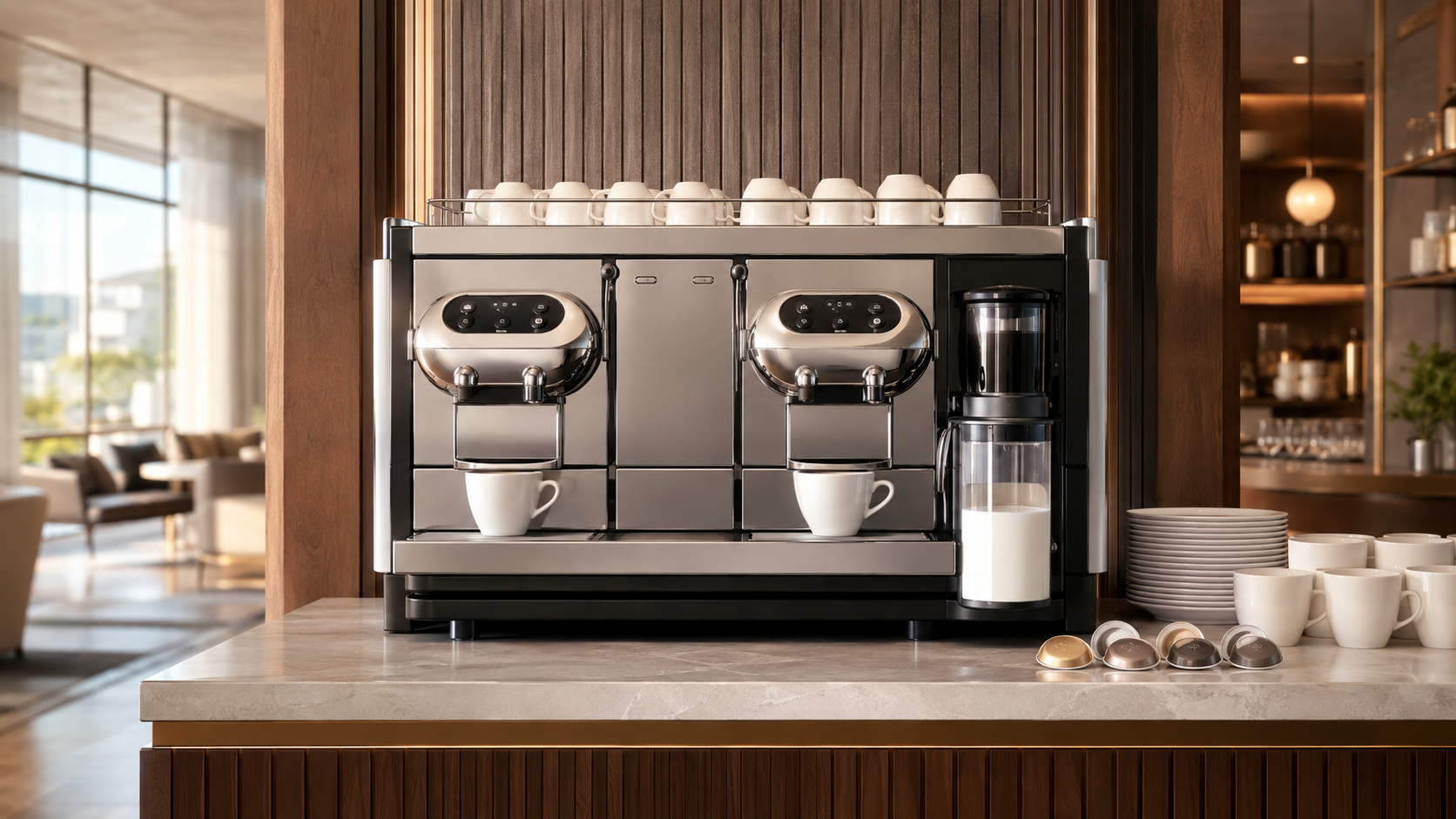
Nespresso Aguila 220 review shoppers are usually looking for a high-capacity commercial coffee machine that can prepare espresso, black coffee, and fresh-milk drinks with speed and consistency. With two extraction heads, an integrated refrigerated milk system, programmable one-touch recipes, and commercial-grade components, the Aguila 220 is built for demanding professional environments rather than ordinary home kitchens.
This machine can serve two black coffees at the same time and automatically prepare drinks such as cappuccino, latte macchiato, and flat white. It also dispenses hot milk, hot milk foam, cold milk foam, and hot water, giving businesses a broader menu than most standard capsule machines.
However, the Aguila 220 is large, heavy, expensive, and dependent on professional installation and disciplined daily cleaning. It is a serious commercial appliance—not the sort of machine you casually squeeze between the office microwave and somebody’s forgotten lunchbox.
In this Nespresso Aguila 220 review, we examine its coffee quality, milk performance, capacity, speed, cleaning requirements, operating costs, advantages, disadvantages, and ideal business users.
Nespresso Aguila 220 Review: Quick Verdict
The Nespresso Aguila 220 is a powerful commercial capsule machine for businesses that need fast, repeatable coffee service without operating a traditional barista station. Its two extraction heads reduce waiting times, while the integrated milk system allows staff or customers to prepare popular café-style beverages with minimal training.
Overall Rating: 4.6/5
| Category | Rating |
|---|---|
| Coffee Consistency | 4.6/5 |
| Milk Drink Performance | 4.7/5 |
| Speed and Capacity | 4.8/5 |
| Ease of Use | 4.5/5 |
| Cleaning and Maintenance | 3.9/5 |
| Commercial Value | 4.5/5 |
Best For
- Hotels and breakfast areas
- Large corporate offices
- Conference and event venues
- Premium customer lounges
- Restaurants and catering businesses
- Self-service stations with heavy daily demand
- Locations serving both black coffee and milk drinks
- Businesses needing two simultaneous coffee extractions
Consider Another Machine If
- Your workplace serves fewer than 50 drinks per day
- Counter and utility space are limited
- Staff cannot complete daily milk-system cleaning
- You want freshly ground coffee and manual espresso control
- Your business mainly serves occasional black coffee
- Professional installation is not practical
- Initial and ongoing operating costs must remain very low
Smaller offices may receive better value from our Nespresso Momento 100 review. Workplaces that want automated fresh-milk drinks but do not require such high capacity should also compare the Aguila with the Nespresso Momento 120 review.
What Is the Nespresso Aguila 220?
The Nespresso Aguila 220 is a high-capacity professional capsule coffee machine manufactured for commercial food-service and hospitality environments. It uses Nespresso Professional capsules rather than the Original or Vertuo capsules sold for home machines.
The machine combines three important systems:
- Two independent coffee extraction heads
- An integrated refrigerated fresh-milk system
- Programmable one-touch beverage controls
This combination allows the Aguila 220 to produce two black coffees simultaneously or prepare automated coffee-and-milk recipes with consistent proportions.
Unlike the touchscreen-driven Momento range, the Aguila 220 uses dedicated beverage buttons and digital displays above its two extraction areas. Users insert a capsule, lower the appropriate lever, and press the required recipe button.
The available selections can include:
- Ristretto
- Espresso
- Lungo
- Americano-style coffee
- Cappuccino
- Latte
- Latte macchiato
- Flat white
- Espresso macchiato
- Hot milk
- Hot milk foam
- Cold milk foam
- Hot water
- Programmable custom recipes
Recipe availability and button configuration can vary by country, installation, and business agreement. Buyers should confirm the exact menu with their regional Nespresso Professional representative.
Nespresso Aguila 220 Specifications
Specifications can differ slightly between markets and electrical configurations. The following table provides a practical overview based on current regional Nespresso Professional information.
| Specification | Nespresso Aguila 220 |
|---|---|
| Machine Type | High-capacity commercial capsule machine |
| Capsule System | Nespresso Professional |
| Coffee Extraction Heads | Two |
| Simultaneous Black Coffees | Yes |
| Milk System | Integrated fresh-milk system |
| Refrigerated Milk Container | Approximately 5 liters |
| Used-Capsule Capacity | Approximately 125 capsules or more, depending on configuration |
| Dimensions | Approximately 65 × 69 × 64 cm |
| Empty Weight | Approximately 75 kg |
| Operational Weight | Up to approximately 90 kg |
| Pump Pressure | Up to 19 bar in supported configurations |
| Boilers | Three |
| Coffee Sizes | Ristretto, espresso, and lungo |
| Milk Functions | Hot milk, hot foam, and cold foam |
| Hot Water Outlet | Yes |
| Cup Storage | Two upper cup-storage areas |
| Heated Cup Area | Available |
| Water Supply | Direct water connection |
| Drainage | Professional fixed installation may be required |
| Interface | Dedicated buttons and digital displays |
| Energy-Saving Mode | Yes |
The Aguila 220’s size and weight immediately separate it from the Nespresso Momento 200. Although both have two coffee heads, the Aguila adds an integrated refrigerated milk system and a more intensive commercial design.
Businesses should not purchase the machine before confirming:
- Counter strength and depth
- Electrical requirements
- Water connection
- Drainage requirements
- Ventilation clearance
- Technician access
- Local installation regulations
- Service-plan availability
Regional versions may have different power ratings and connection requirements. A professional installer or Nespresso representative should verify the site rather than relying solely on specifications found online.
1. Two Extraction Heads Improve Service Speed
One of the strongest reasons to consider the Aguila 220 is its dual-head design. Each coffee side has its own capsule insertion point, lever, outlet, and controls.
This means the machine can prepare two black coffees simultaneously. During a hotel breakfast, conference break, or busy office morning, two guests can use the machine at the same time instead of waiting for every drink to finish sequentially.
Why Two Heads Matter
A single-head capsule machine may perform well when drinks are ordered gradually. The limitation becomes more noticeable when many users arrive together.
For example, suppose 20 employees want coffee during a 15-minute break. A single-head machine must complete 20 separate extraction cycles. A dual-head machine can prepare pairs of black coffees, potentially reducing the extraction portion of the queue.
Actual service time still depends on:
- Selected drink sizes
- Number of milk beverages
- User familiarity
- Cup availability
- Capsule restocking
- Milk supply
- Cleaning or rinse cycles
- Congestion around the machine
The Aguila 220 does not magically turn every queue into a quiet spa experience, but the second extraction head makes a meaningful difference during concentrated demand.
Independent Coffee Selection
The two heads can generally prepare different coffee sizes at the same time. One user may choose an espresso while another selects a lungo, provided each person inserts a compatible Professional capsule and follows the operating controls.
This flexibility suits workplaces where employees have varied preferences. It also helps hotels and catered events serve guests without forcing everyone to choose the same beverage.
For businesses that want dual extraction but do not require integrated fresh milk, our Nespresso Momento 200 review explains the advantages of a simpler two-head professional system.
2. The Integrated Fresh-Milk System Expands the Menu
The Aguila 220 is more than a high-volume black-coffee machine. Its integrated fresh-milk system allows it to prepare milk-based beverages without requiring a separate steam wand or countertop frother.
Milk is stored inside the machine’s refrigerated compartment and drawn automatically for the selected recipe. Depending on the programmed beverage, the system can dispense:
- Hot milk
- Hot milk foam
- Cold milk foam
- Steamed milk for coffee recipes
- Different milk and foam quantities
This allows the machine to create cappuccinos, lattes, latte macchiatos, flat whites, and other customized beverages at the press of a button.
Automated Consistency
Traditional milk steaming depends heavily on the operator’s experience. Temperature, aeration, texture, and pouring technique can change from one drink to the next.
The Aguila 220 automates these variables. Once a recipe is programmed correctly, it delivers a repeatable milk quantity and texture. This provides several commercial advantages:
- Minimal barista training
- Faster preparation
- More consistent drink presentation
- Reduced milk-handling mistakes
- Easier self-service
- Less countertop equipment
- Predictable recipe costs
Automated foam will not provide the same artistic control as a skilled barista using a commercial steam wand. Nevertheless, consistent milk drinks are usually more valuable than latte art in an office, hotel breakfast room, or conference venue.
Cold Milk Foam
Cold milk foam is an important feature because many automatic office machines only prepare heated milk. The Aguila 220 can use cold foam for chilled or specialty recipes, expanding the menu beyond conventional hot cappuccinos and lattes.
The precise results depend on milk temperature, composition, freshness, and machine settings. Dairy milk formulated with an appropriate balance of protein and fat typically produces dependable foam.
Plant-based products may behave differently. Barista-style oat, soy, or almond drinks can offer better stability than standard alternatives, but compatibility should be confirmed with the local service provider before routine use.
3. It Is Built for High-Demand Commercial Locations
The Aguila 220 occupies a higher commercial category than standard office capsule machines. Its substantial construction, two coffee heads, multiple boilers, direct water supply, refrigerated milk system, and large used-capsule container are intended to support demanding service.
Suitable environments may include:
- Large office buildings
- Hotel breakfast rooms
- Executive lounges
- Business-class hospitality areas
- Conference centers
- Restaurants
- Event venues
- Premium retail showrooms
- Healthcare hospitality areas
- High-traffic coworking spaces
Nespresso’s exact recommended daily volume may vary by regional program and service agreement. Rather than choosing only by a published cup number, businesses should measure both total daily demand and peak-period demand.
Daily Volume Is Only Part of the Calculation
Two businesses can each serve 150 drinks per day but place very different demands on the machine.
A corporate office may spread those beverages across nine hours. A hotel may prepare most of them during a two-hour breakfast window. The second environment requires faster restocking, closer milk monitoring, and better queue management.
Before purchasing, estimate:
- Total drinks per day
- Drinks required during the busiest 30 minutes
- Percentage of milk-based beverages
- Average serving size
- Amount of milk consumed
- Number of decaffeinated orders
- Disposable versus reusable cup use
- Staff available for cleaning and restocking
If a business only prepares 30–80 drinks per day, the Aguila 220 may be oversized. The more compact Nespresso Momento 120 may be easier to install and maintain while still providing automated milk recipes.
Large Used-Capsule Capacity
A high-capacity used-capsule container reduces how frequently staff need to interrupt service. Some regional Aguila 220 specifications list a capacity of approximately 125 capsules, although configurations may differ.
Even a large container must be checked regularly. Used capsules retain moisture, and leaving them inside for extended periods can create odors and hygiene problems. The container should be emptied according to the official daily care routine rather than waiting until it overflows.
4. Coffee Quality Is Reliable and Consistent
A practical Nespresso Aguila 220 review must consider whether the coffee quality matches the machine’s commercial price and size. The Aguila 220 produces dependable capsule coffee with minimal variation between users, but it does not provide the flexibility of freshly ground commercial espresso.
Each Nespresso Professional capsule contains a measured amount of ground coffee sealed against air and moisture. The machine controls water temperature, pressure, and beverage volume according to the selected recipe.
This system offers several workplace advantages:
- Consistent strength and serving size
- No grinder calibration
- No weighing or tamping
- Minimal loose coffee grounds
- Fast preparation
- Simple staff training
- Predictable ingredient use
The exact flavor depends primarily on the selected Professional capsule. The range includes mild, intense, decaffeinated, single-origin, and flavored options, although availability varies by region.
Espresso and Black Coffee
Espresso generally delivers the strongest aroma and most concentrated body. Depending on the capsule, users may notice cereal, cocoa, roasted, woody, spicy, or fruity characteristics.
Lungo produces a larger, milder beverage. For an Americano-style drink, the machine can combine extracted coffee with hot water rather than forcing excessive water through one capsule.
This distinction matters because repeatedly extracting the same capsule can create a thin or bitter cup. Businesses should program suitable recipes and provide cups that match each beverage size.
Readers who want to understand the extraction process can visit our guide to how Nespresso machines work.
Milk Changes the Flavor Balance
Milk softens acidity, bitterness, and roast intensity. A mild capsule may disappear beneath a large latte, while a stronger selection usually retains more coffee character.
Businesses can improve results by offering:
- Mild capsules for espresso and lungo
- Medium-roast capsules for smaller milk drinks
- Intense capsules for cappuccino and latte
- Decaffeinated options
- Clear labels describing intensity and flavor
The Aguila 220 cannot adjust grind size, dose, tamping pressure, or extraction ratio like a traditional espresso setup. Its strength lies in consistency rather than customization.
For a detailed comparison of both formats, see our guide to Nespresso vs espresso machines.
5. One-Touch Operation Reduces Training
Despite its commercial construction, the Aguila 220 is relatively straightforward to operate. Dedicated drink buttons and digital displays allow employees or guests to select recipes without navigating a complicated barista interface.
A typical black-coffee preparation follows these steps:
- Place a suitable cup beneath the outlet.
- Lift the capsule lever.
- Insert a Nespresso Professional capsule.
- Close the lever.
- Press the required beverage button.
- Remove the drink when preparation finishes.
Milk recipes may require the user to insert a capsule and select a programmed cappuccino, latte, or latte macchiato button. The machine then controls the coffee and milk sequence automatically.
Programmable Recipes
Authorized technicians or operators may configure drink volumes and recipes to suit the business. This allows a hotel, office, or restaurant to create a menu that matches its cups and customer expectations.
Programmable options may include:
- Coffee volume
- Hot-water quantity
- Milk quantity
- Foam quantity
- Recipe sequence
- Button allocation
Settings and customization access can depend on the installed configuration and service agreement. Businesses should avoid changing technical settings without proper guidance because poorly matched volumes can cause overflowing cups or weak drinks.
Current features and regional service options can be checked through the official Nespresso Professional Aguila 220 product page. Keep this external link set to dofollow so Rank Math can recognize it as an outbound link.
Self-Service Versus Staff Operation
The machine can support self-service, but the surrounding station must be organized carefully. Capsules, cup sizes, lids, sugar, stirrers, and waste disposal should be easy to identify.
A staffed environment may operate more efficiently during peak demand because one trained person can:
- Load capsules quickly
- Prepare two drinks simultaneously
- Monitor the milk level
- Prevent incorrect cup placement
- Wipe spills immediately
- Keep the serving line moving
For public self-service, concise instructions near the machine can reduce confusion. Otherwise, someone will eventually press every button at once as though entering a coffee-themed video-game cheat code.
6. Milk Performance Is Designed for Repeatability
The automated milk system is one of the strongest features identified in this Nespresso Aguila 220 review. It removes the need for manual steaming while providing several milk textures for different recipes.
The system can dispense hot milk, hot foam, and cold foam. Cappuccino can receive a more prominent foam layer, while latte recipes use a larger quantity of smoother milk.
How the Texture Compares With a Steam Wand
The Aguila 220 produces consistent commercial milk foam, but it is not identical to hand-textured microfoam from a skilled barista.
A traditional steam wand provides greater control over:
- Milk temperature
- Aeration
- Foam thickness
- Microfoam texture
- Pouring technique
- Latte-art quality
However, manual steaming requires training and creates greater variation between operators. In a hotel breakfast room or office lounge, dependable automated foam is often more practical than artistic control.
Dairy and Plant-Based Options
Fresh dairy milk generally produces the most predictable foam. Protein, fat content, temperature, and freshness influence the final texture.
Plant-based drinks may also work, especially barista-formulated products, but results vary. Oat, soy, and almond drinks can produce different foam stability and separation.
Before switching milk products, businesses should confirm compatibility with their Nespresso Professional service provider. They must also consider:
- Allergen management
- Cross-contact risks
- Separate milk requirements
- Refrigeration
- Cleaning procedures
- Product shelf life
- Foam consistency
A single internal milk system may be inconvenient for venues that frequently alternate between dairy and several plant-based products. In that situation, a separate approved frother or another commercial setup may provide safer flexibility.
7. The Five-Liter Milk Capacity Supports Busy Service
The Aguila 220 commonly includes an integrated milk container with an approximate five-liter capacity. This is considerably larger than the milk storage offered by many medium-volume office machines.
Nevertheless, five liters can disappear quickly when customers choose large beverages.
Estimating Daily Milk Demand
Suppose a hotel prepares 60 milk-based drinks during breakfast, with each drink using an average of 140 ml:
60 drinks × 140 ml = 8.4 liters of milk
The five-liter container would require replenishment during service.
If 30 cappuccinos use an average of 100 ml:
30 drinks × 100 ml = 3 liters of milk
One properly filled container may be sufficient, although cleaning cycles and recipe variations can affect the practical amount available.
Businesses should calculate milk demand using their actual menu rather than relying only on the number of customers.
Refrigeration and Food Safety
The internal refrigeration system helps maintain suitable milk conditions during operation. However, refrigeration does not eliminate hygiene responsibilities.
Staff should:
- Use fresh milk within its safe date
- Check milk temperature regularly
- Avoid mixing old and new milk indefinitely
- Clean the container as directed
- Follow local food-safety requirements
- Never leave disconnected milk components warm
- Discard milk when safety is uncertain
Milk should be replenished by a designated employee during busy service. Responsibility cannot be left to “whoever notices first,” because that particular employee appears to work at remarkably few businesses.
8. Installation Requires Professional Planning
The Aguila 220 is not a plug-and-play countertop appliance. Its substantial weight, direct water connection, electrical requirements, refrigeration system, drainage needs, and servicing clearances demand professional site preparation.
With approximate dimensions near 65 cm wide, 69 cm deep, and 64 cm high, it occupies more space than most office capsule machines. Its operating weight can approach approximately 90 kg after water, milk, capsules, and accessories are added.
Counter and Clearance Requirements
The installation area should provide:
- A strong, level commercial counter
- Adequate depth
- Space above the cup-warming area
- Access to the capsule containers
- Front clearance for users
- Side or rear access for technicians
- Safe ventilation
- Nearby cup and capsule storage
- Convenient waste disposal
A lightweight cabinet or movable household trolley is unsuitable. The surface must support the machine continuously without flexing or becoming unstable.
Water, Drainage, and Filtration
The machine normally requires a direct water connection. Depending on the local setup, fixed drainage may also be necessary.
Before installation, a technician should assess:
- Water pressure
- Water hardness
- Filtration requirements
- Drain position
- Hose routing
- Backflow regulations
- Shutoff-valve access
- Electrical supply
- Local plumbing codes
Hard water can create scale inside boilers, valves, and water pathways. Suitable filtration may improve beverage quality and reduce mineral buildup, but filters must be replaced on schedule.
Electrical Requirements
Commercial versions may use different voltages, phases, plugs, and power ratings. Buyers should confirm the exact regional model before arranging electrical work.
The machine should have an approved dedicated supply when required. Extension cords and overloaded shared outlets are not appropriate for high-powered commercial coffee equipment.
9. Counter Layout Affects Service Efficiency
A high-capacity machine can still create slow service if the coffee station is poorly arranged. The Aguila 220 needs enough surrounding space for two users or one busy operator to work comfortably.
A practical layout places:
- Cups beneath or beside the relevant extraction area
- Capsules within easy reach
- Decaffeinated capsules in a clearly separated container
- Sugar and stirrers away from the machine controls
- Napkins near the collection point
- Waste disposal beyond the preparation area
- Cleaning cloths in a staff-only location
Because the machine has two extraction heads, the station should allow both positions to remain accessible. Placing the unit tightly against a wall or beside another appliance can prevent users from benefiting fully from simultaneous brewing.
Managing Hotel and Conference Queues
For breakfast rooms and event venues, pre-arranging cups and organizing capsules by intensity can speed up service. During especially busy periods, assigning an employee to the machine may be more efficient than unrestricted self-service.
The employee can start two black coffees together, prepare milk recipes, monitor supplies, and direct completed drinks to the correct guests.
Businesses deciding between office-scale and hospitality-scale equipment may also find our best office coffee machines guide useful for comparing volume, drink variety, maintenance, and available space.
10. Capacity Must Be Judged by Peak Demand
The Aguila 220 is designed for demanding commercial use, but no machine provides unlimited throughput. Black coffees can be prepared rapidly using both extraction heads, while complex milk drinks require additional dispensing time.
This Nespresso Aguila 220 review recommends evaluating the busiest 15–30 minutes rather than looking only at daily totals.
Consider:
- How many customers arrive together
- What percentage order milk drinks
- Whether one or two people operate the machine
- How often capsules and milk require replenishment
- Whether cups are pre-positioned
- How frequently rinse cycles interrupt service
- Whether a second beverage station is available
A single Aguila 220 may comfortably manage steady demand throughout the day but face queues when a large conference group takes a break simultaneously.
For extremely concentrated demand, businesses may need:
- A second coffee machine
- A staffed serving line
- Pre-brewed filter coffee
- Separate hot-water service
- A simplified peak-time menu
The Aguila 220’s dual heads provide a meaningful advantage, but milk recipes still share parts of the automated system. Capacity planning should therefore include the expected drink mix, not merely the machine’s number of coffee outlets.
11. Daily Cleaning Is a Serious Responsibility
A complete Nespresso Aguila 220 review must emphasize that the integrated fresh-milk system requires disciplined cleaning. The convenience of automated cappuccinos and lattes comes with stricter hygiene requirements than a basic black-coffee capsule machine.
Milk residue can accumulate inside containers, tubes, outlets, and internal components. If cleaning is delayed, it may affect:
- Food safety
- Milk flavor
- Foam consistency
- Beverage temperature
- Machine reliability
- Unpleasant odors
- Service costs
The Aguila 220 includes automated cleaning programs, but automation does not mean the machine cleans itself without staff involvement. Employees must start the correct cycle, add the approved cleaning product when required, handle removable components, and confirm that the process finishes successfully.
Typical Daily Cleaning Tasks
The exact routine must follow the official manual and service agreement, but daily responsibilities may include:
- Running the milk-system cleaning program
- Using the approved cleaning tablets or solution
- Cleaning the refrigerated milk container
- Wiping the milk and coffee outlets
- Emptying the used-capsule containers
- Cleaning and rinsing the drip trays
- Wiping the control buttons and displays
- Checking the hot-water outlet
- Cleaning spills around the coffee station
- Inspecting milk tubes and removable components
The milk container should not simply receive fresh milk on top of yesterday’s remaining supply. It must be emptied and cleaned according to the recommended hygiene schedule.
Assign a Responsible Employee
Businesses should designate specific employees to handle opening, daytime checks, and closing procedures. A written checklist can prevent tasks from being forgotten during shift changes.
A practical routine might include:
- Check the machine, milk temperature, and supplies before service.
- Monitor milk and capsule levels during operating hours.
- Empty waste containers before they become completely full.
- Wipe spills immediately.
- Complete the required milk-cleaning cycle after service.
- Record faults or warning messages for the next shift.
- Contact the service provider when an alert cannot be resolved.
Without clear responsibility, everyone assumes someone else has cleaned the machine. Sadly, “someone else” remains the least reliable employee in the entire hospitality industry.
Cleaning Products and Instructions
Only cleaning products approved for the specific machine should be used. Household detergent, improvised chemicals, or unapproved descalers may damage components, leave residue, or affect warranty coverage.
The official Nespresso Professional Aguila 220 product page can provide regional product information, but businesses should follow the operating and cleaning instructions supplied with their installed machine.
12. Descaling and Professional Servicing Add Ongoing Costs
Daily cleaning protects the milk and dispensing systems, while descaling addresses mineral deposits created by the water supply. The required frequency depends on:
- Water hardness
- Filtration quality
- Daily beverage volume
- Machine alerts
- Local water conditions
- Manufacturer recommendations
Mineral buildup may restrict water flow, reduce heating efficiency, alter drink temperature, and place additional strain on internal components.
A suitable commercial water filter can help control scale and improve taste, but filters must be replaced at the correct intervals. Installing a filtration system and then forgetting about it is rather like buying a gym membership and expecting the treadmill to exercise on your behalf.
Professional Maintenance
The Aguila 220 contains multiple boilers, refrigeration components, milk pathways, pumps, valves, electronic controls, and two extraction systems. Some maintenance procedures must therefore be completed by an authorized technician.
Professional servicing may be required for:
- Refrigeration faults
- Boiler or heating problems
- Pump failure
- Leaking valves or seals
- Blocked internal milk lines
- Temperature inconsistencies
- Electronic display faults
- Water-supply problems
- Drainage issues
- Persistent warning messages
- Worn coffee outlets or capsule mechanisms
Businesses should confirm whether preventive servicing, labor, replacement parts, and emergency callouts are included in the purchase, rental, or lease agreement.
Nespresso Aguila 220 Operating Costs
The machine’s quoted price is only one part of its total cost. This Nespresso Aguila 220 review recommends calculating expenses across the expected ownership or contract period.
Ongoing costs can include:
- Nespresso Professional capsules
- Fresh dairy or plant-based milk
- Cleaning tablets and supplies
- Water filters
- Descaling products
- Preventive maintenance
- Emergency repairs
- Electricity
- Disposable cups and lids
- Sugar, stirrers, and napkins
- Staff cleaning and restocking time
- Product delivery charges
- Rental or lease payments
Commercial pricing often varies by country, contract length, capsule volume, installation requirements, and service package. Businesses should request a written quotation showing both initial and recurring costs.
Example Cost per Milk Drink
The following amounts are illustrative and are not current Nespresso prices:
| Cost Component | Example Cost |
|---|---|
| Professional capsule | $0.70 |
| Fresh milk | $0.35 |
| Disposable cup and lid | $0.20 |
| Cleaning and filtration allowance | $0.12 |
| Service allowance | $0.18 |
| Estimated Cost per Drink | $1.55 |
A black coffee prepared in a reusable cup may cost considerably less. Large milk drinks, premium plant-based products, disposable packaging, and intensive service coverage can increase the cost.
Compare the Real Alternatives
The Aguila 220 may seem expensive compared with a compact capsule machine, but the correct comparison depends on the business.
A traditional commercial espresso station may require:
- A commercial espresso machine
- One or two grinders
- Water treatment
- Barista training
- Daily grinder adjustment
- Manual milk steaming
- More preparation space
- Greater cleaning time
- Additional staff during busy periods
The Aguila 220 sacrifices some fresh-ground flavor and manual control in exchange for speed, repeatability, easier operation, and predictable ingredient use.
Nespresso Aguila 220 Pros and Cons
Pros
- Two independent coffee extraction heads
- Two black coffees can be prepared simultaneously
- Automated fresh-milk beverages
- Hot milk, hot foam, and cold foam functions
- Large refrigerated milk capacity
- Consistent capsule extraction
- Minimal barista training required
- Programmable drink recipes
- Suitable for high-demand commercial service
- Large used-capsule capacity
- No grinder calibration or manual tamping
- Less loose coffee mess than a traditional espresso station
- Dedicated hot-water outlet
- Strong hospitality and office versatility
Cons
- Large footprint
- Extremely heavy compared with office capsule machines
- Professional installation is required
- Direct water and suitable drainage may be necessary
- Daily milk-system cleaning is mandatory
- High initial or contractual cost
- Ongoing capsule and milk expenses
- Limited extraction control
- Restricted to Nespresso Professional capsules
- Automated foam offers less control than a steam wand
- Plant-based milk performance may vary
- Multiple milk types can create cross-contact concerns
- Requires trained staff for cleaning and restocking
- May be excessive for low-volume workplaces
Nespresso Aguila 220 vs Momento 120
The Aguila 220 and Momento 120 can both prepare automated fresh-milk beverages, but they serve different levels of demand.
| Feature | Aguila 220 | Momento 120 |
|---|---|---|
| Coffee Extraction Heads | Two | One |
| Simultaneous Black Coffees | Yes | No |
| Fresh-Milk System | Yes | Yes |
| Milk Storage | Approximately 5 liters | Smaller commercial milk container |
| Interface | Dedicated buttons and displays | Color touchscreen |
| Installation | Fixed professional setup | Tank or supported direct-water configuration |
| Footprint | Very large | Large |
| Best Use | Hotels and high-demand venues | Medium-sized workplaces |
| User Experience | Traditional commercial controls | Guided touchscreen operation |
| Cleaning Requirement | Intensive daily milk cleaning | Daily milk cleaning |
Choose the Aguila 220 when peak service speed, two extraction heads, and greater milk capacity justify its size and installation demands.
Choose the Momento 120 when automated milk drinks are important but daily volume is moderate. Our complete Nespresso Momento 120 review covers its touchscreen interface, capacity, maintenance, and ideal workplace size.
Nespresso Aguila 220 vs Momento 200
Both machines provide two extraction heads, but their beverage capabilities are substantially different.
| Feature | Aguila 220 | Momento 200 |
|---|---|---|
| Coffee Heads | Two | Two |
| Simultaneous Coffee | Yes | Yes |
| Integrated Fresh Milk | Yes | No |
| Milk Foam Options | Hot and cold | Not integrated |
| Installation Complexity | Higher | Lower |
| Cleaning Workload | High | Moderate |
| Footprint and Weight | Significantly larger | More compact |
| Primary Strength | High-volume coffee and milk drinks | Fast black-coffee service |
| Best For | Hotels and hospitality venues | Busy offices and self-service stations |
The Momento 200 is the more practical option when most customers want espresso, lungo, or Americano-style drinks. It eliminates the refrigeration and milk-cleaning responsibilities associated with the Aguila.
Read our Nespresso Momento 200 review for a detailed assessment of its dual-head design.
Nespresso Aguila 220 vs Traditional Espresso Machine
The choice between the Aguila 220 and a traditional commercial espresso machine depends on whether a business values consistency and convenience or manual control and specialty-coffee quality.
| Consideration | Aguila 220 | Traditional Espresso Machine |
|---|---|---|
| Coffee Format | Sealed Professional capsules | Freshly ground beans |
| Staff Training | Relatively low | Moderate to extensive |
| Grinder Required | No | Yes |
| Tamping Required | No | Yes |
| Milk Preparation | Automated | Manual steam wand |
| Drink Consistency | Very high | Depends on barista skill |
| Extraction Control | Limited | Extensive |
| Latte-Art Potential | Limited | High |
| Loose Coffee Waste | Minimal | Greater |
| Specialty-Coffee Capability | Limited | High |
| Workflow | One-touch focused | Operator focused |
A specialty café should generally choose a traditional espresso system because customers expect freshly ground coffee, recipe adjustment, skilled milk steaming, and greater flavor control.
The Aguila 220 is more appropriate for hotels, offices, lounges, and event venues where different employees or guests must produce consistent drinks quickly.
Who Should Buy the Nespresso Aguila 220?
The Aguila 220 is best suited to businesses with high drink demand, concentrated service periods, and substantial interest in milk-based beverages.
It may be a strong choice for:
- Hotels serving busy breakfast periods
- Large corporate offices
- Conference and convention venues
- Executive and airport-style lounges
- Restaurants offering convenient coffee service
- Premium car dealerships and retail showrooms
- Catering and event facilities
- Healthcare hospitality areas
- High-traffic coworking spaces
- Businesses needing two simultaneous coffee extractions
- Locations with staff available for daily cleaning
The strongest buying case exists when a business needs both rapid black-coffee preparation and automatic fresh-milk drinks. Smaller systems often provide one of those advantages but not both.
Who Should Skip It?
This Nespresso Aguila 220 review does not recommend the machine for every workplace.
Consider another option if:
- Daily demand is relatively low
- Most users drink only black coffee
- Counter space is limited
- The site cannot support direct plumbing
- The counter cannot safely hold the machine
- Staff cannot complete daily cleaning
- Several plant-based milk choices are required
- Freshly ground specialty coffee is a priority
- Manual drink customization is important
- The budget does not support commercial servicing
- Demand occurs only occasionally
A small or medium office may achieve better value with a Momento model. Businesses comparing several capacity levels can also consult our best office coffee machines guide.
Frequently Asked Questions
Is the Nespresso Aguila 220 suitable for an office?
Yes, but this Nespresso Aguila 220 review recommends it mainly for large offices with substantial daily demand. Its dual extraction heads and automated milk system can serve busy teams efficiently, especially when many employees want cappuccinos, lattes, and other milk-based drinks.
For a smaller workplace, the Aguila 220 may be unnecessarily large and expensive. A Nespresso Momento 100 or Nespresso Momento 120 may provide better value.
How many coffees can the Nespresso Aguila 220 make per day?
The practical capacity depends on the drink mix, peak demand, milk consumption, cleaning interruptions, and regional service recommendations. The Aguila 220 is positioned for high-demand professional environments rather than small offices.
Two black coffees can be extracted simultaneously, but milk-based beverages require additional preparation time. Businesses should ask their Nespresso Professional representative to confirm whether the machine matches their expected daily and peak-period volume.
Can the Aguila 220 make two coffees at the same time?
Yes. The machine has two independent coffee extraction heads, allowing it to prepare two black coffees simultaneously. Each user can generally select a different coffee size, such as espresso or lungo.
This dual-head system is one of the most important advantages highlighted in this Nespresso Aguila 220 review, particularly for hotels, conference venues, and large workplaces.
Can it prepare two cappuccinos simultaneously?
The machine has two coffee heads, but milk preparation uses its integrated milk system. The precise simultaneous workflow can depend on the selected recipes and machine configuration.
Businesses expecting large numbers of cappuccinos or lattes during short service periods should request a live demonstration using their intended cups and recipes before committing to the machine.
Does the Nespresso Aguila 220 use regular capsules?
No. It uses flat, disc-shaped Nespresso Professional capsules. It is not compatible with Nespresso Original or Vertuo capsules.
Professional capsules are typically ordered through Nespresso’s business channel or an authorized regional supplier. Pricing, minimum orders, delivery arrangements, and available varieties may depend on the business contract.
Does the Aguila 220 grind fresh coffee beans?
No. The machine does not contain a grinder. It extracts coffee from pre-portioned Nespresso Professional capsules.
This system reduces training, preparation mess, and inconsistency. However, it does not offer the freshness or extraction control available from a commercial espresso machine using freshly ground beans.
What milk drinks can the Aguila 220 make?
Depending on its programming and regional configuration, the machine can prepare drinks such as:
- Cappuccino
- Latte
- Latte macchiato
- Flat white
- Espresso macchiato
- Hot milk
- Hot milk foam
- Cold milk foam
- Customized milk-and-coffee recipes
Buyers should confirm the exact programmed menu before installation because beverage buttons and recipe settings can vary.
Can the Aguila 220 use oat milk?
A compatible barista-style oat drink may work, but foam quality can differ from dairy milk. Protein content, fat, stabilizers, temperature, and formulation all influence the result.
Businesses should consult their Nespresso Professional representative before changing milk products. They must also establish appropriate procedures for allergen management and cross-contact.
Is the milk refrigerated inside the machine?
Yes. The Aguila 220 includes an integrated refrigerated fresh-milk system, commonly associated with an approximate five-liter container.
Refrigeration does not replace safe handling or daily cleaning. Milk temperature, freshness, storage time, and local food-safety requirements must still be monitored carefully.
How often does the Nespresso Aguila 220 need cleaning?
Milk-contact components require daily cleaning according to the official operating instructions. Drip trays, outlets, used-capsule containers, controls, and the surrounding service area also need regular attention.
Automated cleaning programs simplify the procedure, but staff must still initiate the cycle, use approved cleaning products, and clean designated removable components.
Does the Aguila 220 require plumbing?
Yes, professional installation typically includes a direct water connection, and an appropriate drainage arrangement may also be required. Exact requirements vary by regional machine version and installation site.
A qualified technician should assess water pressure, filtration, drainage, electrical supply, counter strength, and service access before delivery.
How much does the Nespresso Aguila 220 cost?
Public pricing is not always available because the final cost can depend on:
- Country and regional distributor
- Purchase, lease, or rental arrangement
- Installation requirements
- Capsule-order volume
- Water-filtration equipment
- Cleaning supplies
- Preventive maintenance
- Repair coverage
- Contract length
- Delivery and technician charges
Request a written quotation that separates the machine cost from recurring operating expenses. A low rental payment can look charming at first, but contracts occasionally grow extra financial tentacles.
Is the Nespresso Aguila 220 worth it?
The Aguila 220 can be worth the investment for a high-volume business that needs two simultaneous coffee extractions and automatic fresh-milk drinks. It provides speed, repeatability, menu variety, and relatively simple operation.
It is unlikely to offer good value for a small office, a black-coffee-only workplace, or a site without employees assigned to daily cleaning and restocking.
Final Verdict: Is the Nespresso Aguila 220 Worth Buying?
This Nespresso Aguila 220 review finds that the machine is a compelling commercial solution for hotels, large offices, conference venues, lounges, and hospitality businesses requiring both speed and beverage variety.
Its strongest feature is the combination of two coffee extraction heads and an integrated refrigerated milk system. Two black coffees can be prepared simultaneously, while programmed recipes make cappuccinos, lattes, flat whites, and other milk drinks accessible to users without barista training.
Coffee quality is consistent, preparation is relatively clean, and sealed Professional capsules make ingredient use easy to control. Dedicated buttons also allow employees and guests to operate the machine without navigating a complicated manual espresso workflow.
The trade-offs are substantial. The Aguila 220 is large, extremely heavy, and dependent on professional plumbing, electrical planning, water filtration, and servicing. Its milk system must be cleaned every day, and its ongoing capsule, milk, cleaning, and maintenance costs require careful budgeting.
Final Rating: 4.6/5
Choose the Aguila 220 if your business needs:
- Two simultaneous black coffees
- Automated fresh-milk beverages
- Strong peak-period performance
- Consistent recipes across different users
- Minimal barista training
- A commercial machine for sustained demand
Choose another machine if your location has low daily volume, limited counter space, no direct water connection, or insufficient staff for daily milk-system care.
The Nespresso Momento 120 is better suited to moderate demand with automated milk drinks. The Nespresso Momento 200 is a more practical choice when dual coffee extraction matters but integrated fresh milk does not.
Ultimately, the Aguila 220 is not simply a larger office capsule machine. It is a specialized hospitality appliance whose value depends on using its capacity, dual heads, and milk functions frequently enough to justify the installation and maintenance commitment.
Related Articles
- Nespresso Momento 120 Review: 10 Things to Know
- Nespresso Momento 200 Review: Dual-Head Office Coffee Machine
- Nespresso Momento 100 Review: Is It Right for Your Office?
- How Do Nespresso Machines Work?
- Nespresso vs Espresso Machine: Which Is Better?
- Best Office Coffee Machines
- How to Clean a Nespresso Machine