
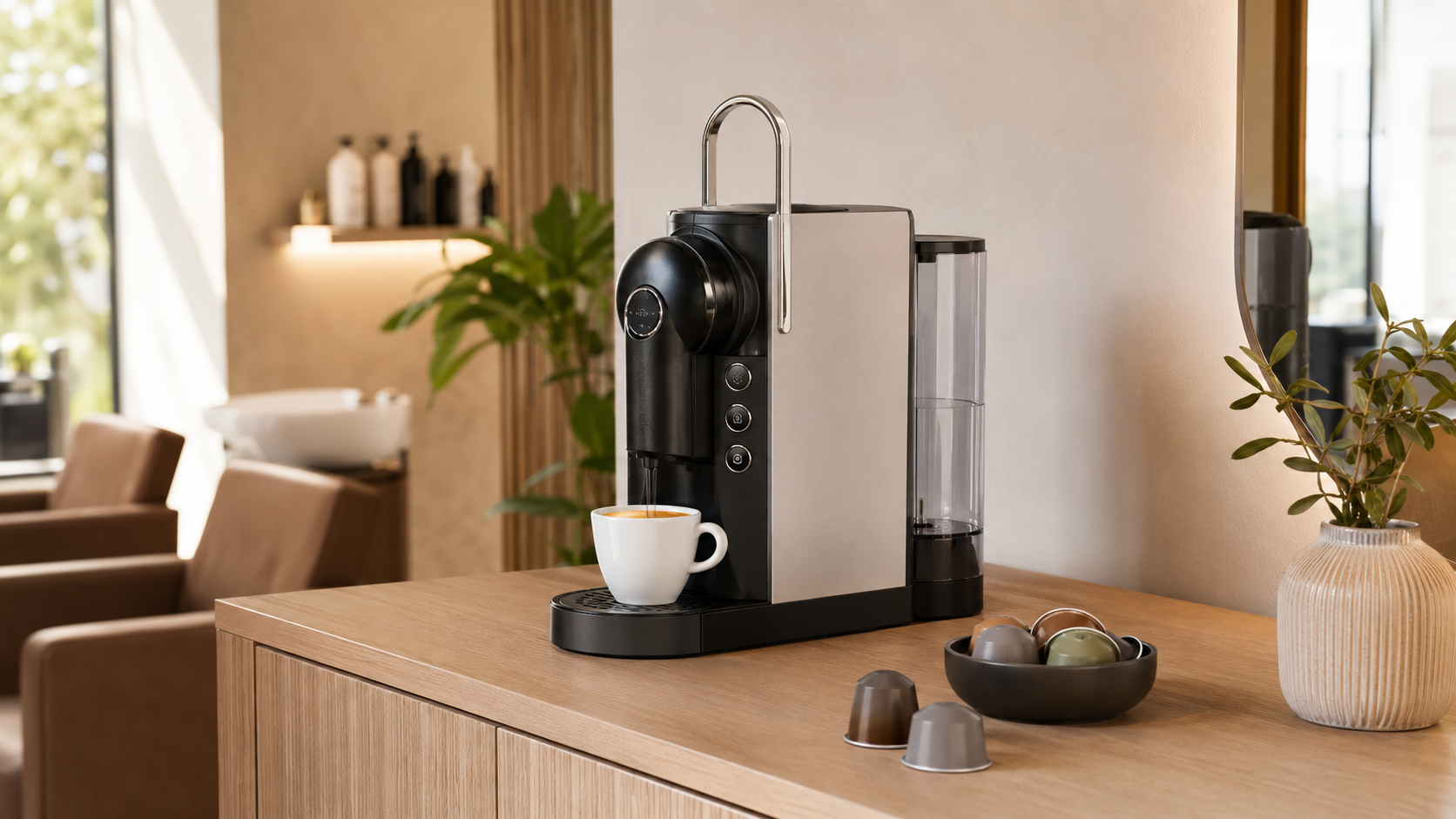
This Nespresso Zenius review explains whether the compact Professional capsule machine is worth buying for an office, salon, guesthouse, meeting room, or busy household in 2026.
The Zenius differs significantly from familiar home machines such as the CitiZ, Pixie, and Essenza Mini. It uses Nespresso Professional capsules, has a larger two-liter water tank, stores approximately 25 used capsules, and includes a separate hot-water function.
Its main features include:
- Nespresso Professional capsule system
- Ristretto, espresso, and lungo settings
- Dedicated hot-water outlet
- Up to 19-bar pump pressure
- Approximately 35-second heat-up
- Two-liter removable water tank
- Used-capsule capacity of approximately 25
- Programmable coffee volumes
- Adjustable coffee temperature
- Descaling and filter alerts
- Manual capsule insertion and ejection
- Commercially oriented construction
The Zenius is designed primarily for smaller professional environments rather than ordinary domestic kitchens. That distinction affects capsule availability, operating costs, maintenance, machine support, and whether it makes sense for your particular coffee routine.
Nespresso Zenius Review: Quick Verdict
The Nespresso Zenius is a strong choice for a small workplace that needs a straightforward capsule machine capable of preparing many drinks throughout the day.
Its large reservoir and capsule container reduce interruptions, while the dedicated hot-water outlet supports tea and Americano-style drinks. The physical coffee buttons are simple enough for customers, employees, and guests to use without detailed instructions.
However, the Zenius is not simply a larger Original Line machine. It accepts Nespresso Professional capsules only. Standard Original and Vertuo capsules do not fit.
This means the machine is most suitable when:
- Professional capsules are readily available in your region.
- The machine will prepare multiple drinks each day.
- A two-liter reservoir is genuinely useful.
- Simple, repeatable operation matters more than advanced customization.
- The business can access suitable maintenance or repair support.
- Users want espresso and lungo rather than large drip-style coffee.
- Counter space is available for its approximately 40-centimeter depth.
It may be a poor choice when:
- You want inexpensive third-party Original-compatible capsules.
- You already own a large supply of Original or Vertuo capsules.
- The machine will make only one or two coffees per day.
- You need automatic cappuccino or latte preparation.
- You prefer freshly ground coffee.
- Professional capsules are difficult to purchase locally.
- A compact domestic machine would provide enough capacity.
The Zenius remains available through Nespresso Professional in several markets, but prices, contracts, capsule ordering, warranty coverage, and service arrangements vary by country. Confirm local conditions before purchasing or importing one.
Nespresso Zenius at a Glance
| Feature | Nespresso Zenius |
|---|---|
| Capsule system | Nespresso Professional |
| Brewing pressure | Up to 19 bar |
| Heat-up time | Approximately 35 seconds |
| Coffee settings | Ristretto, espresso, and lungo |
| Hot-water function | Yes |
| Standard ristretto | Approximately 25 ml |
| Standard espresso | Approximately 40 ml |
| Standard lungo | Approximately 110 ml |
| Water reservoir | 2 liters |
| Used-capsule capacity | Approximately 25 capsules |
| Machine weight | Approximately 7 kg |
| Dimensions | Approximately 19 × 40 × 31 cm |
| Capsule insertion | Manual |
| Capsule ejection | Manual |
| Milk system | Not integrated |
| Best for | Small offices and professional self-service spaces |
These specifications are supported by the official Nespresso Zenius product information and Zenius user manual. Exact electrical ratings and regional specifications may differ.
What Is the Nespresso Zenius?
The Zenius is a compact machine in the Nespresso Professional range.
It was developed for environments such as:
- Small offices
- Meeting rooms
- Hair salons
- Boutiques
- Reception areas
- Guesthouses
- Hotel rooms
- Staff kitchens
- Small hospitality businesses
- Professional home offices
The machine combines the simple operation of a capsule brewer with greater water and waste capacity than most domestic Original models.
Its main controls include:
- Ristretto button
- Espresso button
- Lungo button
- Hot-water button
- Power button
- Temperature and programming functions
- Maintenance indicators
The user raises the lever, inserts a Professional capsule, closes the lever, and selects a drink. After preparation, the lever must be reopened to release the used capsule into the internal container.
Unlike machines with motorized capsule systems, the Zenius uses manual insertion and ejection. This requires one additional movement but avoids relying on a slider motor for routine capsule handling.
The machine does not grind coffee beans, steam milk, or automatically prepare cappuccino. Milk drinks require a separate frother or commercial milk solution.
1. It Uses Nespresso Professional Capsules
The most important fact in this Nespresso Zenius review is that the machine uses Nespresso Professional capsules.
It cannot use:
- Nespresso Original capsules
- Nespresso Vertuo capsules
- K-Cups
- Dolce Gusto capsules
- Ground coffee
- Standard reusable espresso baskets
Professional capsules have a flat, disc-like shape and are designed for compatible business machines such as the Zenius and selected Gemini models.
This dedicated capsule system provides several advantages in a workplace:
- Simple inventory management
- Consistent portioning
- Fast drink preparation
- Minimal loose coffee grounds
- Easy operation for multiple users
- Broad professional coffee selection
- Cleaner shared coffee areas
The primary limitation is purchasing flexibility. Original capsules are widely sold through multiple retail channels, and many third-party companies manufacture compatible options. Professional capsules may need to be ordered directly through Nespresso’s business service or an approved distributor, depending on the country.
Before buying a Zenius, confirm:
- Professional capsules are sold in your region.
- You are eligible to purchase them.
- Delivery quantities suit your actual consumption.
- The available varieties match user preferences.
- Per-capsule cost fits the workplace budget.
- Recycling or collection services are available if required.
Our guide to Nespresso Original vs Vertuo explains the two main consumer capsule systems, but neither is interchangeable with the Professional format used by the Zenius.
2. Three Coffee Sizes Cover the Essentials
The Zenius prepares three principal coffee sizes:
| Drink | Typical Factory Volume | Best Use |
|---|---|---|
| Ristretto | 25 ml | Short, intense coffee |
| Espresso | 40 ml | Standard concentrated serving |
| Lungo | 110 ml | Longer black coffee |
These settings cover the most common capsule-based drinks found in a small workplace.
Ristretto
The 25 ml ristretto setting produces the most concentrated result. It works well for users who prefer a short, intense drink or need a compact coffee base for a small milk beverage.
Espresso
The approximately 40 ml espresso setting is the most versatile choice. It can be served alone or used for:
- Cappuccino
- Latte
- Flat white-style drinks
- Mocha
- Iced latte
- Americano
Lungo
The approximately 110 ml lungo setting provides a longer black coffee. It works best with a capsule designed specifically for a larger extraction.
Extending a ristretto or espresso capsule too far may create thin body, woody bitterness, or a dry finish. For a larger drink, use a suitable lungo capsule or prepare an espresso and add hot water.
3. The Dedicated Hot-Water Function Is Practical
A separate hot-water function makes the Zenius more versatile than many basic capsule machines.
It can be used for:
- Americano-style coffee
- Tea
- Preheating cups
- Diluting a strong espresso
- Warming serving vessels
- Preparing other suitable hot drinks
To make a simple Americano:
- Place a suitable cup beneath the outlet.
- Brew one espresso capsule.
- Remove or eject the capsule.
- Dispense the preferred amount of hot water.
- Stir gently and serve.
Adding separate hot water is usually preferable to forcing a very large volume through one capsule. Excessive extraction can introduce unpleasant bitterness without adding meaningful coffee strength.
For a balanced starting point, combine:
- 40 ml espresso
- 100–150 ml hot water
- A preheated medium-sized cup
People who mainly drink full mugs of regular coffee should still compare the Zenius with Vertuo or drip machines. Our Nespresso vs espresso machine guide also explains how capsule convenience compares with freshly ground coffee, manual control, and ongoing costs.
4. The Two-Liter Water Tank Reduces Refilling
The removable two-liter reservoir is one of the strongest workplace benefits covered in this Nespresso Zenius review.
In theory, a full tank provides enough water for approximately:
- 80 standard 25 ml ristrettos
- 50 standard 40 ml espressos
- 18 standard 110 ml lungos
Actual capacity will be lower because water is also used for:
- Rinsing
- Hot-water servings
- Cup preheating
- Internal priming
- Cleaning
- Incomplete reservoir use
Even so, the reservoir is much larger than those fitted to many domestic Original machines.
For best results:
- Refill it with fresh drinking water each day.
- Rinse the reservoir regularly.
- Install it securely before brewing.
- Do not fill it with milk, hot water, or sparkling water.
- Check the valve and surrounding surface for leakage.
- Follow local guidance for water filtration.
The first part of this Nespresso Zenius review shows that its value comes from capacity and professional simplicity rather than flashy automation. It is essentially the dependable colleague who makes coffee without arranging another meeting about it.
5. Coffee Quality and Extraction Performance
The Zenius uses a pressure system rated at up to 19 bar, but pump pressure alone does not determine coffee quality.
Results also depend on:
- Capsule variety
- Recommended serving size
- Water quality
- Machine cleanliness
- Brewing temperature
- Cup temperature
- Scale buildup
- Time since the machine was last used
A properly maintained Zenius can produce coffee with:
- Consistent volume
- Concentrated aroma
- Stable crema
- Moderate body
- Predictable flavor
- Fast preparation
The espresso setting generally provides the best balance for everyday use. Ristretto produces a shorter, more intense cup, while lungo works best with capsules specifically developed for longer extraction.
If a lungo tastes thin or excessively bitter, try a lungo-specific capsule or prepare an espresso followed by separate hot water.
Readers unfamiliar with capsule crema can explore our guide explaining what crema is and why it matters before comparing the Zenius with a traditional espresso machine.
6. Coffee Temperature Can Be Programmed
An important feature highlighted in this Nespresso Zenius review is its programmable coffee temperature.
The machine provides three temperature settings:
- Low
- Medium
- High
The factory setting is medium.
Unlike a temperature dial intended for adjustment before every drink, this function is configured through the machine’s programming sequence. It is better suited to establishing a general workplace preference than allowing every user to change the temperature instantly.
When to Choose Low Temperature
The low setting may be useful when:
- Coffee will be consumed immediately
- The drink will be poured over ice
- Hot milk will be added
- Users prefer cooler beverages
- Thin cups are being used
When to Choose Medium Temperature
Medium is the most practical starting point for:
- Ristretto
- Espresso
- Lungo
- Americano
- Cappuccino
- Latte
- General office use
When to Choose High Temperature
The high setting may help when:
- Using thick ceramic mugs
- Preparing larger Americanos
- Adding cold milk
- Serving coffee in a cooler room
- The drink will sit briefly before consumption
The setting affects coffee temperature, but it cannot compensate for every problem. If coffee remains lukewarm on the high setting, check for:
- A cold cup
- Heavy mineral buildup
- Incomplete warm-up
- Heating-system wear
- Temperature-sensor failure
- Internal electronic problems
Run a rinse to preheat the system and cup before judging the machine. If the problem continues, follow our guide on how to descale a Nespresso machine.
7. Cup Volumes Are Programmable
The factory beverage volumes are approximately:
- Ristretto: 25 ml
- Espresso: 40 ml
- Lungo: 110 ml
- Hot water: 125 ml
Each volume can be adjusted through the programming mode described in the model-specific manual.
Programmable volumes are useful in a professional environment because they allow the operator to match the machine with:
- Existing cup sizes
- Preferred coffee strength
- Workplace recipes
- Milk-drink proportions
- Americano serving sizes
- Cost-control targets
Avoid setting an excessively large coffee volume merely to fill a bigger cup. Once too much water passes through one capsule, the drink may become weak, dry, or unpleasantly bitter.
For a larger black coffee, use the separate hot-water function after brewing a ristretto or espresso.
If the machine is shared by many people, place a short recipe card nearby. Otherwise, one enthusiastic button programmer can quietly transform everyone’s espresso into soup.
8. Fast Heat-Up Supports Busy Workplaces
The Zenius heats from cold in approximately 35 seconds, according to current Nespresso Professional specifications.
This speed is practical in:
- Morning office rushes
- Client waiting areas
- Meeting rooms
- Staff break areas
- Salons and boutiques
- Small hospitality settings
A normal preparation routine is straightforward:
- Fill and install the water reservoir.
- Switch on the machine.
- Wait until the controls indicate readiness.
- Raise the lever.
- Insert a Professional capsule.
- Close the lever securely.
- Position a suitable cup.
- Select ristretto, espresso, or lungo.
- Allow the programmed cycle to finish.
- Raise the lever to eject the used capsule.
Nespresso lists the Zenius as capable of preparing up to approximately 70 coffees per hour under suitable operating conditions. That specification describes maximum workflow capacity, not a recommendation to run the machine continuously without refilling, emptying, rinsing, or allowing normal handling time.
For a small workplace making 10–30 drinks throughout the day, its capacity should generally feel comfortable.
9. The Used-Capsule Container Holds About 25 Capsules
The internal container accommodates approximately 25 used Professional capsules.
This is convenient compared with compact domestic machines that may require frequent emptying. However, actual capacity can vary slightly depending on how the capsules fall inside the container.
Empty it before it becomes completely packed. An overfilled container may cause:
- Capsules to become trapped
- Difficulty opening the lever
- Incomplete capsule ejection
- Coffee residue around the brewing chamber
- Unpleasant odors
- Mold during long periods of neglect
A sensible workplace routine is to empty and rinse the container at the end of each day.
The drip tray should also be checked daily. Water can accumulate from dripping coffee, hot-water use, cup preheating, and rinse cycles.
10. The Adjustable Cup Support Accommodates Different Drinks
The Zenius includes a pivoting or adjustable cup support that accommodates small espresso cups and taller glasses.
It helps reduce splashing when preparing:
- Ristretto
- Espresso
- Lungo
- Americano
- Iced coffee
- Milk-based drinks
For a small espresso cup, position the support closer to the outlet. For a tall glass, move the support out of the way and confirm that the vessel stands securely on the lower tray.
Always check the available clearance before beginning. A glass that barely fits may be difficult to remove when filled with hot liquid.
The adjustable support adds useful flexibility, but the Zenius does not automatically recognize cup size. The selected button and programmed volume still determine how much liquid is dispensed.
11. Milk Drinks Need Separate Equipment
The Zenius does not include an integrated steam wand or automatic milk system.
To prepare milk-based drinks, pair it with:
- An Aeroccino
- Another automatic milk frother
- A commercial milk frother
- A separate steam appliance
- Cold milk for iced recipes
Simple Office Cappuccino
Use:
- One 40 ml espresso
- Approximately 60–90 ml warm milk
- A generous layer of foam
Brew the espresso first, add warm milk, and finish with foam.
Simple Office Latte
Use:
- One 40 ml espresso
- Approximately 120–180 ml warm milk
- A thin foam layer
For a stronger latte, use two espresso capsules rather than extracting one capsule twice.
Simple Iced Latte
- Fill a tall glass with ice.
- Add cold milk.
- Brew one or two espresso capsules into a heat-safe vessel.
- Pour the coffee over the milk and ice.
- Stir before serving.
Our comparison of latte vs cappuccino explains how milk quantity, foam thickness, and espresso ratios change each drink.
A separate frother increases cleaning work, but it also keeps milk away from the Zenius brewing circuit. This makes daily coffee-machine maintenance simpler than with fully automatic machines containing internal milk tubes.
12. Noise Level and Daily Operation
The Zenius produces the usual sounds associated with a capsule machine:
- Pump vibration
- Capsule piercing
- Water movement
- Coffee dripping
- Lever movement
- Capsule ejection
- Light tray vibration
These sounds should remain reasonably consistent during brewing.
Potential warning signs include:
- Severe metallic rattling
- A strained pump with weak water flow
- Repeated clicking without extraction
- Electrical crackling
- Unexpected stopping
- Water leaking beneath the machine
- A burning smell
- Major changes in brewing volume
A loud pump combined with little or no water may indicate an empty reservoir, trapped air, mineral buildup, a blocked outlet, or pump wear.
Run a capsule-free hot-water cycle when troubleshooting flow. If plain water also dispenses slowly, the problem is more likely related to the machine than the coffee capsule.
Our guide to common Nespresso machine problems covers weak flow, leaking, capsule difficulties, unusual noise, and temperature problems in more detail.
13. Automatic Power-Off Reduces Idle Energy Use
The Zenius includes a programmable automatic power-off function that reduces energy consumption to zero when the machine is switched off.
Depending on the model version and selected programming, the shutoff interval may be configured for:
- 30 minutes
- 1 hour
- 2 hours
- 12 hours
The available factory setting can vary between manuals or regional versions, so confirm the instructions supplied with the exact machine.
A shorter interval is appropriate for occasional workplace use. A longer interval may be more convenient where drinks are prepared frequently throughout the day.
Automatic shutdown helps reduce unnecessary energy use, but it does not replace basic safety. Unplug the machine if it develops an internal leak, electrical smell, damaged power cord, or unpredictable operation.
Overall, this part of the Nespresso Zenius review finds that the machine delivers the capacity and speed expected from a compact professional brewer. Its adjustable temperature, programmable volumes, large capsule container, and quick warm-up offer meaningful advantages over small domestic models, while milk preparation still requires separate equipment.
14. Daily Cleaning Requirements
Regular cleaning helps the Zenius maintain consistent water flow, coffee temperature, capsule ejection, and flavor.
At the End of Each Day
- Remove the last used capsule.
- Empty the used-capsule container.
- Empty and rinse the drip tray.
- Wipe the coffee and hot-water outlets.
- Rinse the water reservoir.
- Refill with fresh drinking water when required.
- Wipe the exterior with a soft damp cloth.
- Clean any separate milk frother immediately after use.
Coffee residue and moisture should not remain in the capsule container overnight. In a warm workplace, neglected capsules can quickly produce stains, odors, and mold.
Weekly Cleaning
- Switch off and unplug the machine.
- Allow it to cool.
- Remove the water reservoir and lid.
- Wash them with warm water and mild detergent.
- Rinse the capsule container and drip tray.
- Clean the adjustable cup support.
- Wipe the visible capsule area carefully.
- Dry all removable parts before reinstalling them.
- Run a capsule-free rinse or hot-water cycle.
Do not immerse the machine body in water. Avoid abrasive cleaners, strong chemicals, and sharp tools around the capsule chamber or outlets.
Our complete guide on how to clean a Nespresso machine provides additional advice for maintaining water quality and preventing stale coffee residue.
15. Descaling the Nespresso Zenius
Descaling removes mineral deposits that develop inside the heating and water systems.
The required interval depends on:
- Local water hardness
- Number of daily drinks
- Hot-water use
- Rinsing frequency
- Water filtration
- Time since the previous treatment
The Zenius can display a descaling alert based on its programmed water-hardness setting and usage.
Possible signs of scale buildup include:
- Slower extraction
- Reduced coffee temperature
- Inconsistent beverage volume
- Louder pump operation
- Weak hot-water flow
- Longer preparation time
- Unusual flavor
Use a suitable Nespresso descaling product and follow the procedure in the manual for the exact regional model.
General Preparation
Before beginning:
- Remove any capsule.
- Empty the capsule container and drip tray.
- Prepare the recommended descaling mixture.
- Install the reservoir securely.
- Place a sufficiently large container beneath the outlet.
- Enter the machine’s descaling mode.
- Complete the entire descaling cycle.
- Rinse the reservoir thoroughly.
- Fill it with fresh water.
- Complete the required rinse cycle.
Do not interrupt the process unless necessary. Descaling solution must be rinsed completely from the internal circuit before coffee preparation resumes.
Avoid using vinegar unless specifically approved by the manufacturer. It may leave a persistent odor and may not be suitable for every seal or internal component.
Follow our guide on how to descale a Nespresso machine to understand how mineral buildup affects water flow, heat, flavor, and serving volume.
16. Common Nespresso Zenius Problems
Maintenance history is an important part of this Nespresso Zenius review, especially when evaluating a used or heavily operated workplace machine.
The Machine Does Not Pump Water
Possible causes include:
- Empty or incorrectly fitted reservoir
- Air trapped in the water circuit
- Mineral buildup
- Blocked outlet
- Damaged reservoir valve
- Worn pump
- Internal leakage
Reinstall the filled reservoir and run a capsule-free hot-water cycle. If the pump sounds strained but produces no water, avoid operating it repeatedly.
Coffee Flows Slowly
Slow extraction may result from:
- Scale buildup
- Blocked coffee outlet
- Damaged capsule
- Residue in the capsule chamber
- Weak pump performance
- Restricted water supply
Test the hot-water function without a capsule. Slow plain-water flow usually indicates that the problem is within the machine rather than the capsule.
Coffee Is Not Hot Enough
Try the following:
- Select the high-temperature setting.
- Allow the machine to heat completely.
- Run a rinse to warm the internal circuit.
- Preheat the cup.
- Descale the machine when required.
Persistent lukewarm coffee may indicate scale buildup, sensor failure, thermoblock wear, or an electronic problem.
Capsule Does Not Eject
Common causes include:
- An overfilled capsule container
- A deformed Professional capsule
- Coffee residue in the chamber
- A capsule inserted incorrectly
- A damaged ejection mechanism
- The lever not being raised completely
Empty the container and inspect the visible chamber after unplugging and cooling the machine. Never force the lever against strong resistance.
Beverage Volume Is Incorrect
Inconsistent volume may be caused by:
- Reprogrammed button settings
- Scale buildup
- Interrupted brewing
- Weak water flow
- Flow-meter problems
- Electronic faults
Restoring the factory volumes may solve an accidental programming change. Continued inconsistency requires further inspection.
Water Leaks Beneath the Machine
Check for:
- An overflowing drip tray
- Incorrectly seated reservoir
- Cracked water tank
- Damaged reservoir valve
- Loose internal tubing
- Failed seals
- Internal component leakage
Unplug the machine if water appears beneath the main body and the source cannot be identified.
17. Water Filters and Hardness Settings
The Zenius supports water-hardness programming and may be used with a compatible water filter where recommended.
Correct hardness programming allows the machine to estimate when descaling is necessary. If the setting is too low for the local water supply, scale may accumulate before an alert appears.
A compatible filter can help:
- Reduce mineral buildup
- Improve water taste
- Protect the heating system
- Extend the interval between descaling cycles
- Support more consistent coffee flavor
A filter does not eliminate maintenance completely. Replace it at the specified interval and descale the machine according to its alerts, water conditions, and operating history.
18. Repair and Replacement-Part Considerations
The Zenius is designed for professional use, but no machine is immune to wear.
Potential repair areas include:
- Pump
- Thermoblock
- Flow meter
- Temperature sensor
- Control board
- Lever mechanism
- Capsule chamber
- Reservoir valve
- Internal tubing
- Seals
- Coffee outlet
- Hot-water system
Removable parts that may be missing from a used unit include:
- Water reservoir
- Reservoir lid
- Drip tray
- Cup support
- Used-capsule container
- Cleaning components
- Power cable
Confirm part compatibility using the full model number. Regional versions may differ in voltage, electrical components, or available service arrangements.
Because the Zenius belongs to the Professional range, repair and capsule support may be handled differently from domestic Nespresso machines. Contact the local Nespresso Professional service before buying an imported or unsupported unit.
19. Buying a Used Nespresso Zenius
Ask the seller for:
- Full model number
- Voltage and plug type
- Approximate drink count
- Previous workplace use
- Descaling history
- Water-filter history
- Repair records
- Reason for selling
- Included accessories
- Evidence of Professional capsule availability
- A video of complete coffee extraction
- A demonstration of the hot-water function
Used-Machine Inspection Checklist
Confirm that:
- The machine powers on normally.
- All coffee buttons respond.
- The lever moves smoothly.
- A Professional capsule fits correctly.
- The pump draws water steadily.
- Ristretto, espresso, and lungo settings work.
- Hot water dispenses consistently.
- Coffee volume remains stable.
- The temperature setting functions properly.
- Capsules eject into the container.
- The reservoir valve does not leak.
- No water appears beneath the machine.
- The power cord is undamaged.
- There is no burning smell or electrical crackling.
A low purchase price is not attractive if local Professional capsules, replacement parts, or servicing are unavailable.
This part of the Nespresso Zenius review shows that routine maintenance is manageable, but a used machine should be assessed as professional equipment rather than as an ordinary kitchen appliance. Its condition, service history, capsule supply, and electrical compatibility matter far more than a polished exterior.
20. Nespresso Zenius Pros and Cons
Pros
- Large two-liter removable water reservoir
- Holds approximately 25 used capsules
- Fast heat-up of around 35 seconds
- Ristretto, espresso, and lungo settings
- Dedicated hot-water function
- Programmable beverage volumes
- Three programmable coffee-temperature levels
- Suitable for multiple users
- Straightforward physical controls
- Adjustable cup support
- Manual lever avoids a motorized capsule-loading system
- Designed for professional environments
- Separate milk equipment keeps milk out of the machine
- Water-hardness and maintenance settings
- More practical than a small domestic machine during busy periods
Cons
- Uses only Nespresso Professional capsules
- Cannot accept Original or Vertuo capsules
- Professional capsules may be harder to purchase
- No integrated milk frother or steam wand
- Larger and heavier than most domestic capsule machines
- Excessive capacity for one or two daily coffees
- Capsule pricing and ordering vary by market
- Service arrangements depend on the region
- Used workplace machines may have high drink counts
- Limited control compared with freshly ground espresso
- Imported machines may have incompatible voltage
- Not designed for large drip-style servings
21. Nespresso Zenius vs CitiZ
The Zenius and CitiZ both prepare capsule coffee quickly, but they use completely different capsule formats and target different environments.
| Feature | Nespresso Zenius | Nespresso CitiZ |
|---|---|---|
| Intended setting | Professional workplace | Home |
| Capsule system | Nespresso Professional | Nespresso Original |
| Coffee sizes | Ristretto, espresso, lungo | Espresso and lungo |
| Hot-water function | Yes | No |
| Water reservoir | Approximately 2 liters | Approximately 1 liter |
| Used-capsule capacity | Approximately 25 | Approximately 9–11 |
| Temperature adjustment | Three programmable levels | No user temperature setting |
| Heat-up time | Approximately 35 seconds | Approximately 25 seconds |
| Milk system | Separate equipment | Separate or bundled Aeroccino |
| Capsule availability | Professional ordering channels | Widely available retail options |
| Best for | Offices and shared spaces | Individual or household use |
The Zenius is better suited to frequent use by several people. Its larger reservoir, capsule container, hot-water outlet, and professional operating design reduce interruptions throughout the day.
The Nespresso CitiZ is generally more practical for a household. It uses widely available Original capsules, occupies less counter space, and offers broader access to third-party compatible coffee.
Do not choose between them based only on water-tank size. Capsule availability and expected daily drink volume are more important.
22. Nespresso Zenius vs Vertuo
The Zenius and Vertuo serve different drinking habits.
Choose the Zenius When You Want:
- Short professional-style coffees
- Ristretto, espresso, and lungo
- A dedicated hot-water function
- A machine shared by several users
- A large used-capsule container
- Programmable temperature and serving volumes
- A professional capsule ordering system
Choose Vertuo When You Want:
- Multiple large cup sizes
- One-button barcode-controlled brewing
- Mug-sized coffee
- A domestic machine
- Capsules available through consumer sales channels
- Less emphasis on workplace capacity
Vertuo machines use barcode recognition and centrifugal extraction. They produce servings ranging from espresso to larger cups, depending on the model and capsule.
The Zenius uses pressure-based extraction and focuses on shorter coffee formats. A larger Zenius drink is normally created by brewing espresso and adding water rather than extracting a mug-sized serving through one capsule.
Read our Nespresso Original vs Vertuo comparison to understand how capsule compatibility, drink sizes, extraction, cost, and third-party availability differ.
23. Nespresso Zenius vs Traditional Espresso Machine
A traditional espresso machine offers substantially more control over coffee preparation.
It allows the user to select and adjust:
- Coffee beans
- Roast level
- Grind size
- Dose
- Distribution
- Tamping
- Brew ratio
- Extraction time
- Milk temperature
- Foam texture
The Zenius replaces those variables with a sealed Professional capsule and a programmed water volume.
Zenius Advantages
- Faster preparation
- Minimal training
- Consistent portions
- Little loose coffee waste
- Cleaner shared workspace
- Easier operation for guests and employees
- No separate grinder required
Traditional Espresso Machine Advantages
- Fresher coffee
- Greater flavor potential
- Adjustable extraction
- Proper steam-wand microfoam
- Wider choice of coffee beans
- Lower packaging waste per drink
- More control over beverage strength
The Zenius is the more convenient option when many people need predictable coffee without barista training. A semi-automatic machine is better when flavor, fresh grinding, and milk texture justify the added work.
Our guide to capsule coffee vs espresso explores the differences in convenience, taste, maintenance, and long-term expense.
24. Who Should Buy the Nespresso Zenius?
This Nespresso Zenius review finds that the machine works best in locations where several people prepare coffee independently.
Good settings include:
- Small offices
- Meeting rooms
- Hair salons
- Customer waiting areas
- Boutiques
- Guesthouses
- Hotel rooms
- Staff kitchens
- Professional studios
- Shared workspaces
It is particularly useful when the operator wants:
- Simple self-service
- Consistent portions
- A larger water supply
- Less frequent capsule-container emptying
- Espresso and lungo preparation
- Hot water from the same machine
- Minimal training and cleanup
A salon or customer waiting area may benefit from its simple controls and professional appearance. However, someone must still refill the reservoir, empty the tray, clean the machine, and maintain capsule inventory. Sadly, “professional” does not mean it has volunteered for the closing shift.
25. Who Should Avoid the Nespresso Zenius?
The Zenius is unlikely to be the best choice when:
- Only one or two drinks are prepared daily.
- Original capsules are already used at home.
- Professional capsules are unavailable locally.
- Third-party capsule variety is important.
- Large mugs of coffee are preferred.
- Automatic milk drinks are required.
- Freshly ground coffee is a priority.
- Counter space is limited.
- Local professional servicing cannot be confirmed.
- The machine’s voltage does not match the destination country.
A compact domestic model such as the Nespresso Essenza Mini will usually be more economical for light household use.
Is the Nespresso Zenius Worth Buying in 2026?
The Nespresso Zenius can be worth buying in 2026 for a small business or shared professional space that regularly prepares several capsule drinks per day.
It is worth considering when:
- Professional capsules are readily available.
- Local service and warranty support are accessible.
- The two-liter reservoir will reduce frequent refilling.
- The large capsule container suits daily demand.
- Users mainly drink ristretto, espresso, lungo, or Americano.
- A separate milk frother is acceptable.
- Simple self-service is more important than brewing control.
- The purchase price matches the expected usage.
- Electrical specifications match the local supply.
It may not offer good value when:
- The machine is intended for occasional home use.
- Capsule ordering requires expensive imports.
- The unit has an unknown commercial history.
- Maintenance alerts have been ignored.
- Coffee or hot-water flow is inconsistent.
- The reservoir or machine body leaks.
- Replacement parts are unavailable.
- A seller cannot demonstrate every function.
- The cost approaches that of a supported new machine.
When evaluating a used unit, do not be distracted by a clean exterior. Pump performance, temperature stability, capsule ejection, leak-free operation, and service history reveal far more about its actual condition.
Final Verdict
The final verdict of this Nespresso Zenius review is that the machine remains a practical professional capsule brewer when its capacity matches the setting.
Its strongest qualities are its two-liter reservoir, approximately 25-capsule waste container, quick warm-up, dedicated hot-water function, programmable volumes, and adjustable coffee temperature. These features make it more convenient than a small household machine in an office, salon, reception area, or shared workspace.
Its biggest limitation is the capsule system. The Zenius accepts only Nespresso Professional capsules, so availability and ordering conditions must be confirmed before purchase. It cannot provide the retail flexibility of Original capsules or the larger drink selection associated with Vertuo.
For the right workplace, the Zenius offers fast and repeatable coffee with minimal training. For a quiet household preparing two cups each morning, it may feel like hiring a conference-room manager to watch the kettle.
Buy it when professional capsule access, service support, and daily demand are all confirmed. Otherwise, a simpler domestic Nespresso machine may provide better long-term value.
Frequently Asked Questions
Does the Nespresso Zenius use regular capsules?
No. The Zenius uses Nespresso Professional capsules. Original and Vertuo capsules are not compatible.
Can the Nespresso Zenius make regular coffee?
It prepares ristretto, espresso, and lungo. For a larger black coffee, brew espresso and add hot water using the dedicated hot-water function.
Does the Nespresso Zenius make Americano?
Yes. Brew an espresso and then dispense the preferred amount of hot water. This usually tastes better than pushing excessive water through one capsule.
Does the Zenius have a milk frother?
No integrated milk system is included. Cappuccino and latte preparation requires a separate milk frother or steam appliance.
How large is the Zenius water tank?
The removable reservoir holds approximately two liters, although regional specifications should be checked before purchase.
How many used capsules does it hold?
The internal container holds approximately 25 used Professional capsules. Emptying it daily is still recommended in a workplace.
Can the coffee temperature be adjusted?
Yes. The Zenius provides low, medium, and high programmable coffee-temperature settings.
How quickly does the Zenius heat up?
Nespresso lists a heat-up time of approximately 35 seconds under normal operating conditions.
Is the Nespresso Zenius suitable for home use?
It can be used at home, but its size, capacity, capsule system, and professional support structure make it more suitable for shared or commercial environments.
What should I check before buying a used Zenius?
Test every coffee button, the hot-water function, temperature settings, lever, capsule ejection, water flow, reservoir seal, and area beneath the machine. Confirm the voltage, service history, included parts, and local Professional capsule supply.
Internal Links
- Nespresso Original vs Vertuo: What’s the Difference?
- Nespresso CitiZ Review
- Nespresso Essenza Mini Review
- Best Nespresso Machines
- Nespresso vs Espresso Machine
- How to Clean a Nespresso Machine
- How to Descale a Nespresso Machine
- Common Nespresso Machine Problems
- What Is Crema?
- Latte vs Cappuccino