
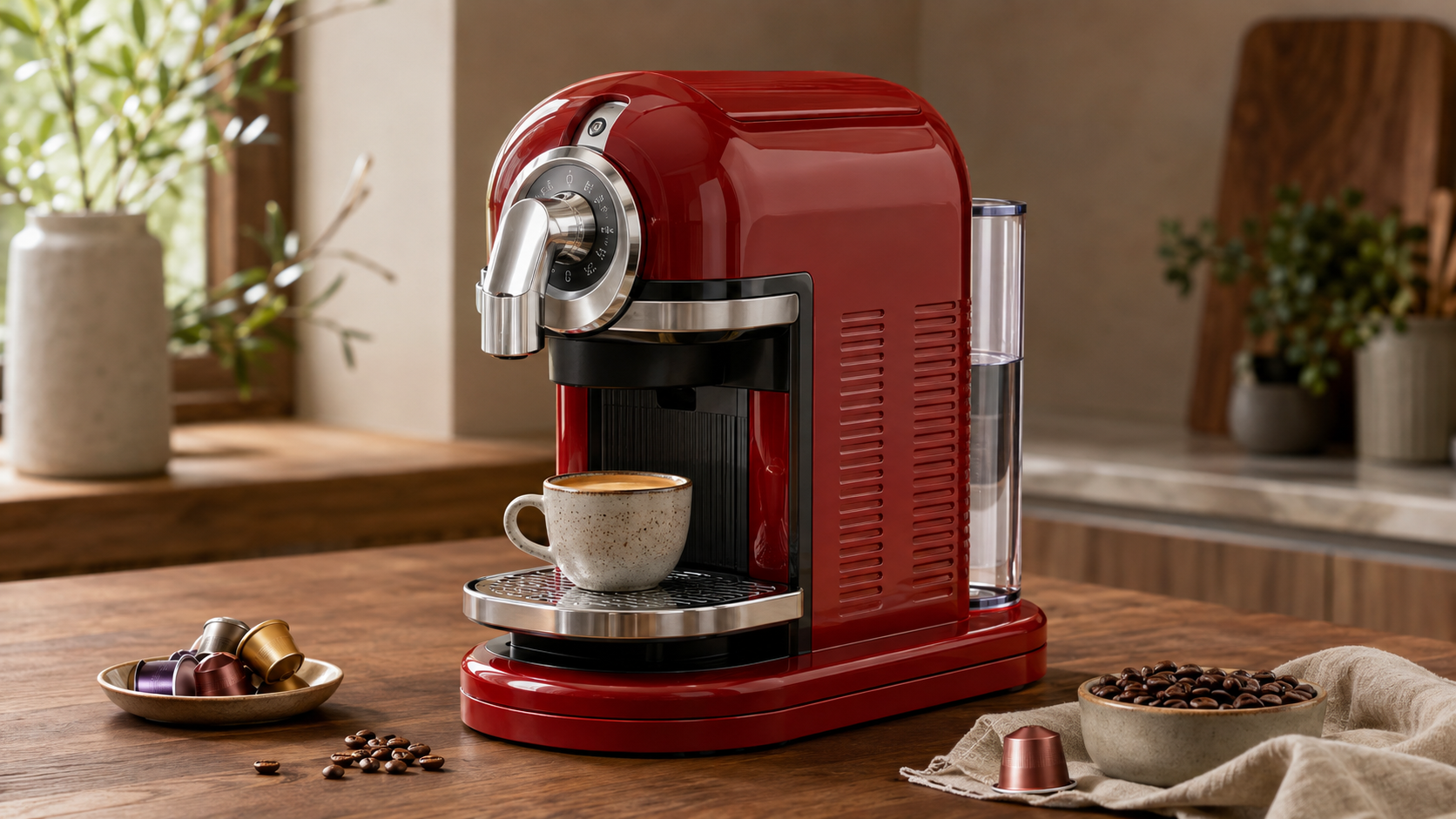
This Nespresso KitchenAid review explains whether the discontinued metal-bodied Original Line machine is still worth buying in 2026, especially for coffee drinkers attracted to its retro design and six adjustable cup sizes.
Created through a partnership between KitchenAid and Nespresso, the machine combines Nespresso capsule convenience with the substantial construction and distinctive styling associated with KitchenAid appliances.
Its main advantages include:
- Six preset coffee volumes
- Nespresso Original capsule compatibility
- Heavy die-cast metal construction
- Simple single-dial operation
- Large used-capsule container
- Adjustable cup platform
- Automatic capsule ejection
- Several standby-time options
However, most examples available today are used. Buyers should consider pump condition, leakage, mineral buildup, capsule mechanism wear, electrical compatibility, missing parts, and repair availability before paying extra for its appearance.
Nespresso KitchenAid Review: Quick Verdict
The KitchenAid Nespresso machine remains appealing for people who want capsule convenience inside a durable, statement-making appliance.
It can prepare:
- Ristretto
- Espresso
- Long espresso
- Lungo
- Coffee for cappuccino
- Coffee for latte
- Short iced-coffee bases
Its six volume settings offer more flexibility than many basic Original Line machines. The heavy body also feels substantially more premium than lightweight plastic capsule brewers.
The disadvantages are equally important. It is bulky, discontinued, heavy to move, and normally sold without warranty protection. It also lacks an integrated steam wand or automatic milk system unless paired with a separate Aeroccino.
A fully tested machine may be an enjoyable purchase. An untested one may become a very stylish red—or silver, or black—paperweight.
Nespresso KitchenAid at a Glance
| Feature | Nespresso KitchenAid |
|---|---|
| Common model numbers | KES0503 and KES0504 |
| Capsule system | Nespresso Original |
| Coffee settings | Six preset volumes |
| Smallest serving | 25 ml |
| Largest serving | 130 ml |
| Controls | Rotary selection dial and brew button |
| Brewing pressure | Up to 19 bar |
| Used-capsule capacity | Up to 14 capsules |
| Milk system | Separate Aeroccino on selected packages |
| Automatic standby | 15, 20, or 30 minutes |
| Construction | Heavy die-cast metal body |
| Best for | Espresso and lungo drinkers who value design |
| Main concern | Discontinued status and secondhand condition |
The serving sizes and operating functions above are documented in the official Nespresso by KitchenAid instruction manual.
What Is the Nespresso KitchenAid Machine?
The Nespresso KitchenAid is a premium capsule coffee machine designed for the Nespresso Original system.
Unlike a traditional KitchenAid espresso machine, it does not use ground coffee, a portafilter, or a separate grinder. Users insert an Original capsule, select one of six serving volumes, and press the brewing button.
The machine’s principal components include:
- Removable water reservoir
- Capsule-loading compartment
- Large metal operating handle
- Six-position selection dial
- Illuminated volume indicators
- Brewing button
- Adjustable cup support
- Removable drip tray
- Used-capsule container
- Espresso outlet
The KES0503 generally refers to the coffee machine alone, while KES0504 packages included an Aeroccino milk frother in certain markets. Because secondhand listings are not always accurate, verify exactly which components are included.
This model should not be confused with KitchenAid’s current semi-automatic espresso machines. Those machines use freshly ground coffee and a portafilter, while the model discussed in this Nespresso KitchenAid review uses sealed capsules exclusively.
1. It Uses Nespresso Original Capsules
The machine accepts Nespresso Original capsules rather than Vertuo capsules.
Compatible options generally include:
- Nespresso Original capsules
- Ristretto capsules
- Espresso capsules
- Lungo capsules
- Decaffeinated varieties
- Flavored capsules
- Many third-party Original-compatible capsules
Original capsules are smaller than Vertuo capsules and are intended primarily for concentrated coffee servings. They are particularly suitable for espresso, cappuccino, latte, and short lungo drinks.
The machine cannot read Vertuo barcodes or accommodate the wider dome-shaped Vertuo capsules. Our Nespresso Original vs Vertuo comparison explains the differences in capsule shape, brewing method, serving size, crema, and coffee selection.
When testing a used KitchenAid machine, begin with a genuine, undamaged Original capsule. Poorly shaped compatible capsules may cause:
- Incomplete piercing
- Weak coffee flow
- Water around the capsule
- Grounds in the cup
- Difficulty closing the handle
- Irregular capsule ejection
Testing with a genuine capsule makes it easier to determine whether a problem comes from the capsule or the machine itself.
2. Six Coffee Volumes Offer Excellent Flexibility
One of the strongest features highlighted in this Nespresso KitchenAid review is its six-position serving-size dial.
The available preset volumes are:
| Dial Position | Approximate Volume | Suggested Use |
|---|---|---|
| 1 | 25 ml | Ristretto |
| 2 | 40 ml | Espresso |
| 3 | 60 ml | Long espresso |
| 4 | 90 ml | Short lungo |
| 5 | 110 ml | Standard lungo |
| 6 | 130 ml | Large lungo |
Best Setting for Espresso
The 40 ml setting is the best starting point for most standard Original capsules. It usually provides a balanced combination of aroma, intensity, body, and crema.
Choose 25 ml when using:
- Intense capsules
- Dark roasts
- Ristretto blends
- Coffee for a small cappuccino
- Coffee for a strong iced latte
The 60 ml setting creates a milder drink, although some capsules may taste thinner or more bitter when extracted beyond their recommended volume.
Best Setting for Lungo
The 110 ml position is intended for capsules developed for lungo preparation.
A 130 ml serving provides more coffee, but more water does not necessarily produce better flavor. Passing too much water through a small capsule can create a weak, dry, or bitter cup.
For an Americano-style drink, a better approach is to brew 25–40 ml of espresso and add separately heated water. This preserves more of the capsule’s intended flavor.
3. The Selection Dial Is Simple to Use
Daily operation requires only the rotary dial and central brewing button.
To prepare coffee:
- Fill the reservoir with fresh drinking water.
- Place a cup on the adjustable support.
- Lift the metal handle fully.
- Insert an Original capsule in the correct orientation.
- Lower the handle until the chamber closes.
- Turn the dial to the desired volume.
- Press the brewing button.
- Wait for the programmed cycle to stop.
- Lift the handle to eject the capsule.
The volume can be changed during brewing by turning the dial before the cycle finishes. Pressing the brewing button again also allows the user to stop the flow early.
The machine remembers the setting selected most frequently during recent use. This is convenient when household members usually prepare the same drink size.
4. Espresso Quality Is Consistent but Capsule-Dependent
The KitchenAid produces espresso comparable to other capable Original Line machines.
Users can expect:
- Concentrated aroma
- A visible crema layer
- Consistent programmed volume
- Moderate body
- Fast and repeatable preparation
- Sufficient intensity for small milk drinks
Coffee quality depends heavily on the capsule and selected volume. A strong capsule brewed at 25–40 ml generally performs better than a mild capsule extracted at 110–130 ml.
For improved results:
- Use fresh water every day.
- Run a capsule-free rinse before the first coffee.
- Warm the cup with hot water.
- Match the capsule to the intended serving size.
- Avoid over-extracting espresso capsules.
- Drink the coffee immediately after brewing.
- Descale the machine when flow or temperature declines.
Unlike a traditional espresso setup, the machine does not let users adjust grind size, dose, tamping pressure, or extraction time. Its purpose is consistency and convenience rather than complete brewing control.
Our Nespresso vs espresso machine comparison explains how capsule brewing compares with freshly ground espresso in flavor potential, preparation time, cleaning, and operating cost.
Buyers who want a similarly distinctive discontinued machine with an integrated milk system can also read our Nespresso Gran Maestria review.
5. Heat-Up Time and Brewing Speed
The Nespresso KitchenAid is designed for quick daily coffee preparation.
After switching it on, the indicator lights flash while the machine heats. Once the lights remain steady, it is ready to brew. The process generally takes less than one minute, although an older machine with mineral buildup may require longer.
A typical espresso routine takes only a few minutes:
- Switch on the machine.
- Fill the water reservoir if necessary.
- Insert an Original capsule.
- Select the 25 ml or 40 ml setting.
- Press the brewing button.
- Lift the handle to eject the used capsule.
- Rinse the outlet before switching off.
This speed is one reason the machine remains attractive in 2026. It delivers a consistent espresso without grinding beans, measuring coffee, tamping, or cleaning a portafilter.
However, users who prepare several drinks should allow time for refilling the reservoir, emptying the capsule container, and operating a separate milk frother.
6. The Heavy Die-Cast Body Feels Premium
The substantial construction is one of the most memorable qualities covered in this Nespresso KitchenAid review.
Many capsule machines use lightweight plastic panels. The KitchenAid model instead features a heavy die-cast metal body with a large operating handle and appliance-style rotary dial.
This construction provides several benefits:
- The machine remains stable when the handle is lifted.
- Controls feel substantial during operation.
- The body resists minor movement from pump vibration.
- Its appearance coordinates with other KitchenAid appliances.
- The design looks appropriate in a permanent coffee station.
Depending on the market, the machine was offered in several colors, including red, black, silver, cream, and other KitchenAid-style finishes.
The weight also creates disadvantages. It is not convenient to move every morning, and sliding it across a countertop may scratch the work surface. Place it on a stable, level surface with enough permanent space for ventilation and reservoir access.
When buying secondhand, inspect the body carefully for:
- Chipped paint
- Deep scratches
- Corrosion
- Loose panels
- Damage around the handle
- Cracks near the water reservoir
- Bent drip-tray components
- Missing rubber feet
Cosmetic wear may not affect brewing, but serious impact damage can indicate that the heavy machine has been dropped.
7. Water Reservoir and Daily Capacity
The removable water reservoir provides enough capacity for several espresso or lungo servings before refilling.
Actual daily capacity depends on:
- Selected coffee volume
- Number of rinse cycles
- Frequency of preheating cups
- Milk-drink preparation
- Water used during cleaning
- Household coffee consumption
A reservoir that appears large can empty surprisingly quickly when several 110–130 ml lungos and rinse cycles are prepared.
For better coffee quality:
- Add fresh drinking water daily.
- Avoid leaving water in the reservoir for several days.
- Rinse the tank regularly.
- Do not use hot or sparkling water.
- Fit the reservoir securely before brewing.
- Check the valve underneath for leakage.
Filtered water may reduce mineral accumulation when local tap water is hard. However, filtered water does not eliminate the need for descaling.
When inspecting a secondhand machine, fill the tank and leave it installed for several minutes before brewing. Water beneath the machine may indicate a damaged reservoir, worn valve, incorrectly fitted tank, or internal leak.
8. The Used-Capsule Container Is Conveniently Large
The used-capsule container can accommodate up to approximately 14 capsules, depending on capsule shape and how they settle.
Automatic ejection makes the daily workflow simple. When the handle is raised after brewing, the used capsule falls into the internal container.
Empty the container regularly, even if it is not completely full. Used capsules retain water and coffee residue, which can create:
- Unpleasant odors
- Mold
- Standing liquid
- Staining
- Difficult capsule ejection
- Overflow into the drip tray
An overfilled container may prevent newly used capsules from falling correctly. It can also make the handle feel unusually stiff.
Remove the capsule bin and drip tray together, empty them, rinse with warm water, and allow them to dry before reinstalling.
If the lever does not operate smoothly, do not force it. Check whether a capsule is trapped inside the brewing chamber or whether the used-capsule container is full.
9. The Adjustable Cup Support Handles Different Sizes
The adjustable cup platform allows the Nespresso KitchenAid to accommodate several drinking vessels.
It works with:
- Small ristretto cups
- Standard espresso cups
- Cappuccino cups
- Regular coffee cups
- Some taller latte glasses
- Iced-coffee glasses
Positioning a small cup close to the outlet reduces splashing and helps preserve crema. Lowering or removing the support creates additional clearance for taller glasses.
For the best results:
- Use the raised position for espresso.
- Center the cup beneath the coffee outlet.
- Select a cup large enough for the programmed volume.
- Lower the support before using a taller glass.
- Empty the drip tray before it becomes full.
- Wipe away splashes after brewing.
The machine does not include the hot-water cup heater found on the Gran Maestria. To preheat an espresso cup, fill it with hot water, wait briefly, empty it, and then brew.
Preheating is especially useful for 25–40 ml servings because a small amount of espresso loses heat rapidly in a cold ceramic cup.
10. Milk Drinks Require a Separate Frother
The coffee machine itself does not contain a steam wand or integrated milk-frothing system.
Some KES0504 packages were sold with a separate Aeroccino. Other listings include only the KitchenAid capsule machine, so buyers should check the package carefully.
A separate milk frother can be used to prepare:
- Cappuccino
- Caffè latte
- Latte macchiato
- Mocha
- Flat white-style drinks
- Iced latte
- Iced cappuccino
- Hot chocolate
The lack of an integrated milk system has both advantages and disadvantages.
Advantages
- The coffee machine has fewer milk-related components.
- A faulty frother can be replaced separately.
- Milk never enters the brewing system.
- The frother can be positioned where convenient.
- Coffee and milk may be prepared at the same time.
Disadvantages
- The frother requires additional counter space.
- It needs a separate electrical connection.
- The jug must be cleaned after every use.
- Automatic foam provides limited texture control.
- A missing frother increases the total purchase cost.
If you already own an Aeroccino or another reliable milk frother, purchasing the machine alone may be perfectly reasonable.
Our guide on how to froth milk at home covers several methods for preparing hot and cold milk foam.
11. How to Make Cappuccino and Latte
The six coffee-volume settings make it easy to create a concentrated base for milk drinks.
Basic Cappuccino
- Choose an intense Original capsule.
- Prepare warm, dense milk foam in a separate frother.
- Select the 25 ml or 40 ml coffee setting.
- Brew into a preheated cappuccino cup.
- Swirl the prepared milk gently.
- Pour warm milk over the espresso.
- Spoon the remaining foam on top.
- Serve immediately.
- Clean the frother before the milk residue dries.
A shorter extraction generally maintains more intensity after milk is added. If you want a stronger drink, use two capsules instead of passing excessive water through one capsule.
Basic Latte
A practical starting ratio is:
- 40 ml espresso
- 120–180 ml warm milk
- A thin layer of milk foam
Choose lighter foam for a latte and denser foam for a cappuccino. The difference between the drinks depends largely on the proportion and texture of the milk.
Read our complete latte vs cappuccino comparison for more information about serving size, espresso ratio, milk quantity, and foam thickness.
Iced Latte
For an iced latte:
- Fill a tall glass with large ice cubes.
- Add cold milk.
- Brew a 25–40 ml espresso in a separate cup.
- Pour the espresso over the milk and ice.
- Add cold foam if desired.
- Stir gently and serve.
Avoid brewing a 110–130 ml lungo directly over ice. The longer extraction is already more diluted, and melting ice can make the drink taste weak.
12. Americano and Large-Cup Performance
The machine does not have a dedicated hot-water outlet or Americano program.
Although it can brew up to approximately 130 ml through one capsule, this is still a lungo rather than a traditional Americano. The entire water volume passes through the coffee grounds.
For a smoother Americano:
- Heat 90–150 ml of water separately.
- Pour the hot water into a cup.
- Brew a 25–40 ml espresso over it.
- Taste and adjust the ratio.
- Use two capsules if more coffee intensity is required.
This method reduces the risk of over-extracting a capsule and usually creates a cleaner, less bitter drink.
If large coffees are your priority, compare the two capsule systems before purchasing. The Nespresso Original vs Vertuo guide explains why Vertuo machines may be more convenient for full-size cups.
13. Noise and Everyday Operation
The KitchenAid model produces the normal sounds associated with a capsule machine:
- Pump vibration
- Capsule piercing
- Water moving through the brewing unit
- Coffee dripping into the cup
- Capsule ejection
- Light tray vibration
Its heavy construction helps keep the machine stable, but it does not make the pump silent.
Watch for unusual sounds when testing a used machine, including:
- Loud grinding
- Repeated clicking
- Severe metallic rattling
- A strained pump sound
- Pump operation without water flow
- Electrical crackling
A loud pump with little or no water may indicate an empty reservoir, trapped air, mineral buildup, or a weakening pump.
Run at least one capsule-free rinse and one complete coffee extraction during the inspection. A brief power-on demonstration is not enough to confirm proper operation.
Our guide to common Nespresso machine problems explains possible causes of weak flow, leakage, unusual noise, and inconsistent extraction.
14. Automatic Standby Settings
The machine can enter standby automatically after a selected period of inactivity.
Available settings include approximately:
- 15 minutes
- 20 minutes
- 30 minutes
The shorter setting is suitable for most households because the machine heats quickly when needed again.
Automatic standby helps:
- Reduce unnecessary electricity use
- Prevent the machine from remaining active all day
- Simplify the morning routine
- Improve safety after coffee preparation
Standby is not a substitute for disconnecting a faulty machine. If the unit leaks, smells burned, produces electrical noise, or behaves unpredictably, unplug it and stop using it until it has been inspected.
Overall, this Nespresso KitchenAid review finds daily operation straightforward. Its controls are simpler than its imposing metal body suggests—essentially, it is a very handsome tank that makes espresso.
15. Routine Cleaning Requirements
Regular cleaning helps preserve coffee flavor and prevents standing water, capsule residue, and mineral deposits from causing problems.
After Every Use
- Lift the handle and eject the used capsule.
- Empty water collected in the drip tray.
- Wipe splashes from the coffee outlet.
- Check whether the capsule container is becoming full.
- Leave the capsule chamber open briefly to release moisture.
- Clean a separate milk frother immediately after use.
Weekly Cleaning
At least once a week:
- Unplug the machine and allow it to cool.
- Remove the water reservoir.
- Wash the reservoir with mild detergent and warm water.
- Empty and rinse the used-capsule container.
- Clean the drip tray and adjustable cup support.
- Wipe the coffee outlet with a soft damp cloth.
- Dry all removable parts before reinstalling them.
- Run a capsule-free rinse after reassembly.
Avoid abrasive pads, strong chemical cleaners, and immersing the machine body in water. The exterior may be metal, but the machine still contains electrical components that are considerably less enthusiastic about baths.
Coffee residue can accumulate around the capsule chamber and outlet. If capsules begin sticking or coffee flow becomes irregular, inspect these areas carefully without inserting sharp objects into the brewing mechanism.
For a more detailed maintenance routine, follow our guide on how to clean a Nespresso machine.
16. How to Descale the Nespresso KitchenAid
Descaling removes calcium and other mineral deposits from the internal water circuit.
Descaling frequency depends on:
- Local water hardness
- Number of drinks prepared
- Use of long coffee settings
- Frequency of rinse cycles
- Water filtration
- Time since the previous treatment
Possible signs that descaling is needed include:
- Slower coffee flow
- Reduced serving volume
- Lower coffee temperature
- Louder pump operation
- Irregular extraction
- Water leaking into the capsule container
- Longer heat-up time
- An unusual taste in the cup
Always follow the procedure specified in the official instruction manual for the exact model.
Basic Preparation
Before beginning:
- Remove any capsule from the chamber.
- Empty the capsule container and drip tray.
- Fill the reservoir with the recommended quantity of water and approved descaling solution.
- Place a sufficiently large container beneath the coffee outlet.
- Enter the machine’s descaling mode.
- Allow the programmed solution cycle to finish.
- Rinse the reservoir thoroughly.
- Complete the required fresh-water rinse.
- Exit descaling mode correctly.
Do not interrupt the process unless necessary. Descaling solution remaining inside the water circuit can affect taste and should be completely rinsed away.
Avoid using vinegar unless the manufacturer explicitly approves it. Vinegar may leave a persistent smell and may not be suitable for internal seals or tubing.
Our complete guide on how to descale a Nespresso machine explains why descaling matters and how to recognize mineral buildup.
17. Common Nespresso KitchenAid Problems
Because the model is discontinued, secondhand condition is one of the most important considerations in this Nespresso KitchenAid review.
The Machine Does Not Pump Water
Possible causes include:
- An empty or incorrectly fitted reservoir
- Air trapped inside the water circuit
- Mineral buildup
- A blocked outlet
- A weakened pump
- A damaged reservoir valve
Refill and reinstall the reservoir, then run several capsule-free rinse cycles. If the pump remains loud but no water appears, the machine may need descaling or professional repair.
Coffee Flows Slowly
Slow or interrupted extraction may result from:
- Heavy scale buildup
- A damaged capsule
- A blocked coffee outlet
- Residue in the brewing chamber
- Insufficient water
- Pump wear
Test the machine with a genuine Nespresso Original capsule. If capsule-free water flow is also slow, the cause is more likely to be inside the machine.
The Handle Is Difficult to Close
Never force the large metal handle.
Check for:
- A capsule inserted incorrectly
- A deformed compatible capsule
- A used capsule trapped in the chamber
- An overfilled capsule container
- Residue around the capsule holder
- Mechanical wear in the closing system
Forcing the handle can damage the capsule mechanism and turn a minor obstruction into an expensive repair.
Coffee or Water Leaks into the Capsule Container
A small amount of water in the container may be normal, but excessive liquid can indicate:
- Incomplete capsule piercing
- A damaged or incorrectly shaped capsule
- Worn internal seals
- A blocked outlet
- Brewing-chamber residue
- Excessive internal pressure
Clean the removable components and test again with a genuine capsule. Persistent leakage may require service.
Water Appears Beneath the Machine
Water underneath the unit may come from:
- An overflowing drip tray
- An incorrectly seated reservoir
- A cracked water tank
- A worn reservoir valve
- A damaged internal hose
- A failed seal
Unplug the machine if the source cannot be identified. Continuing to operate an appliance with an internal water leak can damage electrical components.
Coffee Is Not Hot Enough
Possible causes include:
- A cold cup
- Mineral buildup
- A low starting water temperature
- A declining heating element
- Brewing immediately after startup
- Internal temperature-control problems
Preheat the cup and run a capsule-free rinse. If coffee remains unusually cool, descaling may help, but an older machine may have a failing heater or sensor.
Indicator Lights Behave Abnormally
Unusual flashing may indicate:
- The machine is still heating
- The reservoir is empty
- A selected programming mode is active
- Descaling mode has not been exited
- An internal fault has occurred
Switch the machine off, unplug it briefly, reinstall the reservoir, and restart it. If the same pattern continues, consult the model-specific manual rather than repeatedly pressing controls.
Additional troubleshooting advice is available in our article about common Nespresso machine problems.
18. Replacement Parts and Repair Considerations
Replacement accessories may be more difficult to obtain than parts for current Nespresso models.
Potentially missing or damaged components include:
- Water reservoir
- Reservoir lid
- Drip tray
- Cup platform
- Used-capsule container
- Rubber feet
- Aeroccino and whisk
- Power cable
- Decorative exterior components
Before purchasing, confirm that replacement parts are available for the exact model number and market version. Similar-looking components from another Nespresso machine may not fit.
Internal repairs may involve:
- Pump replacement
- Heating-system repair
- Worn seals
- Damaged tubing
- Electronic control faults
- Capsule-mechanism problems
- Reservoir-valve replacement
The heavy metal body can make the machine feel nearly indestructible, but its pump, seals, heater, and electronics still age like those in any other capsule machine.
Professional repair may cost more than a used machine is worth. Obtain an estimate before buying a unit described as “easy to fix,” a phrase that has sent many brave coffee machines directly to the cupboard of regret.
19. Buying a Used Nespresso KitchenAid
Most people considering this machine in 2026 will be shopping through a secondhand marketplace.
Ask the seller for:
- The complete model number
- Voltage and plug type
- Approximate purchase date
- Descaling history
- Repair history
- Reason for selling
- Photos of the water tank and capsule chamber
- A video showing water flow
- A video showing capsule extraction
- Confirmation that all removable parts are included
- Details about any leaks or unusual noises
Essential Operational Test
Before buying, confirm that:
- The machine powers on normally.
- The lights and dial respond correctly.
- The reservoir valve does not leak.
- The pump draws water without excessive noise.
- Capsule-free water flows evenly.
- A genuine Original capsule is pierced correctly.
- All six volume positions respond.
- Brewing stops automatically.
- The handle opens and closes smoothly.
- Used capsules eject into the container.
- Coffee does not leak excessively into the capsule bin.
- No water appears beneath the machine.
- The drip tray and cup platform fit securely.
- There is no burning smell or electrical crackling.
A short video showing only illuminated controls is insufficient. The seller should demonstrate a complete extraction from cold startup to capsule ejection.
20. Electrical Compatibility Matters
The Nespresso KitchenAid was sold in different regions with different voltage requirements.
Before purchasing an imported machine, check:
- Rated voltage
- Frequency
- Plug configuration
- Power consumption
- Local electrical standards
A plug adapter changes the shape of the plug but does not convert voltage. Operating a machine on an incompatible supply may damage its heater, pump, or electronic controls and can create a safety risk.
The rating label should match the electrical system in the country where the machine will be used. When uncertain, consult a qualified electrician before connecting it.
21. What Is a Fair Used Price?
There is no universal fair price because availability, color, condition, and collector interest differ by region.
A sensible price should reflect:
- Successful operational testing
- Exterior condition
- Descaling and maintenance history
- Absence of leaks
- Smooth capsule operation
- Included accessories
- Aeroccino inclusion
- Local repair availability
- Seller return protection
- Cost of newer alternatives
Do not pay a large premium based only on the metal construction or uncommon color. A rare machine that cannot pump water remains rare—but not especially useful.
Compare the complete purchase cost with current models in our guide to the best Nespresso machines. A newer machine may provide easier servicing, readily available parts, and warranty coverage.
An untested Nespresso KitchenAid should always be priced as a repair risk, regardless of how clean it appears in photographs.
22. Nespresso KitchenAid Pros and Cons
Pros
- Premium die-cast metal construction
- Distinctive retro KitchenAid design
- Uses widely available Nespresso Original capsules
- Six preset coffee volumes from 25 ml to 130 ml
- Simple rotary dial and one-button brewing
- Stable during capsule loading and extraction
- Large used-capsule container
- Adjustable cup platform
- Fast, consistent espresso preparation
- Separate milk frother can be replaced independently
Cons
- Discontinued and generally available only secondhand
- Heavy and difficult to move
- Requires considerable countertop space
- No built-in steam wand or milk system
- No dedicated hot-water outlet
- Long settings may over-extract some capsules
- Replacement parts can be difficult to obtain
- Professional repairs may be uneconomical
- Imported machines may have incompatible voltage
- Most used units have no manufacturer warranty
23. Nespresso KitchenAid vs Gran Maestria
Both machines use Nespresso Original capsules, but they suit different coffee routines.
| Feature | Nespresso KitchenAid | Gran Maestria |
|---|---|---|
| Capsule system | Nespresso Original | Nespresso Original |
| Coffee-volume control | Six preset volumes | Five espresso and five lungo volumes |
| Milk system | Separate frother | Integrated Aeroccino |
| Cold milk foam | With compatible separate frother | Yes |
| Cup heater | No | Built-in hot-water cup heater |
| Construction | Heavy die-cast metal body | Premium metal and plastic body |
| Counter space | Large | Very large |
| Cleaning | Simple coffee system | Coffee, Aeroccino, and heater |
| Main attraction | Design and construction | All-in-one milk-drink convenience |
| Main used-buying risk | Pump, seals, and capsule mechanism | Brewer, Aeroccino, and cup heater |
The KitchenAid is the better choice if you value substantial construction, simple espresso preparation, and the freedom to choose a separate milk frother.
The Gran Maestria is more convenient for households that regularly prepare cappuccino, latte, and cold-foam drinks. However, its integrated systems create additional components that must be tested before purchase.
Read our complete Nespresso Gran Maestria review for a closer comparison of its Aeroccino, cup heater, espresso controls, and secondhand risks.
24. Better Alternatives to Consider
A working KitchenAid Nespresso machine can still perform well, but a newer alternative may offer easier servicing and warranty protection.
Nespresso CitiZ
The Nespresso CitiZ offers Original capsule compatibility in a narrower and lighter design.
It may be preferable if you want:
- A smaller footprint
- Straightforward espresso and lungo buttons
- Easier movement and storage
- Optional Aeroccino pairing
- Wider availability
- Simpler replacement if the machine fails
It lacks the KitchenAid’s heavy construction and six-position volume dial, but it is more practical in a small kitchen.
Nespresso Essenza Mini
The Nespresso Essenza Mini is suitable for drinkers who mainly prepare espresso and lungo.
Its advantages include:
- Compact dimensions
- Fast heat-up
- Simple controls
- Original capsule compatibility
- Lower purchase price
- Easy pairing with a separate milk frother
Choose the Essenza Mini when space and simplicity matter more than appearance or multiple cup sizes.
Nespresso Creatista
A Creatista model combines Original capsules with an automated steam wand.
It is a stronger alternative for people who want:
- Adjustable milk temperature
- Several milk-texture settings
- Better control for latte art
- Integrated milk preparation
- A more modern user experience
- Potential warranty protection
The Creatista normally costs more, but it provides more control over milk than a separate automatic frother.
Traditional Espresso Machine
A semi-automatic espresso machine is better when fresh-bean flavor and brewing control are priorities.
It allows adjustment of:
- Coffee beans
- Grind size
- Dose
- Tamping
- Brewing ratio
- Extraction time
- Milk temperature
- Foam texture
However, it also requires a capable grinder, more counter space, regular cleaning, and time to develop consistent technique.
Our Nespresso vs espresso machine guide compares these systems in convenience, taste, cost, maintenance, and learning curve.
Is the Nespresso KitchenAid Worth Buying in 2026?
This Nespresso KitchenAid review concludes that the machine may still be worth buying in 2026 when it is fully operational, correctly priced, and compatible with your local electrical supply.
It may be worth buying when:
- All six coffee-volume positions work correctly
- The pump produces steady water flow
- Capsules are pierced and ejected properly
- The handle opens and closes smoothly
- The reservoir and internal system do not leak
- All removable components are included
- The voltage matches your local power supply
- Replacement parts or repair services are available
- The price reflects its age and lack of warranty
- You genuinely value its substantial KitchenAid design
It is probably not worth buying when:
- The seller cannot demonstrate a complete extraction
- The machine is advertised as untested
- Water appears beneath the body
- The pump runs loudly without producing steady flow
- The handle or capsule mechanism feels jammed
- Important trays, tanks, or containers are missing
- The machine requires voltage conversion
- It produces a burning smell or electrical noise
- Repair costs approach the price of a newer machine
- You need an integrated milk system
The metal exterior may age gracefully, but internal pumps, heaters, seals, and electronics do not receive the same invitation to live forever.
Final Verdict
The Nespresso KitchenAid remains one of the most visually distinctive machines developed for the Original capsule system.
Its heavy die-cast construction, large operating handle, six adjustable coffee volumes, automatic capsule ejection, and straightforward controls create a more substantial experience than most compact capsule machines.
Espresso quality is consistent when the correct capsule and serving size are selected. The 25 ml and 40 ml settings work particularly well for intense espresso and milk-drink bases, while the longer settings are better reserved for capsules designed for lungo preparation.
Its discontinued status is the main drawback. Most machines available today have an uncertain maintenance history, limited replacement-part support, and no warranty. A clean exterior cannot confirm the condition of the pump, heater, seals, or capsule mechanism.
The final verdict of this Nespresso KitchenAid review is to buy only after a complete operational test. If the machine brews consistently, remains dry underneath, ejects capsules smoothly, and costs considerably less than a suitable new alternative, it can still be a rewarding statement appliance in 2026.
Frequently Asked Questions
Does the KitchenAid Nespresso machine use Original capsules?
Yes. It uses Nespresso Original capsules and many third-party Original-compatible capsules. It cannot use Vertuo capsules.
Is the Nespresso KitchenAid discontinued?
Yes. The machine is discontinued, so most units available in 2026 are sold through secondhand marketplaces.
What are the six Nespresso KitchenAid cup sizes?
The six approximate preset volumes are 25 ml, 40 ml, 60 ml, 90 ml, 110 ml, and 130 ml.
Does it have a milk frother?
The coffee machine itself does not have an integrated milk frother. Some packages were supplied with a separate Aeroccino, while others included only the capsule machine.
Can it make a cappuccino or latte?
Yes. Brew a 25–40 ml espresso and combine it with milk prepared in a separate frother.
Can it make an Americano?
Yes, although it lacks a dedicated hot-water outlet. Brew a short espresso and add separately heated water for better flavor than using the longest extraction setting.
Is the Nespresso KitchenAid difficult to clean?
Routine cleaning is straightforward because milk does not enter the machine. Regularly clean the reservoir, drip tray, cup support, capsule container, and coffee outlet.
How often should it be descaled?
Descaling frequency depends on water hardness and usage. Slower flow, reduced temperature, unusual pump noise, and inconsistent serving volume can indicate mineral buildup.
Is an imported KitchenAid Nespresso safe to use?
Only when its rated voltage and frequency match the local electrical supply. A plug adapter does not convert voltage.
What should I test before buying one?
Test startup, water flow, all six volume settings, capsule piercing, automatic stopping, capsule ejection, handle movement, reservoir sealing, coffee temperature, and leakage beneath the machine.