
Nespresso Maestria Review: 9 Things to Know Before Buying in 2026
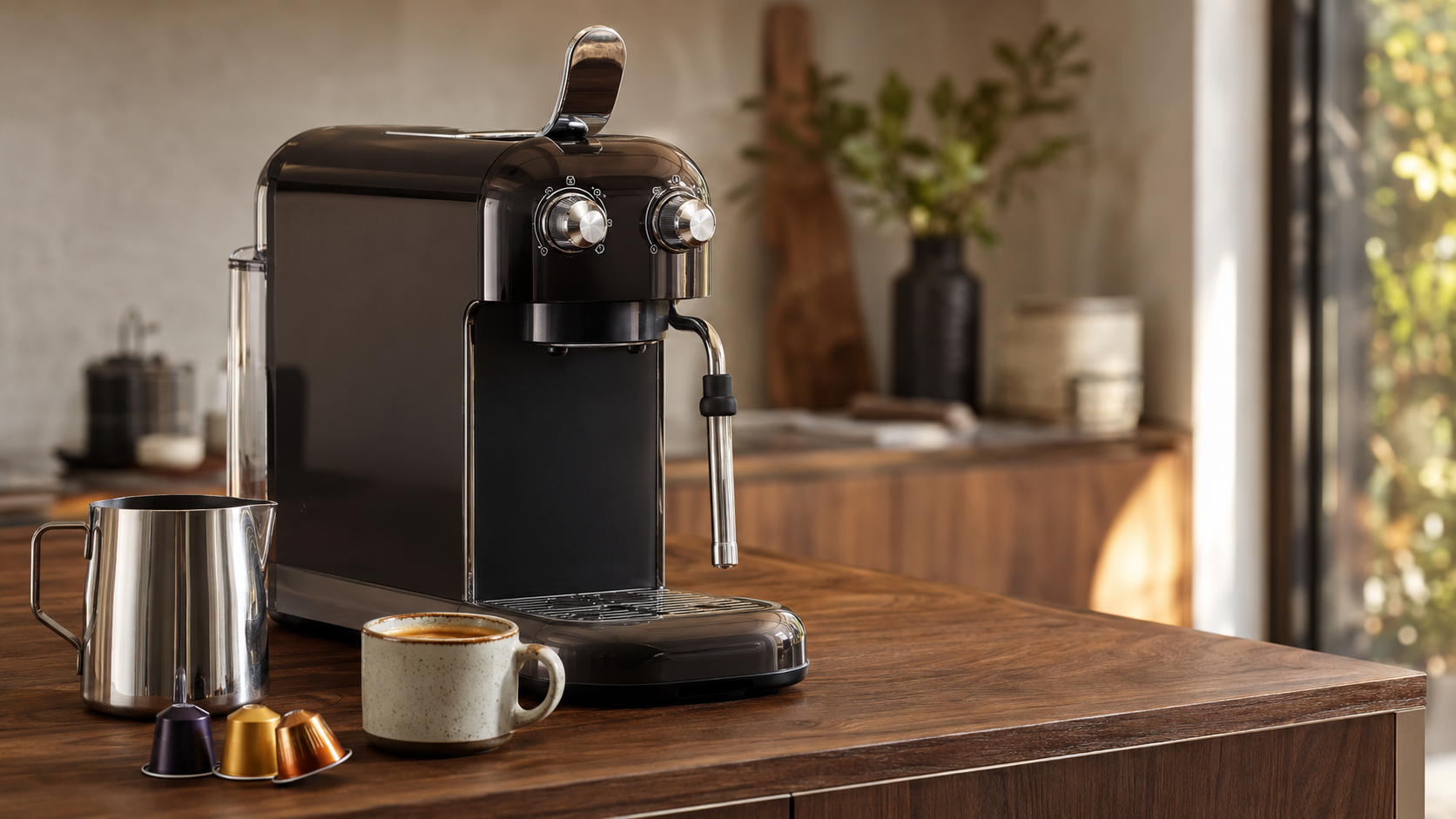
This Nespresso Maestria review explains whether the discontinued premium Original Line machine is still worth buying in 2026, especially for coffee lovers who want capsule convenience combined with manual milk steaming.
The Maestria is noticeably different from a typical two-button Nespresso machine. It combines adjustable espresso and lungo volumes, a large water tank, retro-style controls, and an integrated steam wand that allows users to texture milk inside a pitcher.
That combination makes it appealing for cappuccinos, lattes, macchiatos, and other milk-based drinks. However, most available machines are now used, so the steam system, pump, controls, seals, and overall condition require careful inspection.
Nespresso Maestria Review: Quick Verdict
The Nespresso Maestria remains one of the most distinctive machines created for the Nespresso Original system.
It offers capsule-based espresso without grinding, dosing, or tamping, while its manual steam wand provides more milk-texture control than a basic automatic frother.
Nespresso Maestria at a Glance
| Feature | Nespresso Maestria |
|---|---|
| Capsule system | Nespresso Original |
| Coffee selections | Espresso and lungo |
| Volume settings | Five levels for each drink |
| Espresso range | Approximately 25–60 ml |
| Lungo range | Approximately 70–150 ml |
| Milk system | Manual steam wand |
| Heat-up time | Approximately 25–30 seconds |
| Water tank | Approximately 1.4 liters |
| Used-capsule capacity | Approximately 14 capsules |
| Automatic shutoff | Approximately nine minutes |
| Best for | Espresso, cappuccino, latte, and macchiato |
| Main concern | Aging steam system and limited parts |
The Maestria provides more hands-on milk control than the Nespresso Expert. However, the Expert offers separate hot water, adjustable temperature, and a dedicated Americano program.
What Is the Nespresso Maestria?
The Nespresso Maestria is a premium Original Line capsule machine equipped with an adjustable manual steam pipe.
Its large body, metal accents, raised capsule lever, rotary drink controls, and steam handle give it the appearance of a compact traditional espresso machine.
Important features include:
- Nespresso Original capsule compatibility
- Separate espresso and lungo controls
- Five volume levels for each drink
- Manual milk-steaming system
- Removable 1.4-liter water reservoir
- Adjustable cup support
- Automatic capsule ejection
- Descaling notification
- Programmable automatic shutoff
- Storage for excess power cord
The standard Maestria should not be confused with the Gran Maestria. The Gran Maestria was offered with additional features, including an integrated Aeroccino arrangement and cup-warming system.
Secondhand sellers sometimes use the two names interchangeably, so confirm the model number and included accessories before paying.
The official Nespresso Maestria manual explains the original preparation, steaming, cleaning, and descaling procedures.
1. It Uses Nespresso Original Capsules
The Maestria accepts Nespresso Original capsules and cannot use Vertuo capsules.
Original capsules are intended primarily for concentrated coffee servings. The machine pushes hot water through the capsule under pressure, producing espresso-style coffee with a visible crema layer.
Compatible choices include:
- Nespresso Original capsules
- Espresso and lungo capsules
- Ristretto-style capsules
- Decaffeinated varieties
- Flavored capsules
- Many third-party Original-compatible capsules
This broad capsule selection is an important advantage identified in this Nespresso Maestria review. Owners can compare different origins, intensities, roast levels, flavors, and prices.
However, damaged or poorly manufactured compatible capsules may cause weak flow, incomplete piercing, leakage, loose grounds, or difficulty closing the lever.
Use a genuine, undamaged Original capsule when testing a secondhand machine. This makes it easier to determine whether a brewing problem comes from the machine or the capsule.
If you are still comparing capsule systems, read our Nespresso Original vs Vertuo guide before choosing.
2. Adjustable Coffee Volumes Provide More Control
The Maestria has separate rotary selectors for espresso and lungo, with five volume levels available for each drink.
Espresso Settings
The approximate espresso volumes are:
- 25 ml
- 30 ml
- 40 ml
- 50 ml
- 60 ml
The 40 ml setting is the best starting point for most standard Original capsules. It generally produces a balanced combination of aroma, intensity, body, and crema.
Choose a 25–30 ml serving when using:
- An intense capsule
- A dark roast
- A ristretto-style capsule
- Coffee for a small cappuccino
- A concentrated base for an iced drink
The 50–60 ml levels create a milder serving but may extract greater bitterness from certain capsules.
Lungo Settings
The approximate lungo volumes range from 70 ml to 150 ml.
A setting near 110 ml generally works best with capsules specifically developed for lungo preparation. Passing 150 ml through a regular espresso capsule can produce thin, bitter, or dry coffee.
For a smoother large drink, brew approximately 40 ml of espresso and add hot water from a kettle. The Maestria does not have the separate hot-water outlet found on the Expert.
3. Espresso Quality and Brewing Performance
The Maestria produces coffee comparable to other premium Original Line machines.
Users can expect:
- Concentrated aroma
- A visible crema layer
- Moderate body
- Consistent serving volumes
- Sufficient strength for small milk drinks
- Minimal preparation time
It cannot provide the same control as a traditional espresso machine using fresh beans. Grind size, dose, tamping pressure, and extraction time cannot be adjusted independently.
However, operation is considerably easier. Insert a capsule, choose a volume, press the appropriate control, and the machine stops automatically.
For better results:
- Fill the tank with fresh drinking water.
- Run a capsule-free cycle to warm the system.
- Preheat the cup.
- Insert a fresh capsule.
- Select an appropriate volume.
- Brew and serve immediately.
A cold ceramic cup can rapidly reduce the temperature of a small espresso. Preheating therefore makes a noticeable difference.
Our Nespresso vs espresso machine comparison explains the differences in flavor, convenience, equipment, cleaning, and ongoing cost.
4. The Manual Steam Wand Is Its Defining Feature
The integrated steam wand is the most important feature in this Nespresso Maestria review.
Most Original Line machines either have no milk system or depend on a separate automatic frother. The Maestria allows the user to heat and texture milk manually in a stainless steel pitcher.
It can help prepare:
- Cappuccino
- Caffè latte
- Latte macchiato
- Flat white-style drinks
- Mocha
- Hot chocolate
- Warm milk
Manual steaming offers better control over milk temperature and texture, but it requires practice.
For cappuccino, introduce more air near the milk’s surface to produce thicker foam. For latte or flat white-style drinks, introduce less air and create a rolling motion inside the pitcher. Properly textured milk should appear glossy and contain small, even bubbles.
Cold whole milk is usually the easiest option for beginners. Barista-formulated oat, soy, and almond beverages can also work well.
The coffee and steam functions are completed separately rather than simultaneously. Brew the espresso first and then steam the milk, or reverse the order depending on your preferred workflow.
For additional techniques, see our guide on how to froth milk at home.
5. Steam-Wand Cleaning Is Essential
Milk residue should never be allowed to dry on or inside the steam pipe.
Nespresso instructs users to purge the wand for at least five seconds before and after milk preparation. This removes residual water before steaming and helps clear remaining milk afterward.
After every use:
- Turn off the steam function.
- Wipe the wand with a damp cloth.
- Purge it for at least five seconds.
- Allow the metal pipe to cool.
- Check the nozzle openings for residue.
- Rinse and empty the drip tray.
Dried milk can cause:
- Weak steam output
- Blocked nozzle openings
- Unpleasant odors
- Large, unstable bubbles
- Hygiene problems
- Difficult future cleaning
The wand becomes extremely hot during operation. Handle it only by the designated rubber grip until it has cooled.
When buying a used Maestria, ask the seller to demonstrate continuous steam pressure. A machine that powers on but cannot steam properly has lost the feature that makes it special—which is a little like buying an umbrella with excellent Bluetooth but several holes.
6. Daily Operation and Brewing Workflow
Daily operation is straightforward once you understand the two rotary coffee controls and separate steam system.
Brewing Espresso or Lungo
- Fill the water tank with fresh drinking water.
- Turn on the machine.
- Wait until the indicator lights stop flashing.
- Lift the capsule lever completely.
- Insert a Nespresso Original capsule.
- Close the lever securely.
- Place a cup beneath the coffee outlet.
- Select the desired espresso or lungo volume.
- Press the corresponding coffee control.
- Lift the lever after brewing to eject the used capsule.
The machine stops automatically at the selected volume. You can also stop the flow early by pressing the coffee control again.
For the best flavor, avoid leaving a used capsule inside the brewing chamber for several hours. Eject it after brewing so moisture and coffee residue do not remain around the capsule mechanism.
Adjusting the Automatic Shutoff
The Maestria normally turns itself off after approximately nine minutes of inactivity. Depending on the regional model, the automatic shutoff time may be programmable.
The energy-saving feature is useful for households where the machine remains on the counter throughout the day. However, always switch it off and unplug it before deep cleaning or inspecting the steam nozzle.
7. Heat-Up Time and Beverage Temperature
The Maestria generally reaches coffee-brewing temperature in approximately 25–30 seconds.
That is fast enough for busy mornings and considerably quicker than many traditional espresso machines requiring several minutes to warm the portafilter, group head, and boiler.
However, perceived coffee temperature depends on more than machine heat.
Factors include:
- Cup material
- Cup temperature
- Selected coffee volume
- Room temperature
- Milk quantity
- Time between brewing and serving
- Mineral buildup inside the machine
A small espresso loses heat quickly in a thick, cold ceramic cup. Running a capsule-free rinse into the cup before brewing warms both the coffee path and cup.
The Maestria does not provide the three selectable temperature levels available on the Nespresso Expert. If the coffee seems unusually cool even after preheating, the machine may need descaling or professional inspection.
8. Water Tank and Capsule Capacity
The removable reservoir holds approximately 1.4 liters, making it larger than the tanks found on many compact Original Line machines.
This capacity is practical for:
- Several espresso drinks per day
- Multiple milk-based beverages
- Steam-wand purging
- Households with two frequent coffee drinkers
- Small offices with moderate use
- People who dislike frequent refilling
Milk steaming consumes additional water, so the tank may empty faster than expected when preparing several cappuccinos or lattes.
The used-capsule container holds approximately 10–14 capsules, depending on how they settle inside it. Empty the container regularly instead of waiting until it becomes completely full.
An overfilled container can prevent capsules from ejecting correctly or make the lever difficult to operate.
Countertop Placement
Before buying the machine, check:
- Available counter width
- Space beneath wall cabinets
- Clearance for lifting the capsule lever
- Access to the rear water tank
- Room for a milk pitcher
- Distance from the electrical outlet
- Space around the steam wand
The Maestria is substantially larger and heavier than an Essenza Mini. It is better suited to a permanent coffee station than a counter where the machine must be moved after every use.
9. Milk-Steaming Performance
Milk performance is the main reason to choose the Maestria over a simpler capsule machine.
An automatic frother heats and agitates milk with minimal effort. The Maestria’s steam wand requires more technique, but it gives the user direct control over:
- Milk temperature
- Foam thickness
- Air incorporation
- Vortex strength
- Finished texture
- Amount of milk prepared
With practice, the wand can create smoother and more integrated foam than a basic whisk-style frother.
Choosing the Right Milk Pitcher
A small stainless steel pitcher is usually the most practical choice for one drink.
Choose a pitcher that:
- Provides enough expansion room
- Has a narrow pouring spout
- Is comfortable to hold
- Allows you to feel temperature through the metal
- Is easy to clean around the base
- Fits beneath the steam wand
Do not overfill it. Milk expands during steaming, particularly when preparing thick cappuccino foam.
Recommended Milk Temperature
Milk generally tastes sweetest when heated to approximately 55–65°C. Excessive heat can reduce natural sweetness and produce a cooked flavor.
Beginners can stop steaming when the pitcher becomes too hot to hold comfortably for more than a brief moment. A thermometer offers greater accuracy while learning.
10. How to Make a Cappuccino with the Maestria
The Maestria is especially well suited to traditional small cappuccinos.
Simple Cappuccino Recipe
- Select an intense Original capsule.
- Brew approximately 25–40 ml of coffee.
- Pour cold milk into a stainless steel pitcher.
- Purge the steam wand.
- Position the tip just beneath the milk surface.
- Add air gently during the first few seconds.
- Lower the wand slightly to create a rolling motion.
- Stop when the milk reaches the desired temperature.
- Wipe and purge the wand immediately.
- Swirl the pitcher to combine the milk and foam.
- Pour the milk over the espresso.
- Serve immediately.
A shorter coffee volume generally works better than a lungo because the concentrated espresso remains noticeable after milk is added.
For a stronger drink, use two capsules rather than forcing excessive water through one capsule.
Latte Preparation
For a latte, use less air and more milk. The goal is a thin layer of smooth microfoam rather than the thick foam cap associated with cappuccino.
A practical starting ratio is:
- 40 ml espresso
- 120–180 ml steamed milk
- A thin microfoam layer
Milk ratios are flexible, so adjust them according to capsule intensity and cup size.
Our guide to latte vs cappuccino explains how espresso, steamed milk, foam, serving size, and texture differ between the two drinks.
11. Americano and Large-Cup Performance
The Maestria can prepare espresso and lungo, but it does not include a dedicated Americano program or separate hot-water spout.
To make an Americano:
- Heat water in a kettle.
- Add approximately 90–150 ml of hot water to a cup.
- Brew a 25–40 ml espresso into the water.
- Adjust the ratio to taste.
Adding espresso after the water can help preserve more of the crema, although either order is acceptable.
Avoid using the highest lungo setting as a substitute for an Americano. Passing a large amount of water through one capsule can over-extract the coffee and create:
- Excessive bitterness
- Dryness
- Weak aroma
- Thin body
- A hollow aftertaste
The dedicated Americano system is one area where the Expert is more convenient. However, a kettle gives Maestria owners greater control over water quantity and temperature.
12. Iced Coffee Performance
The Maestria works well for iced milk drinks when you use a short, intense extraction.
Simple Iced Latte
- Choose a strong Original capsule.
- Brew 25–40 ml of coffee.
- Allow the espresso to cool briefly.
- Fill a glass with large ice cubes.
- Add cold milk.
- Pour the espresso over the milk.
- Stir and adjust the ratio to taste.
Large ice cubes melt more slowly than crushed ice and reduce dilution.
Avoid brewing a 110–150 ml lungo directly over ice. The coffee begins diluted, and melting ice weakens it further.
For a stronger iced latte, use two short capsule extractions. This increases coffee intensity without over-extracting a single capsule.
13. Noise Level
The Maestria produces the typical pump noise associated with Original Line machines.
During normal operation, you will hear:
- Pump vibration during extraction
- Capsule piercing
- Water moving through the system
- Steam-system heating
- Hissing while purging the wand
- Used-capsule ejection
It is not silent, but the short brewing time limits how long the sound continues.
Unusual noises may indicate a problem. Be cautious if a used machine produces:
- Loud grinding sounds
- Repeated clicking
- Strong rattling
- Pump noise without water flow
- Irregular steam bursts
- Screeching from the steam system
A noisy pump combined with weak flow may indicate an airlock, mineral buildup, low water supply, or an aging pump.
14. Best Household Size
This Nespresso Maestria review finds the machine most suitable for:
- One or two frequent coffee drinkers
- Households preparing milk drinks daily
- Cappuccino and latte enthusiasts
- Users willing to practice manual steaming
- People with a permanent coffee station
- Buyers who prefer a larger water tank
- Owners comfortable maintaining a steam wand
It may be excessive for someone who drinks only an occasional black espresso. A simpler machine such as the Nespresso Pixie occupies less space and has fewer components requiring maintenance.
The Maestria makes the most sense when its steam wand will be used regularly. Otherwise, much of its size, complexity, and secondhand risk provides little practical benefit.
15. Routine Cleaning and Maintenance
Regular cleaning is especially important because the Maestria contains both a coffee-brewing system and a milk-steaming system.
After Every Coffee
- Eject the used capsule
- Empty standing water from the drip tray
- Wipe coffee splashes from the outlet
- Check that the capsule container is not full
- Refill the reservoir with fresh water when necessary
After Every Milk Drink
- Wipe the steam wand immediately
- Purge it for at least five seconds
- Check the steam-tip openings
- Rinse the milk pitcher
- Remove milk splashes from nearby surfaces
Weekly Cleaning
At least once a week:
- Remove the water tank.
- Empty and rinse the used-capsule container.
- Wash the drip tray and cup support.
- Clean the water-tank connection area.
- Wipe the exterior with a soft damp cloth.
- Run several capsule-free water cycles.
- Inspect the steam wand for dried milk.
- Allow all removable parts to dry before reinstalling them.
Do not immerse the machine, use abrasive cleaners, or place components in a dishwasher unless the original instructions specifically identify them as dishwasher-safe.
Coffee oils and moisture collect inside the capsule container even when it does not appear full. Regular washing helps prevent mold, unpleasant smells, and sticky capsule residue.
16. Descaling the Nespresso Maestria
Descaling removes mineral deposits from the internal water system.
The required frequency depends on:
- Water hardness
- Number of drinks prepared
- Steam-wand use
- Reservoir cleaning
- Time since the previous descaling
- Whether filtered water is used
A household using hard tap water may need to descale more frequently than one using softer filtered water.
Possible signs of mineral buildup include:
- Slower coffee flow
- Reduced beverage temperature
- Smaller servings
- Louder pump noise
- Irregular steam pressure
- Longer heat-up time
- Water dripping after brewing
- A descaling indicator
Use a descaling solution designed for coffee machines. Avoid household vinegar unless the manufacturer specifically permits it, as vinegar may leave a persistent odor and affect internal components.
Before Descaling
- Remove any capsule from the machine.
- Empty the drip tray and capsule container.
- Fill the reservoir with the specified water and descaling solution.
- Place a sufficiently large container under the outlets.
- Follow the correct Maestria descaling sequence.
- Keep the machine attended throughout the process.
- Rinse the reservoir thoroughly afterward.
- Complete the required fresh-water rinse cycles.
Because the Maestria has a separate steam system, follow the model-specific instructions rather than using the procedure for a basic two-button Nespresso machine.
The official Nespresso Maestria manual should be your primary reference for the correct button and dial sequence.
For general maintenance principles, see our complete guide on how to descale a Nespresso machine.
17. Common Nespresso Maestria Problems
Age is the primary concern when purchasing this discontinued model. Even a machine that looks excellent may have internal wear.
Weak or Interrupted Coffee Flow
Possible causes include:
- An empty or incorrectly installed water tank
- Air trapped in the water system
- Mineral buildup
- A blocked coffee outlet
- A damaged capsule
- An aging pump
Begin by checking the tank, inserting fresh water, and running capsule-free rinse cycles. If flow remains weak, descaling may help.
A pump that makes noise without drawing water may have an airlock or mechanical problem.
Coffee Leaking into the Capsule Container
A small amount of water in the capsule bin can be normal, but excessive coffee or water may indicate:
- Incorrect capsule placement
- A deformed compatible capsule
- A blocked brewing outlet
- Worn seals
- Incomplete capsule piercing
- A capsule chamber requiring cleaning
Test the machine using a genuine, undamaged Nespresso Original capsule before assuming that it needs repair.
Weak Steam Pressure
Weak steam may result from:
- Dried milk blocking the nozzle
- Mineral deposits
- Insufficient warm-up time
- Low water level
- A steam-system fault
- Aging internal components
Allow the wand to cool before inspecting it. Never insert a large object that could widen or damage the steam openings.
Steam Wand Leaking Water
A brief release of water before steam production can be normal, which is why the wand should be purged before placing it in milk.
Continuous leaking, however, may indicate a worn valve, scale buildup, or a control that is not closing correctly.
Capsules Do Not Eject Properly
Check whether:
- The capsule container is overfilled
- A capsule is deformed
- Coffee residue has accumulated
- The lever opens completely
- Internal guides are damaged
Do not force the lever. Excessive pressure can damage an already aging capsule mechanism.
Machine Does Not Heat Properly
If the Maestria powers on but remains cool, the cause may involve the heating system, temperature sensor, electronic controls, or internal thermal protection.
Repairs can be difficult because model-specific parts are no longer as readily available as components for current machines.
Our broader guide to common Nespresso problems covers additional causes of weak flow, leakage, unusual noise, and inconsistent coffee.
18. Buying a Used Nespresso Maestria
A used Maestria should be evaluated as an aging appliance rather than a collectible decoration.
Ask the seller for:
- The exact model number
- Approximate purchase date
- Descaling history
- Reason for selling
- Information about previous repairs
- Photos of the water tank and capsule chamber
- A video showing coffee extraction
- A video demonstrating continuous steam
- Confirmation that all removable parts are included
Essential Function Test
Before purchasing, confirm that:
- The machine powers on normally.
- Indicator lights work correctly.
- The water tank connects without leaking.
- The pump draws water consistently.
- Both espresso and lungo controls respond.
- Different volume selections work.
- Coffee flows steadily from the outlet.
- The capsule lever moves smoothly.
- Used capsules eject correctly.
- The steam wand heats and produces strong steam.
- The steam control closes without continued leaking.
- The drip tray and capsule container fit securely.
- No water collects beneath the machine.
- There is no burning smell or electrical noise.
A seller demonstrating only the power light has not demonstrated that the machine works. That proves little more than its continuing relationship with electricity.
Exterior Condition
Cosmetic wear is less important than mechanical condition, but inspect for:
- Cracks in the reservoir
- Missing tray components
- Corrosion around the steam wand
- Heavy scale deposits
- Damaged power cables
- Loose rotary controls
- Broken cup supports
- Coffee staining beneath the machine
Replacement tanks, trays, and model-specific steam components can be difficult or expensive to locate.
19. What Is a Fair Used Price?
There is no universal fair price because availability and condition vary by country.
Value should depend on:
- Complete operational testing
- Steam-wand performance
- Leakage
- Descaling history
- Included accessories
- Cosmetic condition
- Seller return policy
- Availability of local repair service
A fully tested machine with strong steam, reliable flow, and all original components may justify a higher price. An untested machine should be priced as a repair risk.
Do not pay a large premium simply because the Maestria is rare. Rarity does not guarantee reliability, repairability, or better coffee.
Compare the total cost with a current Original Line machine plus a separate milk frother. Our best Nespresso machines guide can help you evaluate newer alternatives with warranty coverage and easier access to parts.
20. Nespresso Maestria Pros and Cons
Pros
- Uses widely available Nespresso Original capsules
- Manual steam wand provides direct control over milk texture
- Five volume levels for both espresso and lungo
- Large 1.4-liter removable water tank
- Fast heat-up for everyday use
- Suitable for cappuccinos, lattes, and macchiatos
- Distinctive premium design
- Larger capsule container than many compact machines
- More engaging milk preparation than an automatic frother
Cons
- Discontinued and generally available only secondhand
- Replacement parts may be difficult to find
- Steam wand requires immediate cleaning after every use
- Larger than most Original Line machines
- No dedicated hot-water outlet
- Cannot brew coffee and steam milk simultaneously
- Aging seals, valves, pumps, and heating components may fail
- No manufacturer warranty on most used units
- Manual milk steaming requires practice
21. Nespresso Maestria vs Gran Maestria
The Maestria and Gran Maestria share a similar premium appearance, but they are not identical.
| Feature | Maestria | Gran Maestria |
|---|---|---|
| Capsule system | Nespresso Original | Nespresso Original |
| Coffee controls | Adjustable espresso and lungo | Adjustable espresso and lungo |
| Milk preparation | Manual steam wand | Integrated Aeroccino system |
| Cup-warming feature | No dedicated cup heater | Yes |
| Milk-texture control | More manual control | Greater convenience |
| Cleaning effort | Steam wand must be purged and wiped | Frother requires separate cleaning |
| Best for | Hands-on milk preparation | Easier automatic milk frothing |
Choose the Maestria if you enjoy steaming milk manually and want control over foam texture. Choose the Gran Maestria if you prefer an automatic milk-frothing system and easier operation.
Because sellers sometimes misidentify these machines, compare the product photographs, model label, milk system, and included accessories carefully.
22. Better Alternatives to Consider
A Maestria in excellent condition can still be appealing, but newer machines may offer better reliability and easier maintenance.
Nespresso Creatista
A Creatista model is the closest modern alternative because it combines Original capsules with an integrated steam wand.
It may be the better choice if you want:
- Automated milk-temperature settings
- Adjustable milk texture
- Newer internal components
- Better parts availability
- A possible manufacturer warranty
- Less uncertainty than a discontinued machine
Nespresso CitiZ with a Milk Frother
The Nespresso CitiZ is more compact and mechanically simpler. Pairing it with an Aeroccino or another milk frother creates a convenient system for everyday cappuccinos and lattes.
Nespresso Essenza Mini
The Essenza Mini is suitable for buyers who primarily drink espresso or lungo and only occasionally prepare milk drinks. It occupies considerably less counter space and is easier to replace.
Traditional Espresso Machine
Choose a traditional espresso machine if fresh-bean flavor, grind adjustment, extraction control, and advanced milk texturing matter more than capsule convenience.
The Maestria occupies an interesting middle ground, but that position is only valuable when both the capsule brewer and steam system remain fully operational.
Is the Nespresso Maestria Worth Buying in 2026?
This Nespresso Maestria review concludes that the machine can still be worth buying in 2026—but only under the right conditions.
It is a good choice when:
- The machine has been fully tested
- Coffee flows consistently
- The steam wand produces strong, continuous steam
- There are no leaks beneath the machine
- The controls and capsule mechanism operate smoothly
- All essential removable components are included
- The price reflects its age and lack of warranty
- You genuinely want to steam milk manually
It is not a good choice when:
- The seller cannot demonstrate the steam wand
- The machine is sold as untested
- Water leaks from the base or steam control
- The pump sounds strained
- Replacement components are missing
- The asking price approaches that of a newer machine
- You want simple one-touch milk drinks
- Local repair options are unavailable
The Maestria should not be purchased solely because it is rare or visually impressive. Its value depends on mechanical condition, especially the steam system that distinguishes it from simpler Original Line machines.
Final Verdict
The Nespresso Maestria remains a fascinating premium capsule machine for coffee drinkers who enjoy hands-on milk preparation.
Its adjustable coffee volumes, Original capsule compatibility, large reservoir, rapid heat-up, and manual steam wand create a satisfying balance between convenience and control. It can produce enjoyable espresso, cappuccino, latte, and macchiato without requiring a grinder or traditional portafilter workflow.
However, age changes the buying decision. Limited parts availability, uncertain maintenance history, worn seals, weak steam pressure, and electrical faults can quickly turn an attractive bargain into an impractical repair project.
The final verdict from this Nespresso Maestria review is straightforward: buy one only after seeing it brew coffee, eject a capsule, and produce strong steam without leaking. If those tests cannot be completed, a current Nespresso machine with warranty coverage is the safer investment.
Frequently Asked Questions
Does the Nespresso Maestria use Original capsules?
Yes. The Maestria uses Nespresso Original capsules and many compatible third-party capsules. It cannot use Vertuo capsules.
Is the Nespresso Maestria discontinued?
Yes. The Maestria is discontinued, so most machines available in 2026 are pre-owned units without a manufacturer warranty.
Does the Maestria have a milk frother?
It has a manual steam wand rather than a whisk-style automatic frother. The wand lets you control milk temperature and foam texture inside a pitcher.
Can the Maestria make a latte?
Yes. Brew a short espresso and use the steam wand to prepare smooth steamed milk with a thin microfoam layer.
Can it make an Americano?
Yes, but it does not dispense separate hot water. Brew a short espresso and add hot water from a kettle.
How often should the steam wand be cleaned?
Wipe and purge the wand immediately after every milk preparation. Dried milk can block the nozzle and weaken steam performance.
Is a used Nespresso Maestria reliable?
Reliability depends heavily on age, maintenance, descaling history, and steam-system condition. Test every major function before purchasing.
Is the Maestria better than a newer Nespresso machine?
It offers more manual milk control than many basic models, but newer machines usually provide better warranty protection, replacement-part availability, and long-term reliability.