
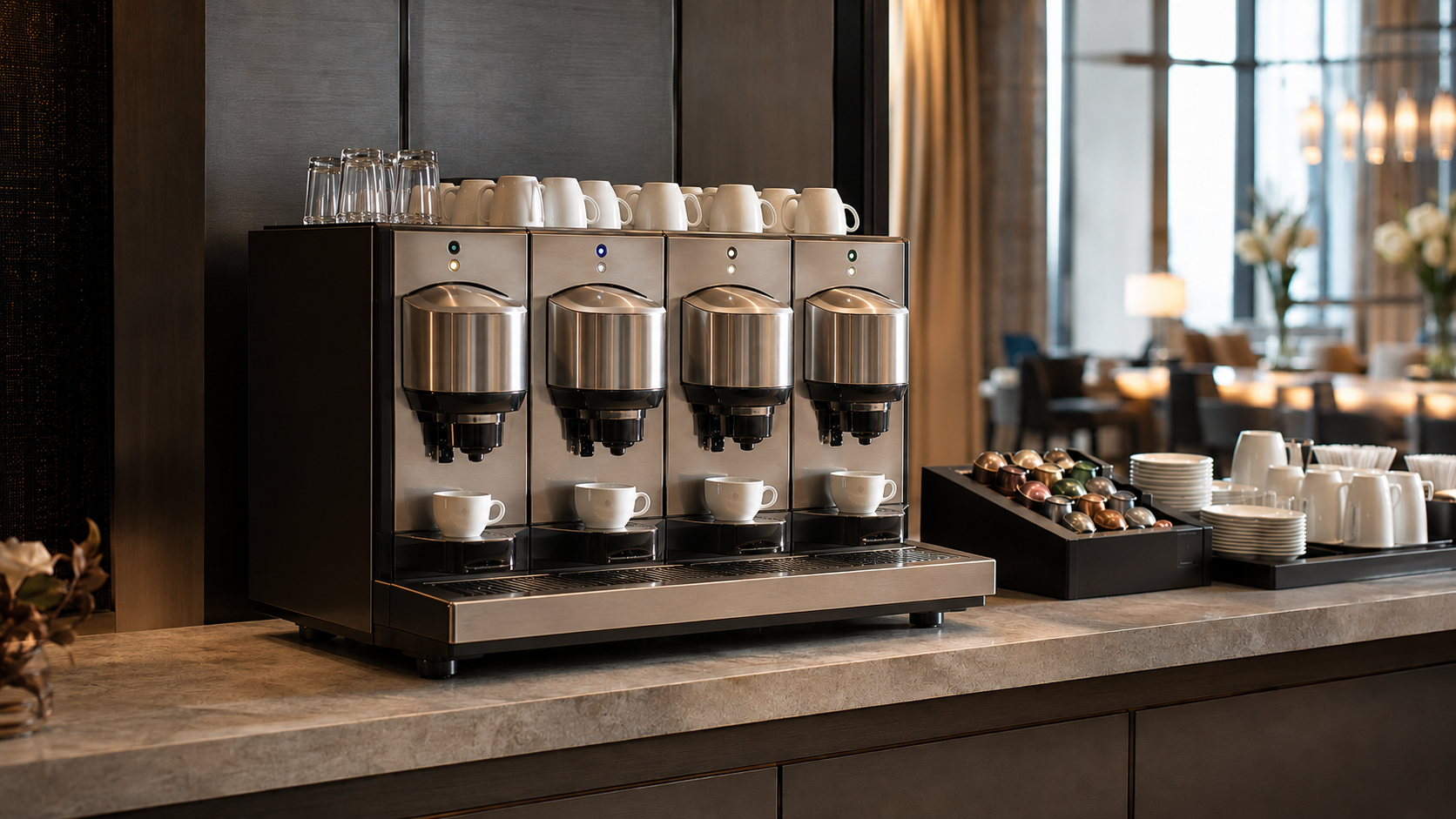
Nespresso Aguila 420 review buyers should examine drink capacity, four-head brewing, milk performance, installation requirements, cleaning, and long-term operating costs before choosing this large commercial coffee machine.
The Aguila 420 is designed for hotels, restaurants, conference venues, premium offices, catered events, and other professional environments requiring rapid coffee service. Its four extraction heads allow several capsule coffees to be prepared simultaneously, while the integrated milk system supports one-touch recipes such as cappuccino and latte macchiato.
This is not a machine that simply arrives, occupies a quiet corner, and begins making coffee. It weighs approximately 100 kilograms, requires a direct water connection, and may draw up to 9,000 watts on supported regional versions. Professional installation and dependable technical support are essential.
This detailed Nespresso Aguila 420 review covers:
- Four-head brewing performance
- Coffee and milk drink options
- Peak-period capacity
- Nespresso Professional capsule compatibility
- Coffee quality and consistency
- Milk refrigeration and sanitation
- Installation requirements
- Daily cleaning
- Maintenance costs
- Advantages and disadvantages
- Ideal business users
- Comparisons with other commercial machines
According to the official Nespresso Professional Aguila 420 product page, the machine is designed to meet demanding professional requirements while delivering consistent coffee quality in high-volume hospitality environments.
Specifications, available recipes, model naming, electrical ratings, and commercial support can vary by country. Some markets refer to closely related configurations as the Aguila 440, so buyers should confirm the precise model and regional specification before ordering.
Nespresso Aguila 420 Review: Quick Overview
| Feature | Nespresso Aguila 420 |
|---|---|
| Coffee system | Nespresso Professional capsules |
| Extraction heads | Four |
| Simultaneous coffee preparation | Up to four cups |
| Integrated milk system | Yes |
| Milk dispensers | Up to four, depending on configuration |
| Milk containers | Two refrigerated containers |
| Used-capsule capacity | Approximately 250 capsules |
| Water supply | Direct connection required |
| Commonly listed pressure | 19 bar |
| Weight | Approximately 100 kg |
| Dimensions | Approximately 100 × 62 × 63 cm |
| Maximum listed power | Up to approximately 9,000 W on some versions |
| Best suited to | Hotels, restaurants, hospitality venues, and high-demand workplaces |
Official regional Nespresso Professional listings commonly state a 100-kilogram weight, dimensions of approximately 100 × 62 × 63 centimeters, and space for around 250 used capsules. Buyers should obtain a written specification sheet for their exact unit because electrical and equipment configurations differ between markets.
What Is the Nespresso Aguila 420?
The Nespresso Aguila 420 is a high-capacity commercial capsule machine designed for professional hospitality service.
Unlike a domestic Nespresso machine, it combines:
- Four capsule extraction heads
- Multiple simultaneous coffee servings
- Integrated refrigerated milk storage
- Automatic milk heating and foaming
- Programmable one-touch recipes
- A direct water connection
- Large used-capsule containers
- Digital operating controls
- Commercial cleaning programs
- Professional service support
Its purpose is to produce repeatable coffee and milk drinks without requiring employees to grind beans, measure doses, tamp coffee, or manually steam every milk serving.
The Aguila 420 can therefore reduce the training required for consistent drink preparation. It may be operated by hotel breakfast staff, catering employees, restaurant teams, or other trained personnel who are not specialist baristas.
Businesses deciding between capsules and conventional espresso equipment can read our Nespresso vs espresso machine comparison for differences in coffee control, convenience, waste, cleaning, and operating cost.
1. Four Extraction Heads Deliver High Peak Capacity
The most important feature in this Nespresso Aguila 420 review is its four-head extraction system.
Four extraction heads allow the machine to prepare up to four capsule coffees at the same time. This can significantly reduce waiting during concentrated service periods.
The additional capacity is particularly useful during:
- Hotel breakfast service
- Conference breaks
- Restaurant dessert service
- Corporate events
- Wedding receptions
- Staff shift changes
- Exhibition hospitality
- Large catered meetings
- Airport or business-lounge service
A single-head capsule machine may produce an acceptable number of drinks across an entire day but still create queues when many guests order within the same ten-minute period.
The Aguila 420 addresses this problem through parallel preparation. Instead of waiting for one complete extraction before beginning the next, trained employees can load several capsules and prepare multiple drinks together.
Peak Demand Matters More Than Daily Totals
Businesses should not choose a coffee machine using only the total number of daily drinks.
Consider two locations:
| Location | Daily drinks | Busiest 15-minute demand |
|---|---|---|
| Small office | 100 | 12 |
| Hotel breakfast area | 100 | 45 |
Both locations serve the same daily total, but the hotel requires far greater short-term capacity. The Aguila 420 is more valuable in the second situation because demand arrives in a concentrated period.
Before purchasing, record:
- Total drinks per day
- Orders during the busiest 15 minutes
- Number of simultaneous users
- Black-coffee demand
- Milk-drink demand
- Average preparation time
- Existing queue length
- Cleaning interruptions
- Refill or waste-emptying interruptions
The machine still requires an organized workflow. Four extraction heads will not prevent delays if employees cannot find cups, capsules, milk, or the one cleaning cloth that apparently entered a witness-protection program.
Test All Four Brewing Positions
During a demonstration, prepare coffee from every extraction head and confirm:
- Capsules load correctly
- Levers operate smoothly
- Brewing begins promptly
- Water flow is even
- Programmed volumes are consistent
- Coffee temperatures are similar
- Capsules eject properly
- Drip trays remain stable
- Warning messages clear correctly
- Simultaneous extraction does not cause unexpected delays
A single successful espresso does not confirm that all four brewing positions perform consistently.
The smaller Nespresso Aguila 220 review covers a two-head alternative for locations that need automated milk drinks but do not require the capacity of four simultaneous extractions.
2. One-Touch Milk Drinks Simplify Hospitality Service
The Aguila 420 combines capsule coffee with an integrated milk system, allowing employees to prepare popular café-style recipes with fewer manual steps.
Depending on regional programming and setup, available recipes may include:
- Ristretto
- Espresso
- Lungo
- Americano
- Cappuccino
- Caffè latte
- Latte macchiato
- Hot milk
- Milk foam
- Customized coffee-and-milk recipes
The exact menu should be confirmed with the local Nespresso Professional supplier.
How One-Touch Preparation Works
A typical milk-drink process involves:
- Selecting the correct Nespresso Professional capsule.
- Loading it into an available extraction head.
- Placing the appropriate cup beneath the outlet.
- Selecting the programmed recipe.
- Allowing the machine to dispense coffee and prepared milk.
- Serving the completed drink.
- Following any required rinsing or cleaning prompt.
This workflow reduces the manual skill needed to steam milk, create foam, and combine the ingredients consistently.
It can be especially helpful when:
- Several employees share coffee-service duties
- Staff turnover is high
- Service must remain consistent across shifts
- Guest waiting time matters
- A trained barista is not always present
- Drink presentation needs to be predictable
Convenience Comes With Less Manual Control
The integrated system does not offer the same freedom as a traditional espresso machine and steam wand.
Operators have less direct control over:
- Grind size
- Coffee dose
- Tamping
- Extraction time
- Milk-texturing technique
- Foam thickness during each order
- Free-pour latte art
- Bean selection outside the Professional capsule range
This tradeoff is central to the Aguila 420. It prioritizes repeatability, speed, and simplified staff training over manual specialty-coffee control.
For a detailed look at how commercial capsule service differs from conventional equipment, see our capsule coffee vs espresso machine guide.
3. It Uses Nespresso Professional Capsules Only
The Aguila 420 uses capsules from the Nespresso Professional system.
It is not compatible with:
- Nespresso Original capsules
- Nespresso Vertuo capsules
- Standard third-party domestic capsules
- Dolce Gusto capsules
- Keurig K-Cups
- Loose ground coffee
- Whole coffee beans
Professional capsules are intended for Nespresso’s business machines and are supplied through commercial channels that vary by country.
Available selections may include:
- Intense ristretto blends
- Balanced espresso coffees
- Longer lungo options
- Single-origin coffees
- Mild aromatic profiles
- Decaffeinated capsules
- Limited or rotating selections
Readers unfamiliar with Nespresso’s domestic systems can see our Nespresso Original vs Vertuo comparison to understand why neither capsule type fits a Professional machine.
Confirm Commercial Capsule Supply in Advance
Before signing a purchase or lease agreement, verify:
- Available Professional capsules
- Current price per capsule
- Minimum order quantities
- Delivery charges
- Typical delivery time
- Commercial account requirements
- Decaffeinated availability
- Emergency restocking options
- Contracted purchase commitments
- Capsule recycling services
- Future price-adjustment terms
A machine built for rapid service becomes less impressive when the venue runs out of capsules halfway through breakfast.
Estimate Capsule Storage Requirements
A high-demand location should maintain enough stock for normal service plus a reasonable contingency allowance.
For example, if a hotel prepares 250 drinks per day and receives one capsule delivery each week, it may require:
- At least 1,750 capsules for expected weekly demand
- Additional stock for unusually busy days
- Separate inventory for decaffeinated coffee
- Rotation to prevent older stock remaining unused
- Secure, dry storage away from excessive heat
Track consumption by capsule variety rather than ordering equal quantities of every option. Actual use frequently differs from staff surveys and initial menu expectations.
4. Coffee Quality Prioritizes Consistency
The Aguila 420 is designed to deliver repeatable Nespresso Professional coffee across many operators and service periods.
Each capsule provides a premeasured portion of roasted and ground coffee. The machine then controls water delivery according to the selected recipe.
Employees do not need to manage:
- Coffee weighing
- Grinder calibration
- Grind-size adjustment
- Dose distribution
- Tamping pressure
- Portafilter preparation
- Manual extraction timing
- Knock-box cleaning
- Loose coffee grounds
This consistency can be valuable in hospitality environments where several employees operate the machine during different shifts.
However, coffee quality remains dependent on:
- Capsule selection
- Programmed drink volume
- Correct cup size
- Machine cleanliness
- Water quality
- Brewing temperature
- Maintenance condition
- Milk freshness
- Milk-system sanitation
- Staff following the correct procedure
The Aguila 420 can produce predictable commercial capsule coffee, but it cannot provide the freshness and recipe control of a skilled barista using freshly ground specialty beans.
The best choice depends on the business model. A hotel focused on fast and consistent breakfast service may value automation. A specialty café built around origin character, manual extraction, and latte art will usually require a traditional espresso setup.
5. The Integrated Milk System Supports Faster Drink Preparation
The integrated milk system is one of the most valuable features covered in this Nespresso Aguila 420 review.
Rather than requiring an employee to steam each serving manually, the machine draws milk from refrigerated containers and automatically heats or foams it according to the selected recipe.
This can improve:
- Preparation speed
- Drink consistency
- Staff productivity
- Milk-temperature control
- Foam repeatability
- Service during busy periods
- Training across different shifts
The system is particularly useful in hotels and conference venues where cappuccinos, lattes, and other milk-based drinks must be produced quickly by employees with varying levels of coffee experience.
Two Refrigerated Milk Containers Add Flexibility
Commonly documented Aguila 420 configurations include two refrigerated milk containers. This allows a business to manage two different milk options, depending on local supplier settings and operating procedures.
Possible arrangements include:
- Whole milk and low-fat milk
- Dairy milk and oat drink
- Regular milk and lactose-free milk
- Two containers of the same milk for higher capacity
Using two milk varieties can expand the menu, but it also creates additional sanitation and allergen-management responsibilities.
Businesses should clearly label:
- Each milk container
- Milk type
- Opening date
- Use-by time
- Storage temperature
- Responsible staff member
Milk should never remain in the system beyond the approved holding period. Refrigeration slows bacterial growth, but it does not place the milk in suspended animation.
Allergen Cross-Contact Must Be Evaluated
Businesses offering dairy and plant-based alternatives must confirm whether the complete milk pathway reliably prevents cross-contact.
Shared components may include:
- Milk hoses
- Pumps
- Heating chambers
- Foaming components
- Dispensing outlets
- Rinsing pathways
- Cleaning accessories
A separate container alone does not necessarily make a drink dairy-free or allergen-free.
When strict separation is required, businesses may need:
- Dedicated milk pathways
- Separate equipment
- Documented cleaning procedures
- Clear customer notices
- Staff allergen training
- Supplier confirmation of system limitations
Never promise allergen-free preparation unless the entire process supports that claim.
6. Milk Quality Affects Flavor and Foam
Automatic preparation cannot compensate for unsuitable or poorly stored milk.
Milk performance may vary according to:
- Fat content
- Protein content
- Freshness
- Storage temperature
- Brand
- Plant-based formulation
- Previous freezing
- Container cleanliness
- Time spent outside refrigeration
Cold, fresh milk generally produces more predictable results than milk that has repeatedly warmed and cooled.
Plant-Based Drinks Require Testing
Oat, soy, almond, coconut, and other alternatives can behave differently inside an automatic commercial milk system.
Potential differences include:
- Foam volume
- Foam stability
- Heating tolerance
- Separation
- Sweetness
- Residue
- Cleaning difficulty
- Final drink texture
Use only milk alternatives approved for the machine and local operating procedure. Barista-formulated products may perform more consistently, but each option should be tested before it is added to the permanent menu.
Evaluate:
- Dispensing consistency
- Final beverage temperature
- Foam texture
- Flavor with selected capsules
- Separation after serving
- Residue left in the outlet
- Additional cleaning requirements
- Customer satisfaction
7. Direct Plumbing Is Required
Unlike smaller machines with removable water tanks, the Aguila 420 is designed for a fixed commercial installation with a direct water supply.
This supports high-volume service by eliminating repeated manual refilling. However, it also makes installation more complex.
The site may require:
- A suitable potable-water connection
- Correct water pressure
- A commercial shutoff valve
- Approved filtration
- Backflow protection
- Drainage
- Leak protection
- Adequate hose clearance
- Technician access
- Compliance with local plumbing codes
A qualified installer should complete or approve the connection.
Water Quality Protects Flavor and Components
Water forms most of every finished drink. Its mineral balance and cleanliness directly influence flavor, heating performance, and internal machine condition.
Poor water quality can contribute to:
- Flat or harsh coffee
- Chlorine taste
- Scale accumulation
- Restricted water flow
- Longer heating times
- Inconsistent drink volume
- Temperature problems
- Valve or sensor faults
- More frequent servicing
The filtration system should match:
- Local water hardness
- Daily drink volume
- Hot-water demand
- Manufacturer requirements
- Filter capacity
- Expected replacement interval
Record the filter installation date and rated capacity. Waiting until coffee tastes strange or the machine develops a fault is not an especially economical filter reminder.
The broader effects of water on brewing are explained in our best water for coffee guide.
Plan for Leaks and Drainage
Because the machine is permanently connected, businesses should prepare for potential leaks.
The installation area should include:
- A water-resistant counter
- Accessible shutoff valve
- Correctly installed drainage
- Leak-detection procedures
- Clear space around hoses
- Immediate fault-reporting instructions
- Safe separation between water and electrical connections
Employees should know how to stop the water supply if a significant leak occurs.
8. Its Size Demands a Permanent Commercial Space
The Aguila 420 is a large, heavy machine rather than a portable countertop appliance.
Commonly listed measurements are approximately:
| Measurement | Approximate specification |
|---|---|
| Width | 100 cm |
| Depth | 62 cm |
| Height | 63 cm |
| Weight | 100 kg |
Exact specifications may vary by regional configuration. Obtain the current technical sheet before designing the counter or arranging delivery.
The installation area must provide room for:
- The full machine footprint
- Ventilation clearance
- Capsule-loading access
- Milk-container access
- Control-panel use
- Used-capsule removal
- Cleaning
- Plumbing
- Drainage
- Electrical cables
- Technician servicing
- Cup and capsule storage
Check the Entire Delivery Route
Before delivery, measure:
- Building entrances
- Doorways
- Corridors
- Elevator doors
- Elevator capacity
- Stairways
- Tight corners
- Kitchen or service entrances
- Final counter access
The supporting surface must safely carry the machine’s operating weight and resist water, cleaning products, vibration, and heat.
Professional handling equipment may be required. A 100-kilogram coffee machine is not the ideal setting for discovering that four enthusiastic employees do not collectively constitute a lifting plan.
9. Electrical Requirements Can Be Substantial
Some Aguila 420 configurations are commonly listed with maximum power requirements approaching 9,000 watts. Actual voltage, phase, frequency, and power consumption depend on the regional version.
Before purchase, confirm:
- Rated voltage
- Electrical frequency
- Single-phase or three-phase requirements
- Maximum power consumption
- Plug or hardwiring requirements
- Circuit capacity
- Grounding
- Isolation switch requirements
- Local commercial electrical codes
A qualified electrician should assess the installation before the machine arrives.
Do not rely on:
- Domestic extension cords
- Lightweight power strips
- Plug adapters
- Overloaded shared circuits
- Damaged outlets
- Unverified imported-machine specifications
Operating Power Supports Fast Recovery
The substantial electrical demand helps the machine maintain temperature and prepare several coffee-and-milk drinks during busy periods.
However, businesses should include energy use in total ownership calculations. Actual consumption depends on:
- Operating hours
- Standby settings
- Number of drinks
- Milk preparation
- Heating demand
- Cleaning cycles
- Automatic power-management settings
- Shutdown procedures
Staff should use approved energy-saving modes rather than disconnecting the machine in a way that interrupts required cleaning or damages programmed operation.
10. Large Used-Capsule Capacity Reduces Interruptions
The Aguila 420 is commonly listed with storage for approximately 250 used Professional capsules.
This capacity is appropriate for high-volume service, but it does not remove the need for regular inspection and cleaning.
Emptying frequency depends on:
- Daily coffee volume
- Peak demand
- Capsule moisture
- Waste-container arrangement
- Cleaning schedule
- Machine alerts
- Local recycling procedures
Used capsules retain moisture and coffee residue. If they remain inside the machine too long, they may cause:
- Unpleasant odors
- Sticky residue
- Overflow
- Mold
- Capsule-ejection problems
- Insects
- An unprofessional service area
Empty and Clean the Containers Daily
A practical routine is:
- Stop beverage preparation.
- Remove the waste containers safely.
- Dispose of or separate used capsules.
- Wipe away coffee and liquid residue.
- Clean the containers using the approved method.
- Dry them thoroughly.
- Reinstall them correctly.
- Confirm that warning messages have cleared.
High-volume locations may need to inspect the containers more than once per day.
Commercial capsule recycling services differ by country. Ask the local Nespresso Professional supplier about collection containers, minimum quantities, storage rules, fees, and reporting options.
Our Nespresso environmental impact guide examines capsule recycling, aluminum use, energy consumption, and practical ways to reduce waste.
11. Daily Milk-System Cleaning Is Essential
The integrated milk system provides speed and convenience, but it also creates the most demanding cleaning responsibility discussed in this Nespresso Aguila 420 review.
Milk residue can accumulate inside:
- Refrigerated containers
- Container lids
- Milk hoses
- Connectors
- Pumps
- Heating components
- Foaming chambers
- Dispensing outlets
- Drip trays
- Rinsing pathways
These areas require approved cleaning procedures because milk contains proteins, fats, and sugars that can support bacterial growth and produce unpleasant odors when residue remains inside the system.
Follow Every Cleaning Prompt
The Aguila 420 may provide automatic rinsing and guided cleaning programs, depending on its configuration. These functions simplify the process but do not make employee involvement unnecessary.
Staff may still need to:
- Remove remaining milk.
- Refrigerate or discard it according to food-safety procedures.
- Disassemble approved milk components.
- Prepare the recommended cleaning solution.
- Connect the cleaning equipment correctly.
- Start the complete cleaning program.
- Rinse removable components.
- Clean the dispensing outlets.
- Empty and wash drip trays.
- Dry and reinstall every component.
- Record completion on the cleaning log.
Never interrupt a cleaning cycle unless the official instructions or an authorized technician specifically require it.
Do Not Substitute Household Cleaning Products
Use only products approved for the exact machine and milk system.
Avoid:
- Dishwashing liquid inside internal milk pathways
- Vinegar
- Bleach unless specifically authorized
- Abrasive powders
- Strongly scented cleaners
- Unapproved descaling products
- Excessively concentrated cleaning solution
- Homemade chemical mixtures
Incorrect products may damage seals, leave residues, affect beverage flavor, or create a food-safety risk.
Assign Responsibility by Shift
A machine serving hundreds of drinks should not depend on someone eventually remembering to clean it.
A practical responsibility schedule may include:
| Task | Suggested responsibility |
|---|---|
| Opening inspection | Morning supervisor |
| Milk temperature check | Opening employee |
| Mid-service outlet cleaning | Assigned service employee |
| Capsule-waste inspection | Midday employee |
| Milk-container refill | Trained beverage staff |
| End-of-day milk cleaning | Closing employee |
| Cleaning-log review | Shift manager |
| Filter monitoring | Facilities manager |
| Fault reporting | First employee observing the problem |
The cleaning record should include the date, time, employee name, cleaning program completed, product used, and any warning or fault observed.
For broader capsule-machine care principles, read our guide on how to clean a Nespresso machine.
12. Food-Safety Procedures Must Cover Milk Handling
Automatic refrigeration does not eliminate the need for strict milk-handling rules.
The business should establish procedures for:
- Receiving milk deliveries
- Checking use-by dates
- Refrigerated storage
- Container labeling
- Opening-time records
- Maximum holding time
- Refilling rules
- Temperature checks
- End-of-day disposal
- Allergen management
- Cleaning and sanitizing
- Staff illness reporting
Local food-safety regulations and official operating instructions should always take priority over a general routine.
Avoid Topping Up Old Milk
Adding fresh milk to a container that still holds older milk can make it difficult to track freshness and safe holding time.
A safer procedure generally involves:
- Removing the container.
- Discarding milk that has exceeded the approved holding period.
- Cleaning and sanitizing the container.
- Allowing it to dry correctly.
- Adding fresh refrigerated milk.
- Recording the new opening time.
- Returning the container to refrigeration promptly.
Businesses should never return dispensed or previously heated milk to the refrigerated container.
Monitor Temperature Consistently
Milk temperature should be checked using the business’s approved food-safety procedure.
Investigate immediately if:
- Milk feels unusually warm
- The refrigerator displays a warning
- Foam quality suddenly changes
- Milk develops an unusual smell
- Containers remain outside the machine too long
- Power has been interrupted
- A door or cover fails to close
- The machine has been inactive without proper shutdown
When safety is uncertain, discard the milk rather than attempting to rescue it. Coffee equipment can be repaired; a breakfast buffet’s reputation is less cooperative.
13. Cleaning Interruptions Must Be Included in Capacity Planning
Theoretical brewing capacity does not equal continuous real-world output.
Actual service capacity is affected by:
- Capsule loading
- Cup placement
- Recipe selection
- Milk replenishment
- Capsule-waste emptying
- Drip-tray cleaning
- Automatic rinsing
- Mandatory milk cleaning
- Staff movement
- Customer order taking
- Drink collection
- Fault recovery
A venue should observe a live demonstration under realistic conditions rather than relying only on the number of extraction heads.
Conduct a Timed Service Test
Prepare a representative sequence such as:
- Four espressos
- Four lungos
- Four cappuccinos
- Four latte macchiatos
- Two decaffeinated drinks
- Two plant-based drinks, if supported
- Several hot-water servings
Record:
- Total preparation time
- Time to load capsules
- Milk recovery between drinks
- Coffee-temperature consistency
- Foam consistency
- Number of rinsing interruptions
- Staff errors
- Cup-positioning difficulty
- Cleaning time after service
- Queue length
The test should reflect the venue’s actual menu. Four simultaneous espressos do not prove that the machine can maintain the same pace while producing large milk drinks.
14. The Interface Is Designed for Trained Commercial Use
The Aguila 420 uses digital controls and programmed recipe selections to make complex drink preparation more manageable.
Depending on its regional configuration, the interface may provide:
- Beverage selection
- Programmable recipes
- Coffee-volume settings
- Milk and foam options
- Cleaning instructions
- Rinsing alerts
- Waste-container warnings
- Maintenance notifications
- Error messages
- Operating-status information
Although operation is more automated than a traditional espresso machine, employees still require training.
Staff Training Should Cover More Than Drink Buttons
Every authorized operator should understand:
- Compatible Professional capsules
- Correct capsule loading
- Cup positioning
- Recipe selection
- Milk-container handling
- Allergen limitations
- Cleaning prompts
- Waste-container removal
- Safe hot-water use
- Fault reporting
- Emergency shutdown
- Water shutoff location
- What employees must never disassemble
Training should be documented and repeated when procedures, menu recipes, milk products, or staff assignments change.
Limit Recipe Changes
Managers should restrict access to important programming settings.
Uncontrolled changes can produce:
- Weak coffee
- Overflowing cups
- Inconsistent drink sizes
- Excessive milk use
- Poor foam balance
- Higher ingredient costs
- Different drinks across shifts
A designated manager or technician should approve and record recipe adjustments.
15. Preventive Maintenance Protects a Significant Investment
The Aguila 420 is a complex commercial machine with four extraction heads, milk refrigeration, automatic milk preparation, plumbing, heating components, sensors, and electronic controls.
Professional preventive maintenance may include:
- Checking all four extraction systems
- Inspecting seals and valves
- Testing pumps
- Verifying brewing temperatures
- Confirming programmed volumes
- Examining milk hoses and connectors
- Servicing foaming components
- Checking refrigeration performance
- Inspecting drainage
- Testing water pressure
- Replacing filters
- Assessing scale accumulation
- Reviewing electrical connections
- Updating supported settings or software
- Testing safety functions
The appropriate schedule depends on drink volume, local water quality, operating hours, and supplier requirements.
Keep a Detailed Service Log
Record:
- Installation date
- Machine serial number
- Daily drink volume
- Water-filter installation
- Filter replacements
- Cleaning completion
- Milk-system faults
- Coffee-volume changes
- Error codes
- Leaks
- Unusual sounds
- Technician visits
- Components replaced
- Repair costs
- Periods out of service
A maintenance log helps identify recurring problems and may support warranty or service-contract claims.
Confirm Technical Support Before Purchase
This Nespresso Aguila 420 review strongly recommends verifying the support network before signing an agreement.
Ask the supplier:
- Is installation included?
- Who provides warranty service?
- What is the normal response time?
- Are technicians available locally?
- Which parts are stocked locally?
- Is preventive maintenance included?
- Are emergency visits available?
- Is remote diagnosis supported?
- Is a replacement machine provided during long repairs?
- What happens after the warranty ends?
- How long will this model remain supported?
- Are milk-system components included in coverage?
A high-capacity machine can become a serious operational problem if the venue depends on it and technical support takes several days to arrive.
16. Descaling and Filtration Requirements Depend on Local Water
Direct plumbing provides convenient continuous water, but it also exposes the machine to every mineral and contaminant allowed through the filtration system.
Scale can affect:
- Heating efficiency
- Water flow
- Drink volume
- Brewing temperature
- Pump performance
- Valve operation
- Hot-water delivery
- Energy consumption
- Component life
Possible warning signs include:
- Slower preparation
- Lower beverage temperature
- Irregular water flow
- Unexpected noise
- Volume differences between heads
- Repeated heating faults
- Increased energy use
- Scale residue around outlets
Descaling a large plumbed commercial machine should follow the official procedure. Some work may need to be completed by an authorized technician rather than ordinary staff.
Water Filters Must Be Replaced on Capacity, Not Memory
Filter replacement may depend on:
- Liters processed
- Water hardness
- Daily drink count
- Hot-water use
- Cleaning cycles
- Manufacturer instructions
- Time since installation
Mark the installation date and calculate the expected replacement point. High-volume venues may reach a filter’s rated capacity much sooner than a calendar-only schedule suggests.
17. Operating Costs Extend Far Beyond Capsule Prices
The Aguila 420’s total ownership cost includes much more than the amount paid for each Professional capsule.
Businesses should calculate:
- Purchase or lease payments
- Delivery
- Plumbing installation
- Drainage work
- Electrical work
- Counter reinforcement
- Professional capsules
- Dairy and plant-based milk
- Water filters
- Milk-system cleaning products
- Descaling products
- Electricity
- Preventive maintenance
- Emergency repairs
- Replacement components
- Staff cleaning time
- Cups, lids, and accessories
- Capsule recycling
- Product waste
- Business interruption during faults
Illustrative Cost per Milk Drink
This example is for planning purposes only and does not represent current Nespresso or supplier pricing.
| Cost component | Illustrative amount |
|---|---|
| Professional capsule | $0.70 |
| Milk | $0.35 |
| Cup and lid | $0.22 |
| Cleaning and filtration allowance | $0.12 |
| Energy and servicing allowance | $0.23 |
| Illustrative total per drink | $1.62 |
Actual cost varies by country, contract, capsule choice, milk type, serving size, labor rates, service plan, and drink volume.
Include Milk Waste
Milk waste can become significant when:
- Containers are overfilled
- Demand is forecast incorrectly
- Holding times expire
- Cleaning begins with excessive milk remaining
- Recipes dispense more milk than necessary
- Staff refill containers before checking existing stock
- Plant-based options sell slowly
Track milk usage and waste separately for each type. A second refrigerated container adds flexibility only when its contents are used efficiently.
18. A Service Contract May Be Worth the Cost
A service contract can provide more predictable ownership expenses for a machine that plays a central role in hospitality operations.
Coverage may include:
- Scheduled preventive maintenance
- Technician labor
- Callout fees
- Selected replacement parts
- Water-filter service
- Milk-system inspections
- Telephone support
- Priority response
- Temporary replacement equipment
- Staff refresher training
Review exclusions carefully.
Common exclusions may involve:
- Damage caused by incorrect cleaning
- Unapproved milk products
- Scale caused by neglected filtration
- Accidental damage
- Plumbing faults outside the machine
- Electrical supply problems
- Pest damage
- Unauthorized repairs
- Consumable components
- After-hours visits
Compare the contract price with the likely cost of downtime, emergency service, and lost beverage sales.
Nespresso Aguila 420 Pros and Cons
Pros
- Four independent capsule extraction heads
- Up to four coffees prepared simultaneously
- Integrated automatic milk system
- Two refrigerated milk containers on common configurations
- Suitable for intense peak-period demand
- Consistent recipes across different operators
- Minimal grinder and dosing work
- Large used-capsule capacity
- Direct water connection
- Reduced loose-coffee mess
- Programmable drink options
- Suitable for hotels and large hospitality venues
Cons
- Very large and heavy
- Complex professional installation
- Substantial electrical requirements
- Direct plumbing and drainage required
- High purchase or lease cost
- Uses only Nespresso Professional capsules
- Milk pathways require strict daily sanitation
- Less extraction control than a traditional espresso machine
- No freshly ground whole-bean flexibility
- Operating costs include capsules, milk, cleaning, and servicing
- Technical faults can disrupt a large portion of beverage service
- Excessive capacity for many small businesses
Nespresso Aguila 420 vs Aguila 220
The Aguila 220 is the closest smaller alternative within the same commercial family.
| Feature | Aguila 420 | Aguila 220 |
|---|---|---|
| Extraction heads | Four | Two |
| Simultaneous capsule coffees | Up to four | Up to two |
| Integrated milk system | Yes | Yes |
| Refrigerated milk storage | Two-container capability on common configurations | Smaller configuration |
| Used-capsule capacity | Approximately 250 | Lower |
| Width | Approximately 100 cm | Considerably narrower |
| Weight | Approximately 100 kg | Lower |
| Peak-period capacity | Very high | Moderate to high |
| Best suited to | Large hotels and busy venues | Smaller hospitality operations |
| Main limitation | Size, installation, and cost | Lower simultaneous output |
Choose the Aguila 420 when demand regularly arrives in large, concentrated waves and four-head preparation will be used frequently.
Choose the Aguila 220 when automated milk drinks are important but two extraction heads can meet the venue’s busiest service period.
Read our complete Nespresso Aguila 220 review for its capacity, milk system, cleaning requirements, and ideal commercial settings.
Nespresso Aguila 420 vs Momento 200
The Aguila 420 and Momento 200 both use Nespresso Professional capsules, but they serve different workplace and hospitality needs.
| Feature | Aguila 420 | Momento 200 |
|---|---|---|
| Extraction heads | Four | Two |
| Integrated fresh-milk system | Yes | No |
| One-touch cappuccino and latte | Yes | No |
| Refrigerated milk storage | Yes | No |
| Simultaneous coffee preparation | Up to four cups | Up to two cups |
| Installation complexity | Very high | Moderate |
| Cleaning requirements | Extensive milk-system care | Simpler |
| Best suited to | Large hospitality venues | Busy offices and self-service areas |
Choose the Aguila 420 when automated milk drinks and very high peak capacity are essential.
Choose the Momento 200 when a business primarily serves black coffee, wants simpler maintenance, or prefers separate milk equipment.
See our complete Nespresso Momento 200 review for its touchscreen operation, dual-head capacity, cleaning, and workplace suitability.
Nespresso Aguila 420 vs Traditional Espresso Machine
A traditional commercial espresso machine provides greater control but requires more skill.
| Consideration | Aguila 420 | Traditional espresso machine |
|---|---|---|
| Coffee format | Professional capsules | Freshly ground beans |
| Grinder required | No | Yes |
| Barista skill | Relatively low | Moderate to high |
| Drink consistency | Highly repeatable | Depends on operator |
| Extraction control | Limited | Extensive |
| Milk preparation | Automated | Usually manual |
| Latte art | Limited | Possible |
| Loose coffee mess | Minimal | Higher |
| Daily cleaning | Complex milk system | Group heads, grinder, and steam wands |
| Peak service | High with four heads | High with trained baristas |
| Coffee flexibility | Limited capsule range | Broad bean and recipe choice |
The Aguila 420 suits businesses prioritizing predictable results across multiple employees. A traditional espresso machine is generally better for specialty cafés where freshly ground coffee, manual recipe control, and barista presentation define the customer experience.
Who Should Buy the Nespresso Aguila 420?
The Aguila 420 may be suitable for:
- Large hotels
- Conference centers
- Premium event venues
- Busy restaurants
- Corporate hospitality suites
- Airport lounges
- Exhibition facilities
- Catering operations
- Large workplaces with concentrated demand
- Venues requiring consistent milk drinks across several shifts
It becomes especially valuable when four extraction heads are used regularly during busy periods.
Who Should Avoid It?
Consider a smaller or different machine if your business:
- Serves relatively few drinks
- Has limited counter space
- Cannot install direct plumbing
- Lacks a suitable electrical supply
- Does not need automatic milk drinks
- Cannot complete strict daily milk cleaning
- Has limited access to authorized servicing
- Wants to use freshly ground beans
- Requires specialist barista control
- Experiences steady but low demand
- Cannot justify the installation and ownership costs
A machine with unused capacity still consumes space, capital, cleaning time, and maintenance resources.
Questions to Ask Before Ordering
Before purchasing, leasing, or accepting a refurbished machine, obtain written answers to these questions:
- Is the exact model the Aguila 420, Aguila 440, or another regional version?
- What are its voltage, phase, frequency, and maximum power requirements?
- Are plumbing, drainage, filtration, and installation included?
- How many milk containers and dispensing pathways are supplied?
- Which drink recipes can be programmed?
- Which plant-based products are approved?
- Can dairy and alternative milk be kept reliably separate?
- What daily cleaning products and procedures are required?
- How much do capsules, filters, and cleaning supplies cost?
- Is operator training included?
- What warranty and service response times apply?
- Are replacement parts stocked locally?
- Is temporary equipment available during repairs?
- What happens when the initial contract ends?
- Is Professional capsule delivery dependable in your area?
- Is capsule recycling available?
- Can the machine be demonstrated under realistic peak demand?
For a refurbished unit, also request:
- Serial number
- Manufacturing or installation date
- Service history
- Recorded drink count
- Milk-system repair history
- Descaling records
- Refrigeration test results
- Electrical inspection
- Leak test
- Warranty terms
- Confirmation of ongoing parts support
Frequently Asked Questions
How many coffees can the Nespresso Aguila 420 make simultaneously?
The Aguila 420 has four extraction heads and can prepare up to four capsule coffees simultaneously. Actual service speed depends on the selected recipes, milk preparation, capsule loading, rinsing, and staff workflow.
Does the Aguila 420 use regular Nespresso capsules?
No. It uses Nespresso Professional capsules and is not compatible with Original or Vertuo capsules.
Does it make cappuccinos and lattes automatically?
Yes. Its integrated milk system can prepare programmed milk-based recipes such as cappuccino and latte macchiato. Available recipes vary by configuration and region.
Does the machine need a water connection?
Yes. The Aguila 420 is designed for direct plumbing and requires a suitable potable-water supply, filtration, drainage, and professional installation.
How often must the milk system be cleaned?
Milk-contact components require cleaning according to the official operating instructions and local food-safety requirements. A complete cleaning procedure is normally essential every operating day, with additional rinsing and cleaning during service as required.
Can it use oat or other plant-based milk?
Some alternatives may work, but compatibility and performance must be confirmed with the supplier. Businesses must also assess residue, foam quality, sanitation, and allergen cross-contact.
Is the Aguila 420 suitable for a small office?
Usually not. Its size, four extraction heads, milk system, plumbing, electrical requirements, and maintenance demands are generally excessive for a small office. A Nespresso Zenius or Nespresso Momento 100 may be more practical.
Is it better than the Aguila 220?
It offers greater simultaneous output, but it is not automatically the better purchase. The Aguila 220 may deliver sufficient capacity with a smaller footprint and lower installation burden.
How much does the Nespresso Aguila 420 cost?
Commercial pricing varies by country, supplier, contract, installation, service coverage, and machine condition. Buyers should request a complete quotation covering equipment, installation, consumables, servicing, and projected operating costs.
Final Verdict: Is the Nespresso Aguila 420 Worth It?
This Nespresso Aguila 420 review finds that the machine can be a strong solution for high-demand hospitality venues requiring rapid, consistent capsule coffee and automated milk drinks.
Its main strengths are:
- Four simultaneous extraction positions
- Integrated milk heating and foaming
- Refrigerated milk storage
- Repeatable programmed recipes
- Large used-capsule capacity
- Direct water supply
- Reduced dependence on specialist barista skills
- Strong peak-period performance
Its main disadvantages are equally substantial:
- Large 100-kilogram body
- Demanding plumbing and electrical installation
- Strict milk-system sanitation
- Dependence on Professional capsules
- Limited manual extraction control
- High ownership and servicing costs
- Significant operational disruption if the machine fails
Final Rating: 4.4/5
Choose the Aguila 420 if your venue needs:
- Four simultaneous coffees
- Fast automated milk drinks
- Consistent service across multiple shifts
- High output during concentrated demand
- Minimal grinder and dosing work
- Professional installation and support
- A fixed, long-term commercial coffee station
Choose another machine if you need:
- Freshly ground specialty coffee
- Manual espresso control
- A compact installation
- Simple daily cleaning
- Low-volume service
- Portability
- Low electrical demand
- Freedom from a proprietary capsule system
The Aguila 420 is not designed to be modest. In the right hotel or venue, its capacity can reduce queues and simplify drink preparation. In a smaller operation, it may spend much of its day looking impressively overqualified.
Related Articles
- Nespresso Aguila 220 Review: Commercial Coffee Machine Guide
- Nespresso Aguila 440 Review: High-Volume Hospitality Machine
- Nespresso Momento 200 Review: Dual-Head Office Coffee Machine
- Nespresso Momento 100 Review: 11 Key Facts
- Nespresso Zenius Review: Is It Right for Your Office?
- Nespresso Gemini CS 223 Pro Review
- Best Office Coffee Machines
- How to Clean a Nespresso Machine
- Nespresso Environmental Impact